Looking ahead: The future of adaptive camouflage may look oddly familiar as it resembles the skin of an octopus. In a recent study published in Nature Communications, engineers at Penn State developed a hydrogel material that can hide or reveal images in response to subtle environmental changes. The project draws direct inspiration from cephalopods, organisms that have mastered color, contrast, and texture control over millions of years.
The hydrogel behaves like a programmable canvas. Rather than using traditional pigments, researchers embedded data directly into its physical structure during printing. When the hydrogel warms or interacts with a different solvent, hidden information inside – ranging from letters to portraits – gradually comes into view. In one demonstration, the team encoded Leonardo da Vinci's Mona Lisa, turning what appeared to be a blank surface into a distinct grayscale image as the temperature rose.
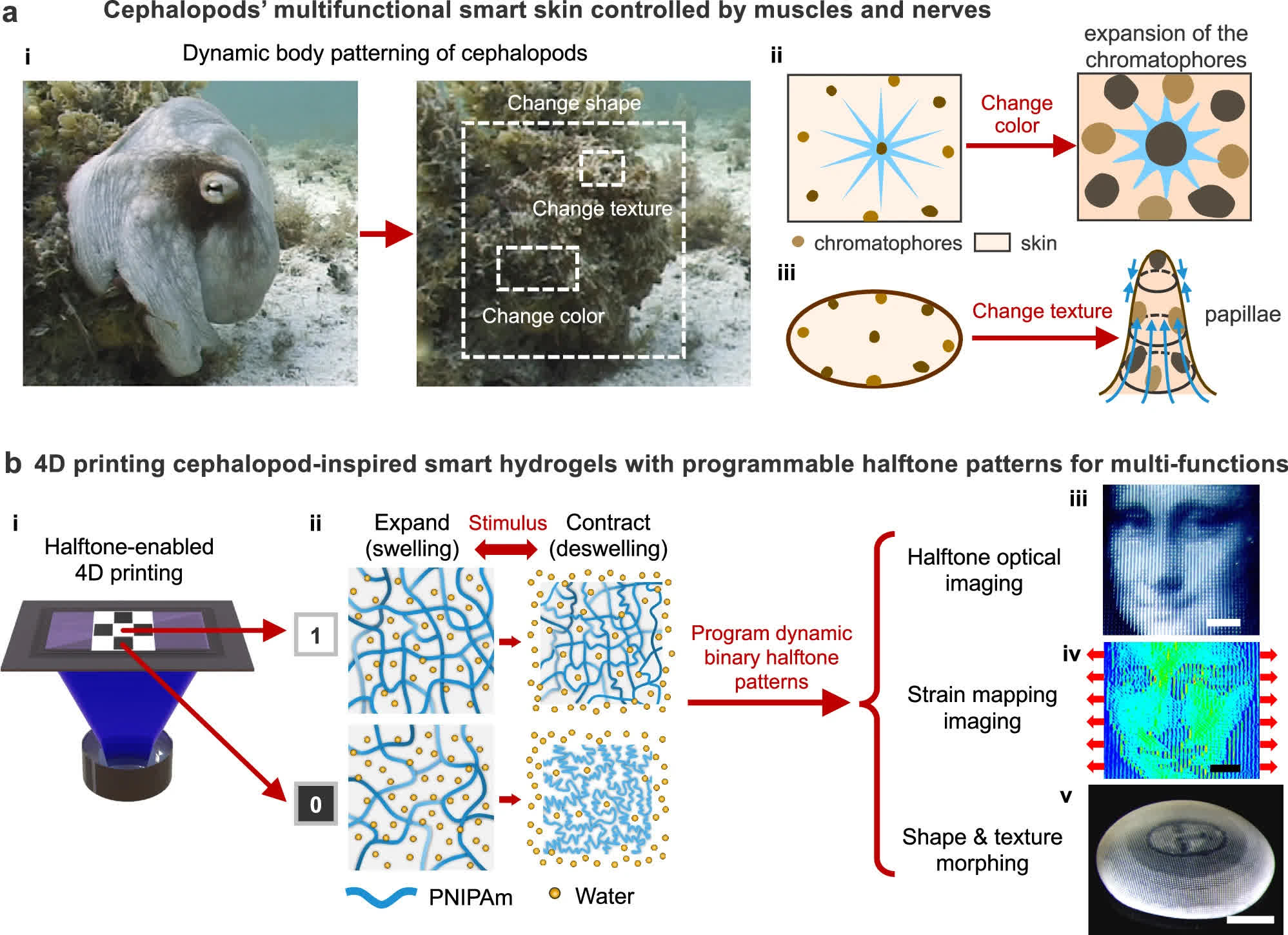
The technique uses a manufacturing process known as halftone-encoded 3D printing. Borrowing a concept from early newspaper printing, the researchers translated digital images into grids of binary pixels, each representing a "1" or "0."
These micro-patterns determine how specific zones of the hydrogel respond to light during fabrication. Ultraviolet exposure then "writes" this pattern into the soft polymer, altering its internal crosslink density without using ink or dyes. Under normal room conditions, these differences remain invisible; under thermal or chemical changes, they shift in optical contrast, producing a visible image.
The process qualifies as "4D printing," a term for three-dimensional objects that evolve over time in response to external stimuli. As co-author Hongtao Sun of Penn State explains, the method allows engineers to print instructions into matter itself – physical directions that tell the material how to react when its environment changes.
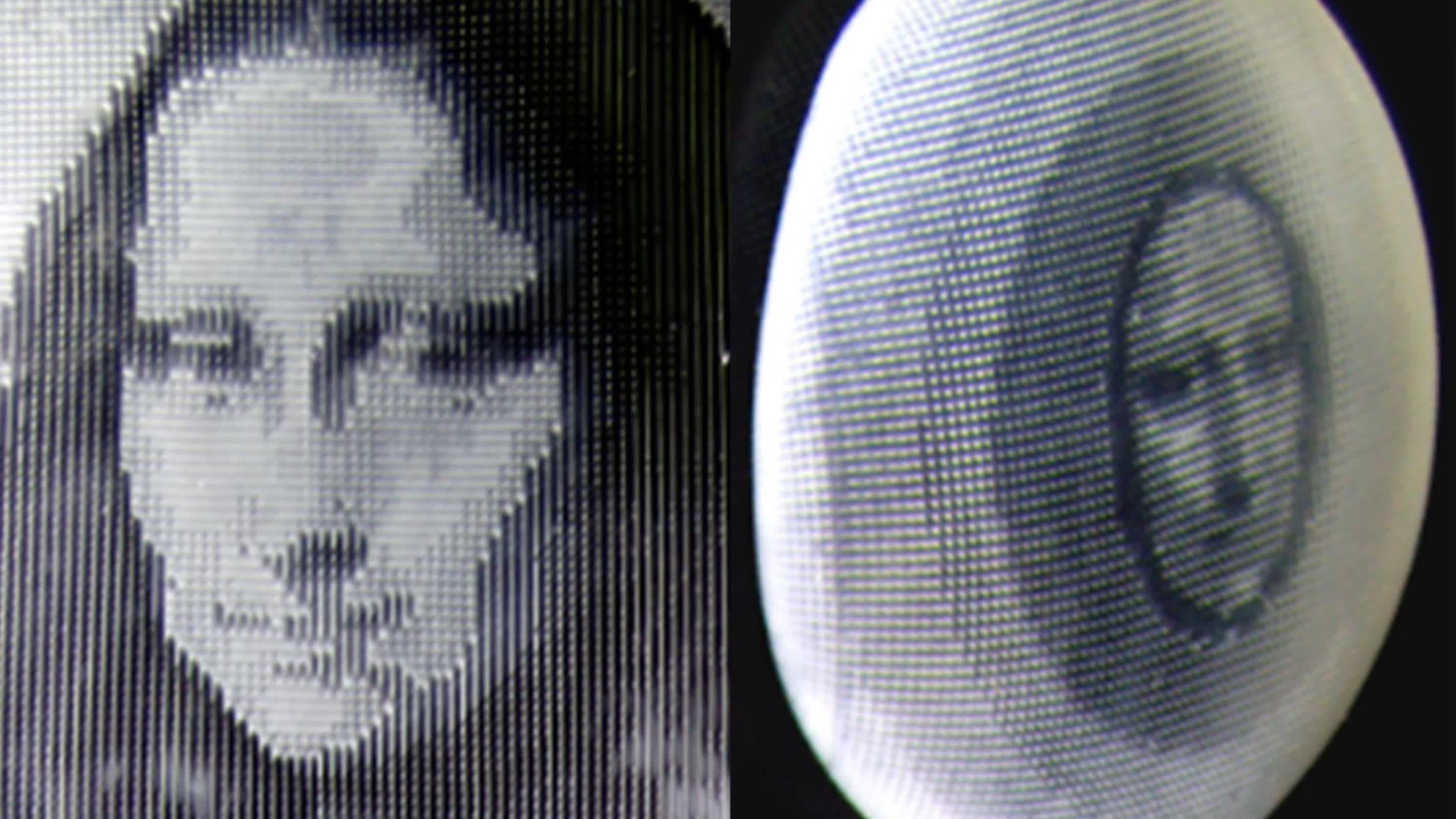
Early experiments with the team's hydrogel sheets produced clear results: after encoding the university's initials, "PSU," the letters appeared only after a controlled temperature shift, demonstrating reversible memory in the material.
This mechanical intelligence stems from an organic model. Cephalopods – think octopuses, cuttlefish, and squids – achieve complex camouflage through networks of pigment sacs called chromatophores, coupled with muscle-controlled skin structures.
Neural impulses expand or compress these sacs, adjusting surface texture and enabling rapid transformations that allow the animals to blend seamlessly with rock or coral. Engineers have long admired this efficiency but have struggled to replicate it synthetically. Penn State's discovery moves closer to that benchmark, merging digital precision with bio-inspired adaptability.
Other labs have approached the problem from different angles. In 2021, researchers at Rutgers University 3D-printed artificial muscles that bend when exposed to light. More recently, Stanford engineers created a flexible synthetic material that expands and changes color under an electron beam.
Robotics groups have even developed "Tentacle Bots" – silicone-based appendages that mimic the grip and fluid motion of living arms. But the Penn State hydrogel stands out for embedding information directly into its structure rather than relying on circuitry, turning the material itself into a data medium that changes over time.
Potential applications extend beyond camouflage. The same principle could inform self-adjusting medical sensors, smart packaging that signals spoilage, or soft robotic skins capable of context-aware transformation. By imitating one of nature's most sophisticated examples of responsive design, the researchers have opened a pathway toward materials that not only adapt, but also communicate through their physical makeup.
Octopus-inspired hydrogel reveals hidden image when exposed to temperature changes or solvents


