Physicists create one-dimensional gas out of light, achieving bizarre quantum state

zohaibahd

Posts: 976   +19
Staff
What just happened? Physicists have managed to turn light particles into what they describe as an "exotic state of matter" – a one-dimensional gas. They did this by confining the photons in a tiny space and cooling them. The results were astonishin, to say the least.
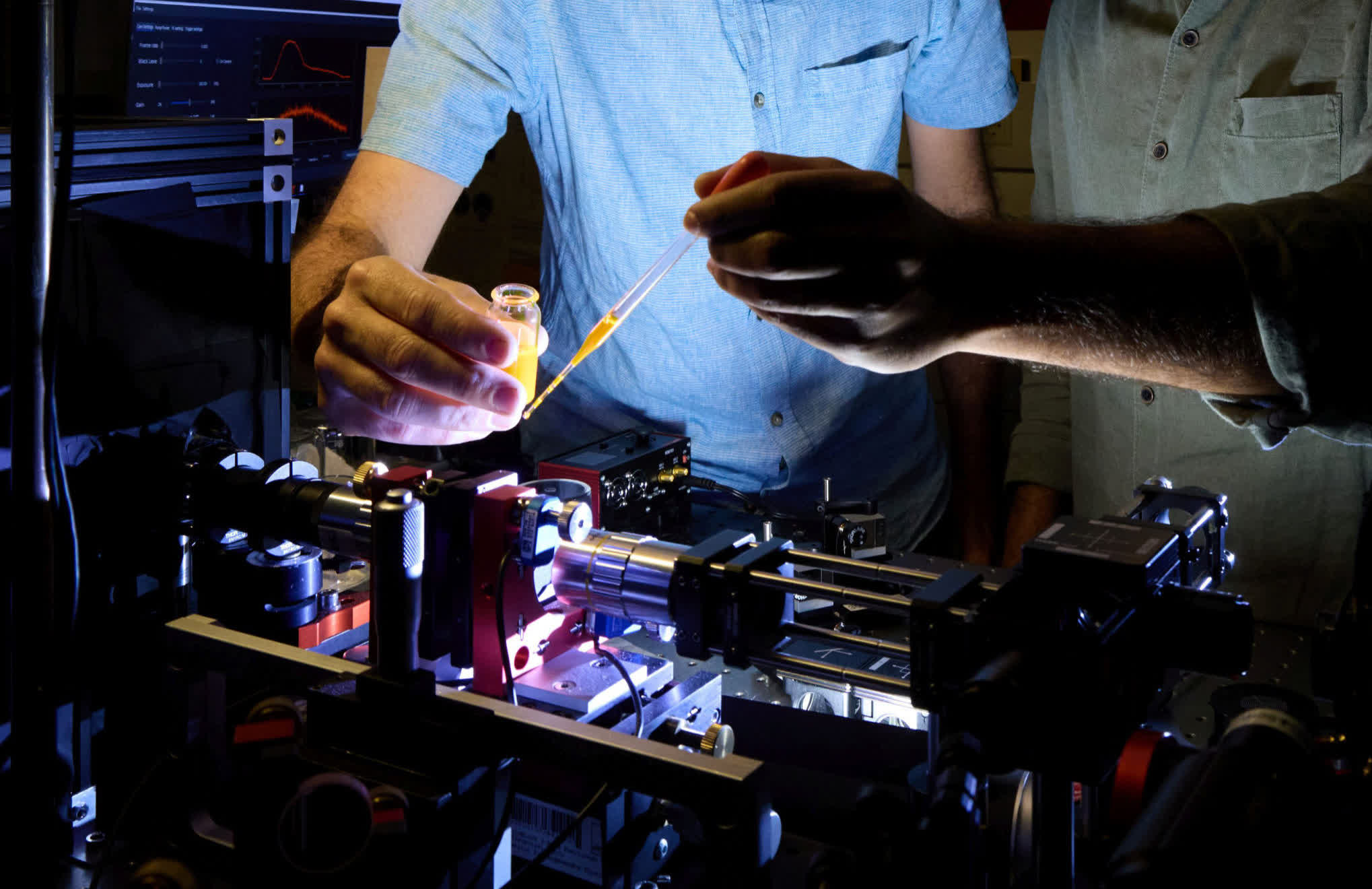
The experiment, conducted by teams from the University of Bonn and RPTU (University of Kaiserslautern-Landau), took a cue from an everyday phenomenon – a garden hose filling a pool compared to filling a gutter. When water hits the pool's surface, it disperses outward, and any change in water level is minimal because it's dispersed across. But if you shoot that stream of water into a narrow gutter, it creates concentrated waves that travel along the gutter's length

"The narrower the gutter, the higher the amplitude of the wave, and thus, the "more one-dimensional" it becomes," noted the researchers.

Essentially, the physicists miniaturized this phenomenon by creating "microscopically small gutters" to constrain light in a similar one-dimensional path. Their setup involved filling a tiny container with a dye solution and stimulating it with a laser. The resulting photons ricocheted between the reflective walls, losing energy with each collision against the dye molecules until they ultimately condensed into a photon gas.

Crucially, the dimensionality of this photonic matter could be tuned further by tweaking the reflective surfaces inside the container.
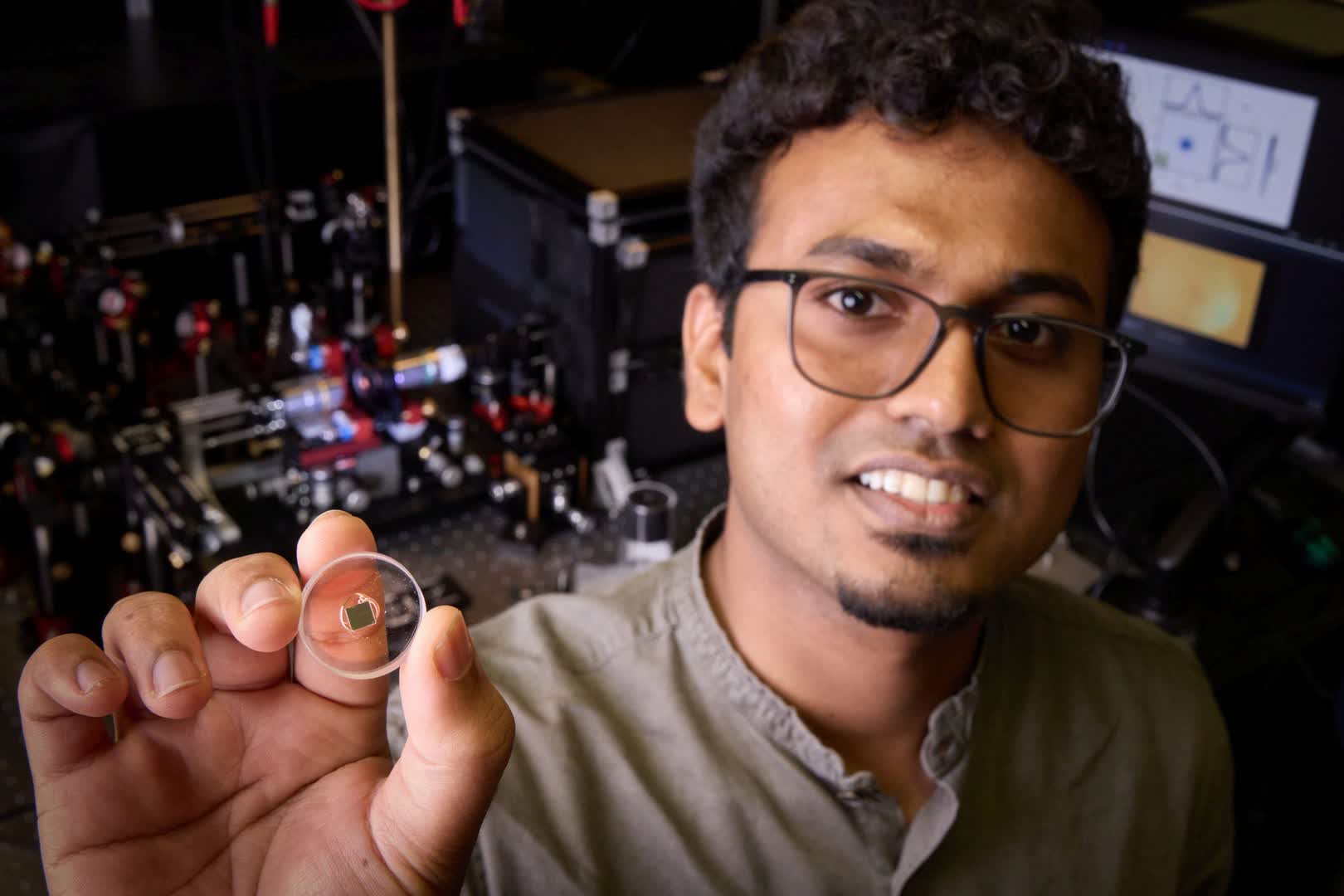
"We were able to apply a transparent polymer to the reflective surfaces to create microscopically small protrusions," explains Julian Schulz from the RPTU. "These protrusions allow us to trap the photons in one or two dimensions and condense them."

"These polymers act like a type of gutter, but in this case for light," says Kirankumar Karkihalli Umesh, lead author of the study. "The narrower this gutter is, the more one-dimensionally the gas behaves."

Speaking of one-dimensional behavior, the researchers discovered that the rules governing these exotic states of matter differed from traditional 2D photon gases. For example, the phase transitions start to get messy. In ordinary matter, materials undergo precise phase shifts – think water freezing at 32°F. However, in low dimensions, thermal fluctuations can disrupt this.

"So-called thermal fluctuations take place in photon gases but they are so small in two dimensions that they have no real impact. However, in one dimension these fluctuations can – figuratively speaking – make big waves," Vewinger explained.

It may sound like the researchers have broken laws of quantum physics, but that's not the case. The properties of the gas are still governed by them – such gases are called "degenerate quantum gases." They compare these gases to water, which can turn into slush at low temperatures without completely freezing.

However, the study is still enlightening as the researchers were able to demonstrate that single-dimensional photon gases do not actually have a precise condensation point. Looking ahead, they wish to dig deeper into the phenomena straddling different dimensionalities while unlocking new applications harnessing "quantum optical effects."

Image credit: Volker Lannert/Uni Bonn

Permalink to story:

 
Stephen Hawking's theoretical Lorentzian Traversable Wormholes seem like more and more becoming a (far future) possibility with each new Quantum Physics breakthrough... I was born way to early in history dammit...
 
Harks back to studying the 1-dimensional Ising model. I wonder how different the phase transition properties are, as is made of fermions and the others bosons.
 
Harks back to studying the 1-dimensional Ising model. I wonder how different the phase transition properties are, as is made of fermions and the others bosons.
The biggest difference is that bosonic gases condense into that weird state of matter known as a BEC -- a Bose-Einstein condensate. This article, though, didn't make clear that what these researchers found was that 1-D photonic gases don't have a well-defined phase transition, and thus never truly condense.

FYI: whenever you see an object hot enough to radiate ... the blackbody glow you see is the most common example of a photonic gas.
 
One dimension is a perfect row of single photons, right? 1) How can the trough be that thin? 2) Isn't a laser a collection of one dimensional rows?
 
One dimension is a perfect row of single photons, right? 1) How can the trough be that thin?
The trough itself isn't one-dimensional; it traps photons in a manner where their wave function becomes one-dimensional, I.e. able to be modeled with a single degree of freedom.

2) Isn't a laser a collection of one dimensional rows?
Photons from any source -- laser or not -- always travel in a single dimension; lasers are simply (partially) coherent, meaning their photons don't destructively interfere with each other. Their wave functions are still three-dimensional, however.
 
What just happened? Physicists have managed to turn light particles into what they describe as an "exotic state of matter" – a one-dimensional gas. They did this by confining the photons in a tiny space and cooling them. The results were astonishin, to say the least.

The experiment, conducted by teams from the University of Bonn and RPTU (University of Kaiserslautern-Landau), took a cue from an everyday phenomenon – a garden hose filling a pool compared to filling a gutter. When water hits the pool's surface, it disperses outward, and any change in water level is minimal because it's dispersed across. But if you shoot that stream of water into a narrow gutter, it creates concentrated waves that travel along the gutter's length

"The narrower the gutter, the higher the amplitude of the wave, and thus, the "more one-dimensional" it becomes," noted the researchers.

Essentially, the physicists miniaturized this phenomenon by creating "microscopically small gutters" to constrain light in a similar one-dimensional path. Their setup involved filling a tiny container with a dye solution and stimulating it with a laser. The resulting photons ricocheted between the reflective walls, losing energy with each collision against the dye molecules until they ultimately condensed into a photon gas.

Crucially, the dimensionality of this photonic matter could be tuned further by tweaking the reflective surfaces inside the container.

"We were able to apply a transparent polymer to the reflective surfaces to create microscopically small protrusions," explains Julian Schulz from the RPTU. "These protrusions allow us to trap the photons in one or two dimensions and condense them."

"These polymers act like a type of gutter, but in this case for light," says Kirankumar Karkihalli Umesh, lead author of the study. "The narrower this gutter is, the more one-dimensionally the gas behaves."

Speaking of one-dimensional behavior, the researchers discovered that the rules governing these exotic states of matter differed from traditional 2D photon gases. For example, the phase transitions start to get messy. In ordinary matter, materials undergo precise phase shifts – think water freezing at 32°F. However, in low dimensions, thermal fluctuations can disrupt this.

"So-called thermal fluctuations take place in photon gases but they are so small in two dimensions that they have no real impact. However, in one dimension these fluctuations can – figuratively speaking – make big waves," Vewinger explained.

It may sound like the researchers have broken laws of quantum physics, but that's not the case. The properties of the gas are still governed by them – such gases are called "degenerate quantum gases." They compare these gases to water, which can turn into slush at low temperatures without completely freezing.

However, the study is still enlightening as the researchers were able to demonstrate that single-dimensional photon gases do not actually have a precise condensation point. Looking ahead, they wish to dig deeper into the phenomena straddling different dimensionalities while unlocking new applications harnessing "quantum optical effects."

Image credit: Volker Lannert/Uni Bonn

Permalink to story:

A more visual presentation of the effects would allow lay people to understand your accomplishment better. Maybe a practical example of how it may be adapted to a surface or within a substance.
 
Sounds like it can be used for optical chip communications. Temperature on CPUs and GPUs can get pretty high but this can ignore that.
 
Back