Why it matters: New research from the University of California, Riverside, marks an important shift in quantum hardware design. Rather than waiting for flawless quantum chips and connections, researchers now have evidence that current technology can be integrated into larger, fault-tolerant systems immediately. This could accelerate the timeline for deploying quantum computers capable of solving complex, real-world problems at scale.

The researchers have shown that quantum computers can be built from interconnected smaller chips, and that these systems can still work reliably even if the connections and hardware are imperfect. The findings lay the groundwork for assembling large quantum systems from smaller units and highlight a crucial advance in making fault-tolerant quantum computers more practical.
Quantum computers, which have begun to influence research in fields such as chemistry and cryptography, currently remain limited in their capacity for large-scale computations. The main constraint is the size and reliability of the quantum hardware itself. Traditionally, quantum progress has been measured by the raw number of qubits – the quantum equivalent of classical bits – but without fault tolerance, these additional qubits do not guarantee usable results. Fault tolerance is the critical property that enables a system to detect and correct errors automatically, a necessity due to the inherently error-prone nature of quantum components.
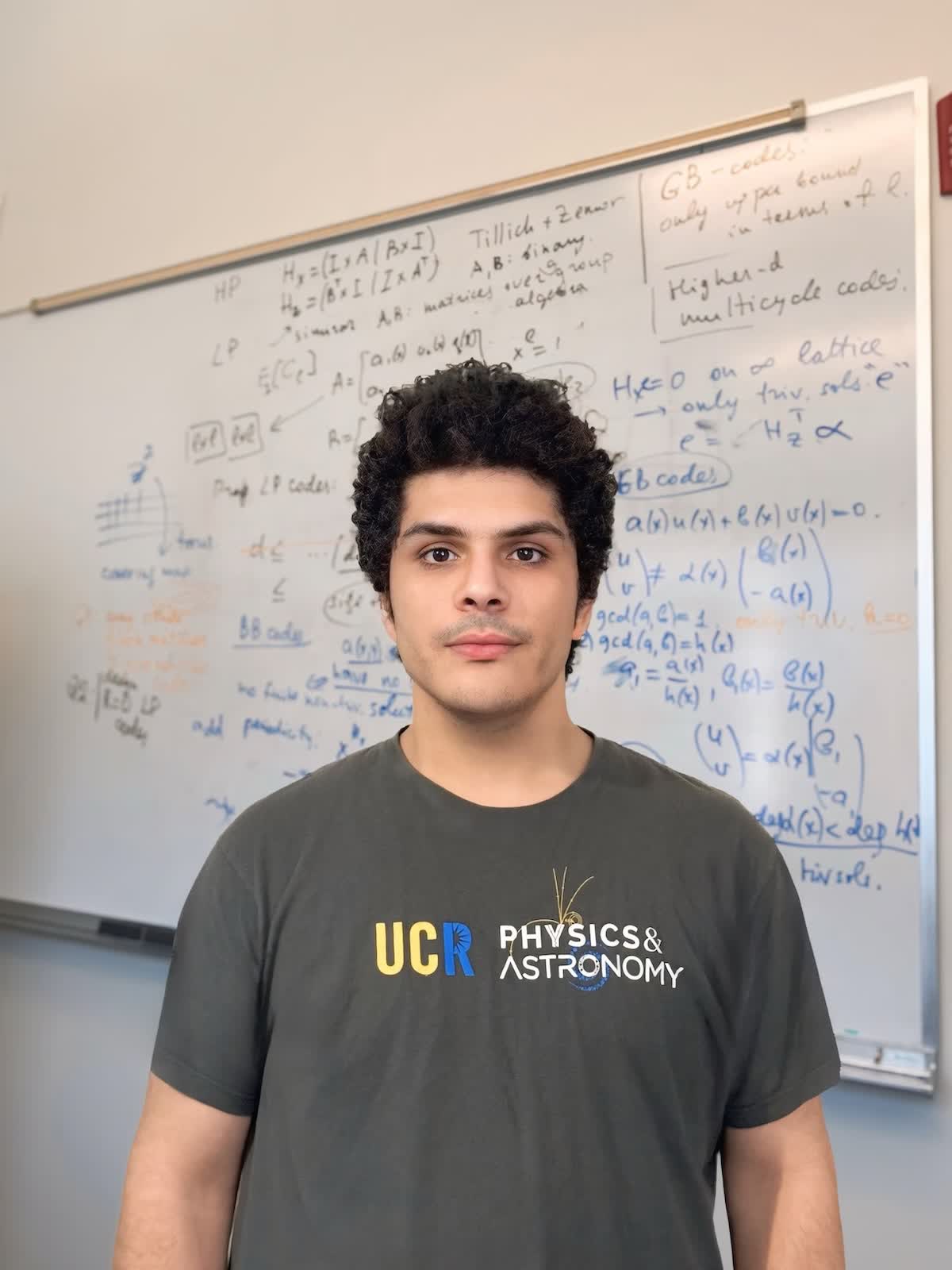
Mohamed A. Shalby demonstrated that existing chips can be linked to form larger, reliable systems – a key advance in quantum hardware design.
This new research approaches the scaling problem by simulating realistic quantum architectures composed of many smaller chips, each designed to work as part of a unified whole. Led by Mohamed A. Shalby, a doctoral candidate at UC Riverside's Department of Physics and Astronomy, the team used thousands of simulations to test six different modular designs. Their models incorporated practical parameters, drawing inspiration from Google's existing quantum infrastructure and making use of simulation tools developed by Google Quantum AI.
One major technical obstacle in modular quantum computers has been the noisy connections between chips – a concern that's especially acute when chips must communicate across separate cryogenic refrigerators. Such links typically introduce far more errors than operations performed within a single chip, threatening the effectiveness of error correction techniques and the overall reliability of the quantum system.
The UC Riverside-led team discovered, however, that even when inter-chip connections are up to ten times noisier than the individual chips themselves, a quantum system can still perform effective error correction, provided each chip maintains high operational fidelity. This effectively lowers the hardware requirements for assembling scalable systems, suggesting that quantum computers need not wait for perfect engineering before expanding their capabilities.
Much of their modeling focused on the surface code, the most widely used error correction technique in current quantum research. In this method, "surface code chips" organize physical qubits into logical clusters, relying on redundancy to guard against the errors that quantum operations naturally accumulate. The study showed that by using surface code architecture, modular systems can encode high-fidelity logical qubits robustly, even with imperfect links between modules.
Quantum computers may arrive sooner as scientists bypass flawless chip requirement


 -
- 


