Researchers develop 90-nanometer LEDs for future ultra high-resolution displays

Skye Jacobs

Posts: 1,982   +58
Staff
Forward-looking: Downscaling has long been the driving force in technological progress – from boosting computing power through smaller transistors to advancing display technology with micro-LEDs. Now, researchers from Zhejiang University and the University of Cambridge are pushing the boundaries of LED innovation even further, unveiling the world's smallest LEDs: nano-PeLEDs, based on perovskite semiconductors.

These nano-PeLEDs feature pixel lengths as small as 90 nanometers, enabling an unprecedented pixel density of 127,000 pixels per inch (PPI). For comparison, a typical 27-inch 4K gaming monitor has a pixel density of just 163 PPI.

"Making electronic devices smaller is an everlasting pursuit for scientists and engineers," said Professor Di Dawei, Deputy Director of the International Research Center for Advanced Photonics at Zhejiang University.

He explained that while micro-LEDs based on III-V semiconductors are considered state-of-the-art, their efficiency drops sharply when pixel sizes fall below 10 micrometers – a limitation that has hindered their use in ultra-high-resolution displays.
Unlike conventional micro-LEDs, nano-PeLEDs exhibit minimal performance degradation even at microscopic scales. This resilience is attributed to their unique composition: halide perovskites – a class of semiconductors more commonly associated with solar cells. "Halide perovskites are a new class of semiconductors," noted Professor Zhao Baodan of Zhejiang University.

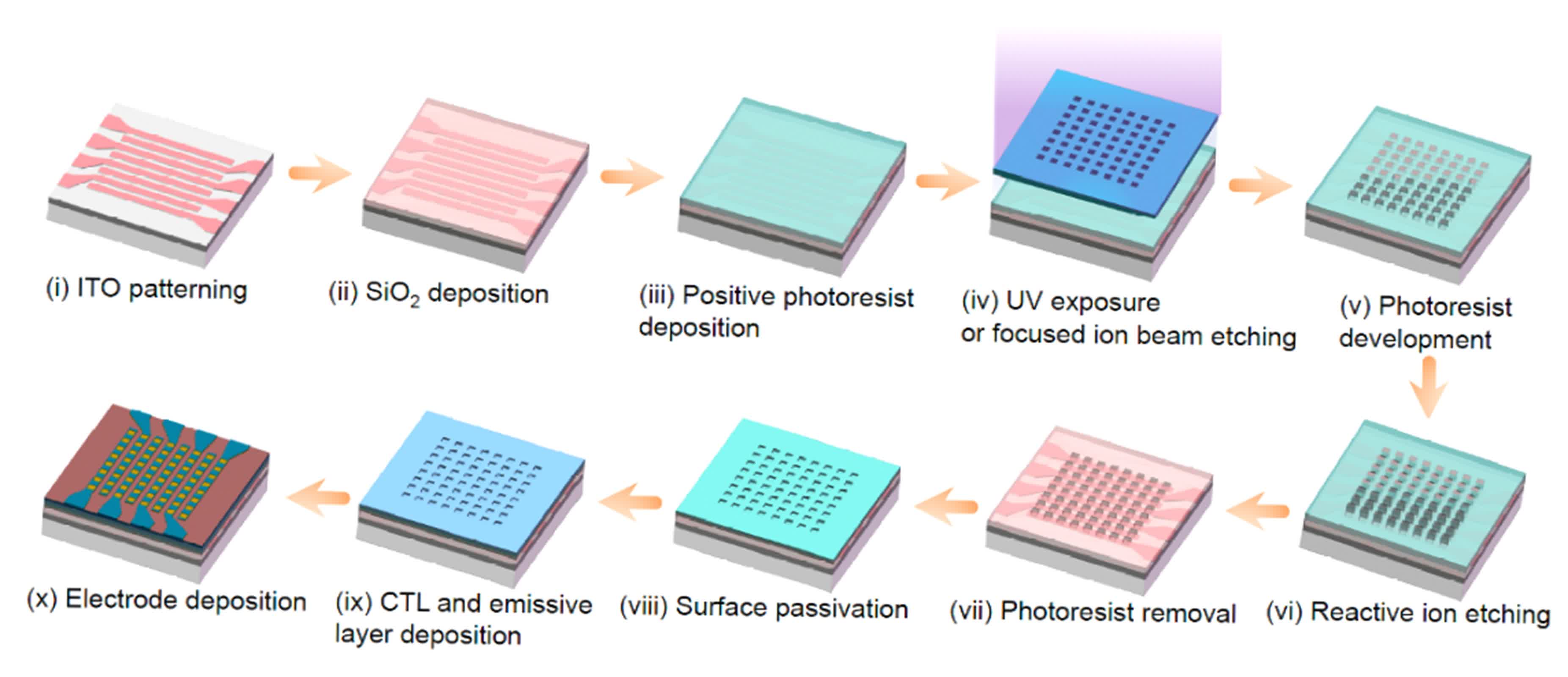
Creating nano-PeLEDs, however, was no simple task. Perovskite materials are notoriously fragile and susceptible to damage during conventional photolithographic processes used to pattern LED displays. To overcome this, the research team developed a novel fabrication method involving lithographically patterned windows in an insulating layer. This technique protects the delicate perovskite material while preserving high image quality.

"Conventional photolithographic processes are not suitable for direct patterning of the perovskite layers – it would damage the materials," said Lian Yaxiao, first author of the study, published in Nature. "This problem is overcome by our localized contact fabrication scheme."
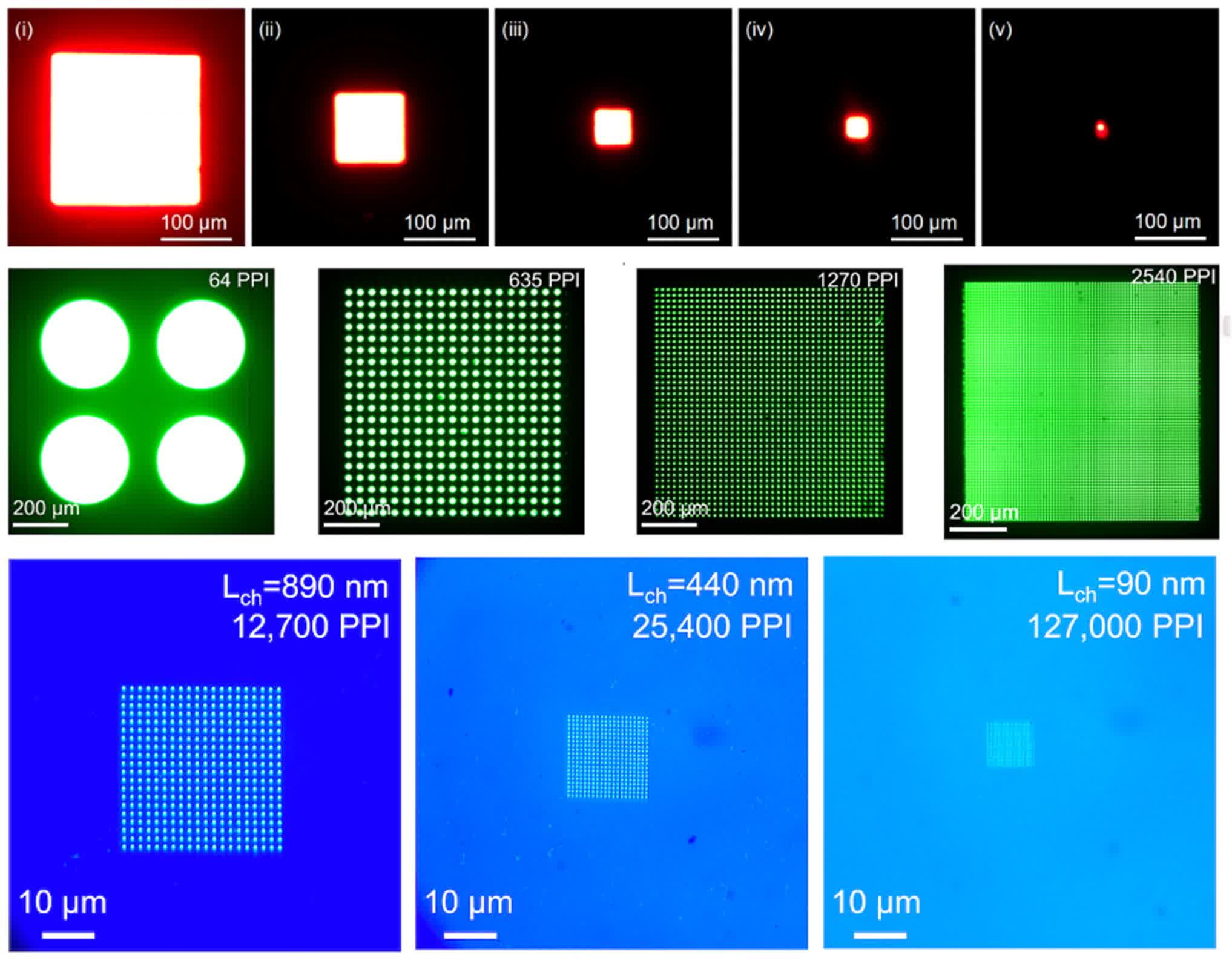
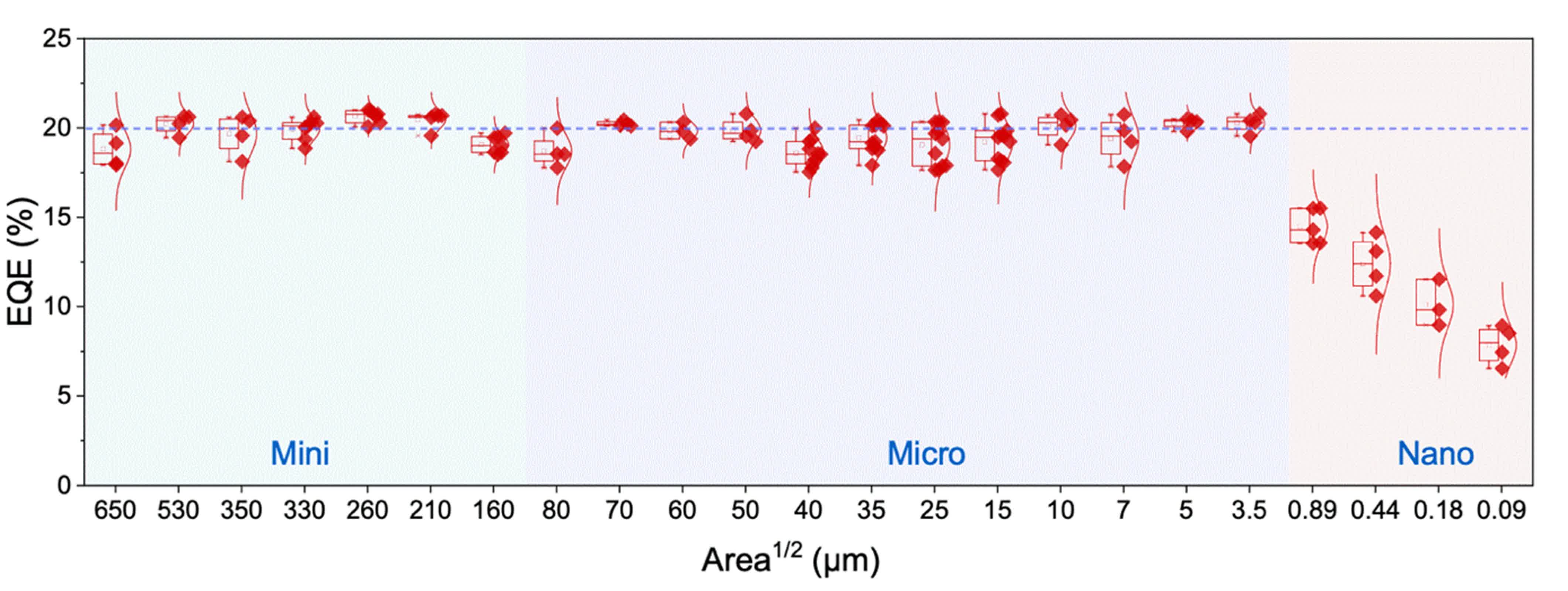
The team demonstrated that their green and near-infrared nano-PeLEDs maintained external quantum efficiencies of around 20 percent across pixel sizes ranging from several hundred microns down to just 3.5 microns.

Even at extreme miniaturization – approximately 180 nanometers – the drop in efficiency was significantly less than that seen in traditional micro-LEDs. This suggests that nano-PeLEDs could outperform III-V semiconductor-based micro-LEDs in applications requiring ultra-small pixels.
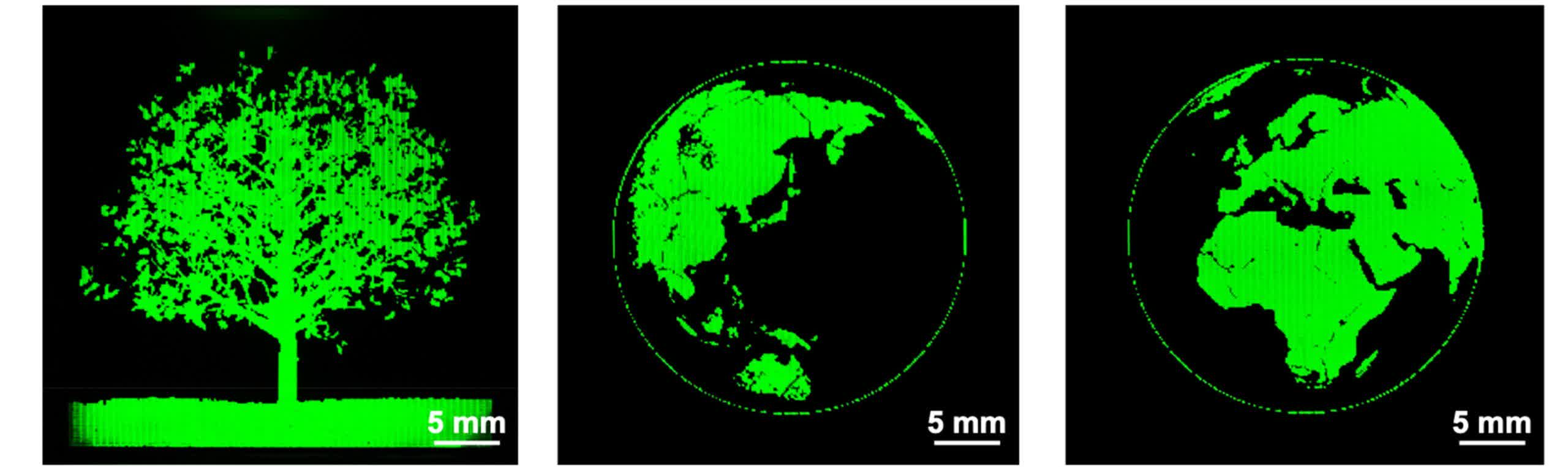
While nano-PeLEDs offer tremendous promise for high-resolution displays, practical implementation requires integration with programmable circuits capable of dynamic content delivery. To that end, Zhejiang University has partnered with LinkZill, a Hangzhou-based company specializing in thin-film transistor (TFT) technology.

Together, they developed a prototype active-matrix micro-PeLED display driven by a TFT backplane. This prototype is crucial to commercializing nano-PeLED technology and unlocking its potential for complex images and video playback.
As researchers continue refining this technology, its potential applications are rapidly expanding. The ultra-high resolution enabled by nano-PeLEDs could redefine display standards across various industries – from gaming and augmented reality to medical imaging.

Permalink to story:

 
This will be purchased by LG or Samsung, until that point it's not really something to anticipate. This is lab work. A buyer will decide if it's more useful as a product or as a restrictively held patent.
 
Doesn't there come a point where there no longer a use case? High pixel density consumer devices come in at around 650 ppi. Where would you use 127,000 ppi?

Maybe some very high tech stuff attached to very good sensors. Then a zoomer or large screen can be attached on top. Very high resolution nanoscope ??

Also assumption is for human eyes - ie just a 1 to 1 output for some data, that does not have to be visual. Then an AI eye views it , why not miss middlebit - then not 1 to 1 variable sensors ( output levels , or just straight binary ) and then another complication connecting and transferring that data

so maybe a real time sensor monitoring 100 000 things
 
Doesn't there come a point where there no longer a use case? High pixel density consumer devices come in at around 650 ppi. Where would you use 127,000 ppi?
The vision pro has a 3386 ppi density, LG has a prototype Micro-OLED screen as high as 4175 ppi.


https://www.cnet.com/tech/computing...a-microled-display-with-a-flick-of-your-eyes/
I believe it till target the vr markets,those smart glasses with augmented reality and last but not least smart contact lenses with ar capabilities.


https://www.pcmag.com/news/lg-displays-new-oled-screen-beats-apple-vision-pros-pixel-density
 
Oh goodie! Another way to jack up the price on tv's and monitors LOL
An OLED quality display without the "benefit" of burn ins, deserves a premium price.
I bet, some people are already prepared to pay more for such tech.
Just imagine, a typical OLED monitor costs around 1k. But what if you could buy one for something like 1500, but it does not burn in.
 
An OLED quality display without the "benefit" of burn ins, deserves a premium price.
I bet, some people are already prepared to pay more for such tech.
Just imagine, a typical OLED monitor costs around 1k. But what if you could buy one for something like 1500, but it does not burn in.
I got a 17 inch Microled screen for my laptop and it’s amazing
 
Doesn't there come a point where there no longer a use case? High pixel density consumer devices come in at around 650 ppi. Where would you use 127,000 ppi?

I was wondering what the limit of human vision is, Surely it's a much smaller number than 127,000ppi ? Even on screens that are very close like VR glasses... Going to have to do a search now and find out :)
 
Sounds like there's a firm working on the problem, however, given these are substantially smaller, I wonder whether the same difficulty that exists with their larger cousins will exist with these? That difficulty, placement during manufacturing.
 
Edit, I mistook the PPI calculation, 127k PPI is a lot and if it is in full color would be nice for a lot of wearable applications
 
Last edited:
127k PPI is a lot for a computer monitor but not for other applications. Keep in mind 1080P is 2 million pixels, so you can do glasses sized AR displays without a bulky headset, better IR/NV displays for aviation and military, and mixed reality displays too. I'd say even 500k or 1m PPI would be fine for those, to reduce the bulk on your face.
You also need alot less batteri to power it - which adds another layer to why it's so great in wearables
 
127k PPI is a lot for a computer monitor but not for other applications. Keep in mind 1080P is 2 million pixels, so you can do glasses sized AR displays without a bulky headset, better IR/NV displays for aviation and military, and mixed reality displays too. I'd say even 500k or 1m PPI would be fine for those, to reduce the bulk on your face.
PPI (pixel count in one dimension) can't really be compared to total pixels (2 dimensions). A one inch square display with 127,000 PPI would have over 16 billion pixels. A 2160p display at 127,000 PPI would be less than 2 hundredths of an inch tall.
 
Back