Researchers test how much detail eyes can see - or why Ultra HD might be overkill

Alfonso Maruccia

Posts: 2,723   +1,039
Staff
Cannot See: Manufacturers continue to release new TV models featuring Ultra HD and even higher-resolution panels. However, according to a recent UK study, much of this effort may be largely unnecessary, as the human eye has a natural "resolution limit."
A team of researchers at the University of Cambridge set out to determine the true number of pixels the human eye can actually perceive. Using a sliding 4K monitor that could be moved closer or farther from the viewer, they found that the eye can detect far more pixels than previously thought, but that larger TVs often have a pixel density far beyond what most viewers can appreciate.

The experiment led to the identification of what the researchers call "retinal resolution" – the pixel threshold beyond which adding more pixels does not improve the perceived image quality. This limit depends on several factors, including screen size, room lighting, and the distance between the viewer and the display.

The key takeaway from the study is that in a typical living room, a viewer sitting 2.5 meters away would be perfectly served by a 44-inch 2K/QHD screen. A TV of the same size with Ultra HD (4K or 8K) resolution would simply provide more pixels than the eye can detect, offering little to no perceptible benefit.
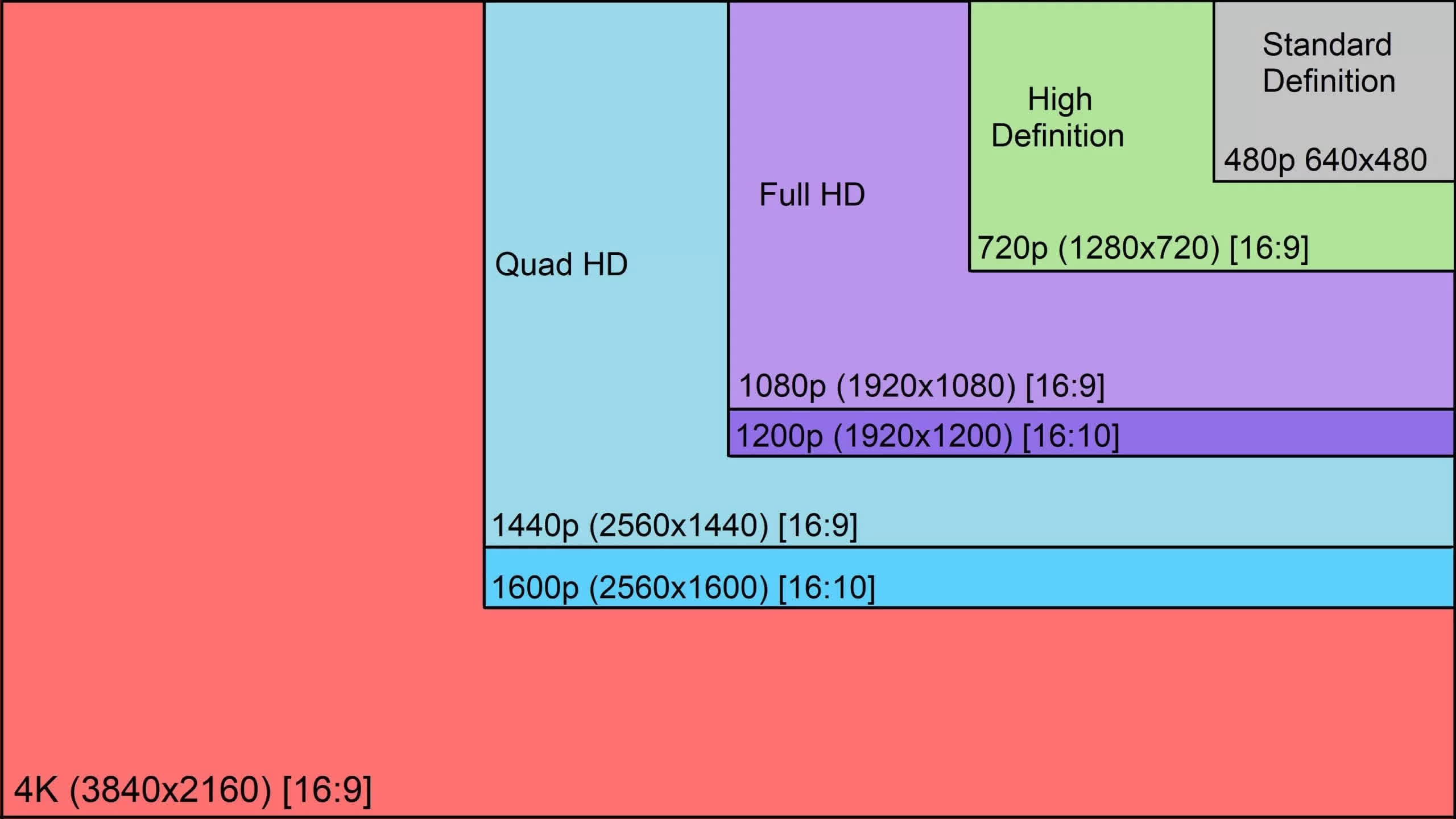
Instead of relying on traditional TV specifications, the researchers tested how well participants could detect lines in patterns of different colors. They measured pixels per degree (PPD), the number of individual pixels that fit within a one-degree portion of a viewer's field of vision.

The conventional 20/20 visual acuity standard suggests that the human eye has a PPD of 60 pixels. However, the study found that this 19th-century test underestimates human perception: participants with normal or corrected vision averaged 94 PPD when viewing greyscale images. Red and green patterns reduced the detectable PPD slightly to 89, while yellow and violet lines scored even lower at 53 PPD.

As explained by the study's co-author Professor Rafał Mantiuk, the human brain cannot sense colors that well. "Our eyes are essentially sensors that aren't all that great, but our brain processes that data into what it thinks we should be seeing," he said.

The researchers also developed an online display resolution calculator that allows users to determine the optimal screen resolution and size based on their specific viewing setup. They hope their findings will inform better manufacturing standards in the TV industry.

If their conclusions hold, it may explain why the market for 8K, 16K, or even larger displays remains limited. Sony, for example, has already paused production of new 8K TVs for the time being.

Image credit: Leawo

Permalink to story:

 
I think the biggest issue is that our equipment isn't coherent and neither is our input.

What good is a 4K or 8K monitor if your sources aren't 4K or 8K?

It's like buying a 5090FE to run it on a 1080p monitor. It's overkill - even though you get maximum Framerates, but at a certain point human limitations make it excessively expensive overkill.

Of course, the market is designed to get wealthy by selling us "cutting edge" whether we need it or not.
 
Higher res may not help much with the precieved clarity of an image, but it makes a huge difference in reducing aliasing. Even at a res where the eye can't see individual pixels, it would still see the pattern errors that aliasing causes because our eyes are extremely adept at recognizing patterns and flickering.
 
Higher res may not help much with the precieved clarity of an image, but it makes a huge difference in reducing aliasing. Even at a res where the eye can't see individual pixels, it would still see the pattern errors that aliasing causes because our eyes are extremely adept at recognizing patterns and flickering.

This is TV, with people sitting 2.5 m from a 44" screen and there's little to no aliasing in filmed content. Interestingly this makes a 65" 4K TV perfect for that 2.5m sitting distance. You only "need" a bigger TV if you sit farther away.

Video games are entirely different, sitting .5-1 m from a 24-32" screen and a much much worse image generation algorithm with all those aliasing problems. I'll bet even a 32" 8K monitor still shows aliasing artifacts.
 
This is TV, with people sitting 2.5 m from a 44" screen and there's little to no aliasing in filmed content. Interestingly this makes a 65" 4K TV perfect for that 2.5m sitting distance. You only "need" a bigger TV if you sit farther away.

Video games are entirely different, sitting .5-1 m from a 24-32" screen and a much much worse image generation algorithm with all those aliasing problems. I'll bet even a 32" 8K monitor still shows aliasing artifacts.
Weird that I have to be the one to break this to you but ppl can play video games on TVs. 😲
 
If the content is good, upscaled 720p looks pretty good on a 65-inch 4k TV.
Lol. If you can't tell the difference between the two, maybe you need glasses. I literally have a 65 inch 4K TV that I play games and watch movies on and I can easily tell the difference between 4K and anything that's not 4K. The difference is variable obviously, but usually easy to notice. The only time it's not easy to notice is if it's 4K vs something that's only a bit lower res than 4K. I don't care how high the bit rate is, the difference between 720p and 4K video is massive.
 
Weird that I have to be the one to break this to you but ppl can play video games on TVs. 😲

Wow so clever, how did you ever figure that out? Consoles rarely render at 4K so the problem isn't even aliasing, rather it's the original image is too low resolution with games like CP2077 rendering at ~1200p and crap like that. Fix consoles being too weak first and then we can talk about the benefits of exceeding 4K for playing games on a living room TV.
 
Wow so clever, how did you ever figure that out? Consoles rarely render at 4K so the problem isn't even aliasing, rather it's the original image is too low resolution with games like CP2077 rendering at ~1200p and crap like that. Fix consoles being too weak first and then we can talk about the benefits of exceeding 4K for playing games on a living room TV.
Consoles not rendering at 4K has nothing to do with this. The res at which current consoles can render does not dictate what the human eye can see.

I'm not saying anyone should invest in an 8K TV, but that doesn't mean that rendering in a higher res inherently will always reduce aliasing for 3D rendering.

And FYI, I game with my PC on my TV and my GPU is usually fast enough to render at native 4K if I don't use heavy RT effects.
 
He said nothing about not seeing a difference between 720p and 4K but damn are you reactionary and militant. Back off a bit and try to understand what people are saying instead of assuming things and then attacking your imaginary strawmen.
Who's being reactionary? Arguing that 720p holds up against 4K on a 65 inch TV is silly. I can't help that.
 
Lol. If you can't tell the difference between the two, maybe you need glasses. I literally have a 65 inch 4K TV that I play games and watch movies on and I can easily tell the difference between 4K and anything that's not 4K. The difference is variable obviously, but usually easy to notice. The only time it's not easy to notice is if it's 4K vs something that's only a bit lower res than 4K. I don't care how high the bit rate is, the difference between 720p and 4K video is massive.
I can see the difference. 4k HDR landscape content is beautiful. My point is that I don't care, as long as I enjoy what I'm watching on my OLED screen. The content needs to be entertaining, not just visually crisp.
 
Again, he didn't argue that at all. You're missing the point again. He's saying it still looks good even though you can tell it's not 4K. See post above.
Context matters, and in this context his statement is his argument.
I can see the difference. 4k HDR landscape content is beautiful. My point is that I don't care, as long as I enjoy what I'm watching on my OLED screen. The content needs to be entertaining, not just visually crisp.
It's fine not to care, but to imply that the difference is small is just wrong, and I would argue that 720p on a 4K TV isn't "pretty good" for anything where clarity matters, but that has nothing to do with my point.


Also, going above 4K may not be a huge deal for general TVs, but the larger the TV the more it would matter. If for example someone wanted to have a 120 inch TV and sit relatively close to it, it would definitely make a difference. For VR, resolution makes a huge difference and even 4K is a long way away from being to the point where anything looks sharp.

Again, it's fine if you just "don't care" about the difference between 720p video and 4K video, but that is not the point of this article.

I didn't say anything about video in my first comment so you'll have to forgive me for replying in context. My point was simply that for 3D, rendering in a higher res even above 4K reduces aliasing noticeable. A counter point would be DLSS, but that doesn't mean rendering in a higher res doesn't reduce aliasing; it just means DLSS is a reasonably good mitigating technique.
 
The study wasn’t considering gaming. For those who only “watch” their TVs, unless your screen is over 120”, you’re fine with 4k and probably can’t tell the difference between it and 1080p.

Since almost all content is still 1080p (or less) upscaled to 4k, if you’re not watching movies, 1080p is more than sufficient for 99% of the population.
 
It's mostly "the industry" and consumers that fall for it.
More megapixels, more ram, faster CPU's and on and on.
Consumers typically will fall for the "more is better".
 
"Our eyes are essentially sensors that aren't all that great, but our brain processes that data into what it thinks we should be seeing,"

So basically our eyes our eyes give us a low resolution image and our brain AI upscales it to 4k or something. :)
 
The study wasn’t considering gaming. For those who only “watch” their TVs, unless your screen is over 120”, you’re fine with 4k and probably can’t tell the difference between it and 1080p.

Since almost all content is still 1080p (or less) upscaled to 4k, if you’re not watching movies, 1080p is more than sufficient for 99% of the population.

I can certainly see the difference between 1080p and 4K on a 65" TV from 3m away. I would never want more than 4K though unless I had something like a 100" TV and were still within say 4m. But I agree, 1080p still looks great on my 65" 4K TV.
 
Somewhere out there is a guy sitting 10 inches from his 85-inch 8K just to justify the purchase, silently insisting he can totally see the difference.
He can because the bought the premium super silver 99.9999% rated HDMI cable. The study missed all the benefits because it used generic cable. Total rookie move.
 
"Our eyes are essentially sensors that aren't all that great, but our brain processes that data into what it thinks we should be seeing,"

So basically our eyes our eyes give us a low resolution image and our brain AI upscales it to 4k or something. :)
I think there's some truth to that. Further complicating that is that on-device upscaling is steadily improving (I.e., RTX super resolution and HDR); and that sources marketed as 4K and/or HDR are sometimes themselves only upscaled versions of lower resolution masters vs. true end-to-end 4K captured and mastered; so on a lot of (especially older) content the perceptible gap between the 1080p and 4K versions can be small.

I think is why, on the one hand, enthusiasts with a critical eye looking for details can perceive various differences; but casual viewers just wanting to see a movie or TV show are often pretty uncaring about the hardware details. I have a range of older to newer equipment in my house and its pretty rare for normal guests to notice they're on the old 720p plasma vs. the latest 4K tv.
 
I can certainly see the difference between 1080p and 4K on a 65" TV from 3m away. I would never want more than 4K though unless I had something like a 100" TV and were still within say 4m. But I agree, 1080p still looks great on my 65" 4K TV.
If it isn’t a movie, I doubt you can…
 
I have an 85” TV because I sit 13 feet (4M) away and that is the recommended field of view for emersion. 4K is a minor improvement over 1440p gaming, but very noticeable over “2K” streaming (due to compression). DVD content (480p) looks
noticeably bad but not enough to be unwatchable.

It’s actually perfect for gaming because I don’t have to game at 4K but do see some benefit if I do (on less demanding games).
 
Back