Samsung unveils fastest PCIe Gen 6 SSD, capable of transferring 40GB LLMs in just 1.4 sec

DragonSlayer101

Posts: 984   +14
Staff
In brief: Samsung has started mass production of its PM1763 enterprise-class SSD, featuring a PCIe 6.0 interface that promises double the throughput of PCIe Gen 5. The new drives are designed to meet the fast, reliable storage demands of cutting-edge AI data centers and high-performance computing environments.
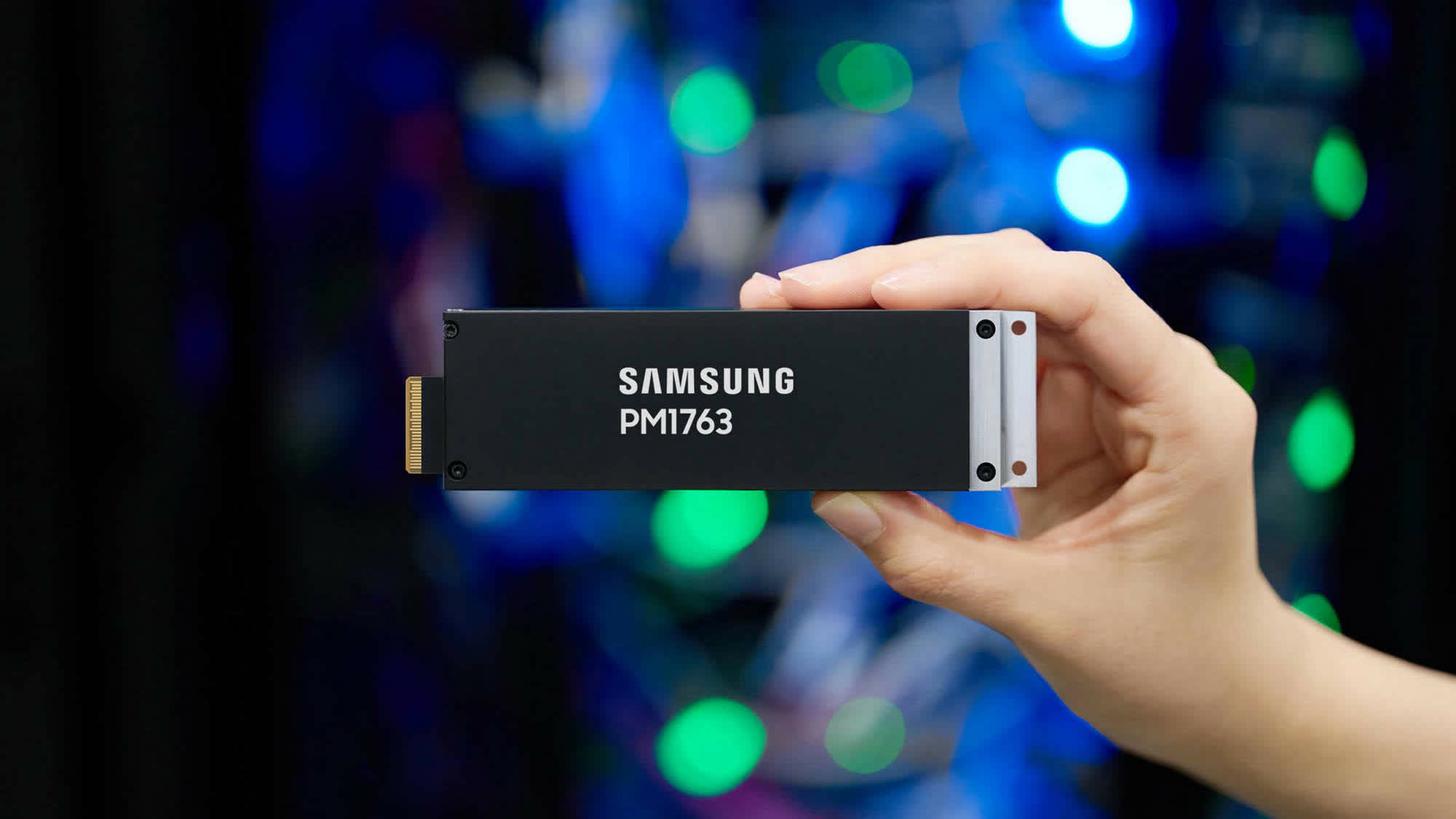
The 16TB model delivers sequential read and write speeds of up to 28.4 GB/s and 21.9 GB/s, respectively, while claimed random read and write performance reaches up to 6,800K and 950K IOPS. At these speeds, the new SSDs can transfer a 40GB LLM in just 1.4 seconds, roughly twice as fast as the PCIe Gen 5-based PM1753 drives, which require around 2.7 seconds to complete the same task.
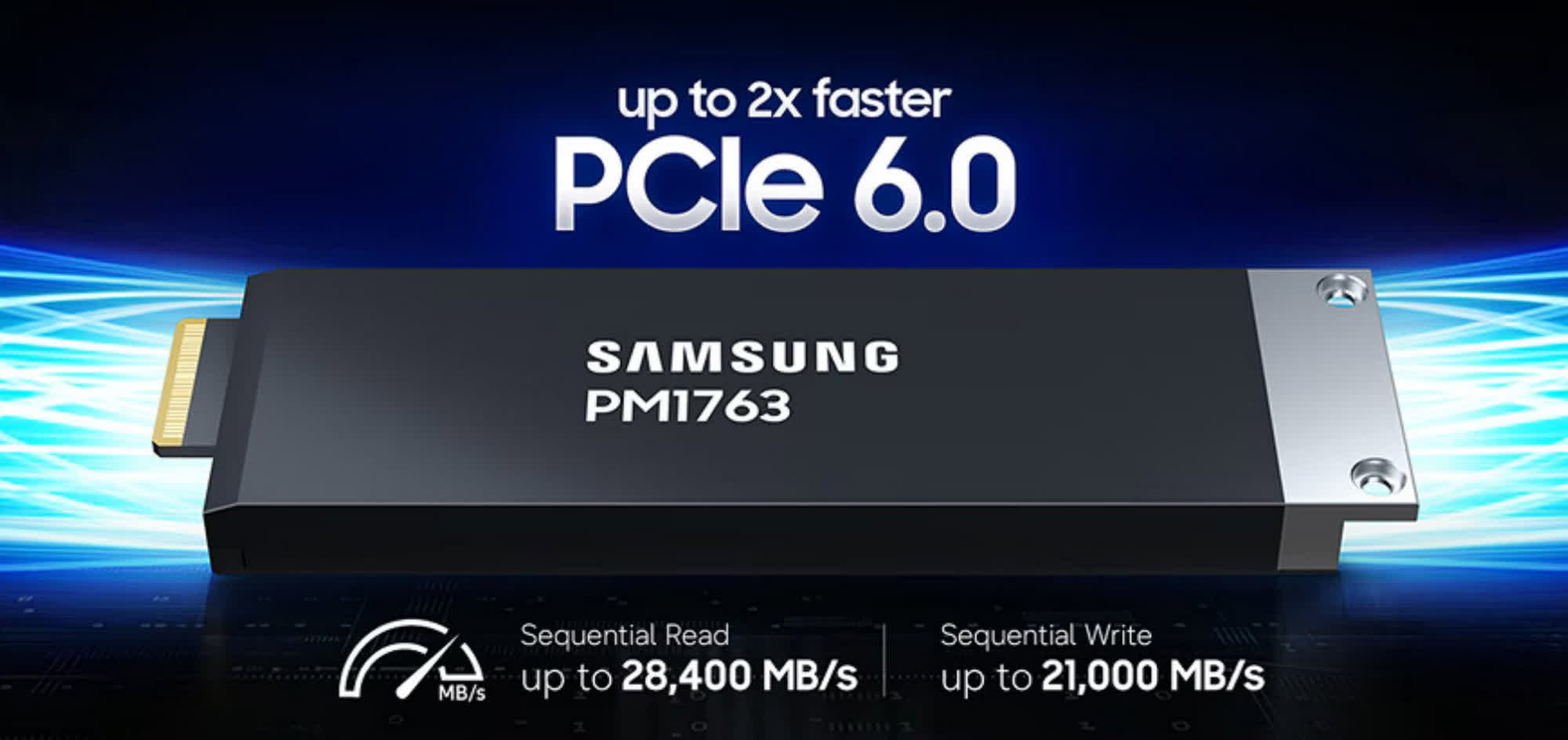
The Gen 6 drives are built using Samsung's 9th-generation V-NAND and a newly developed 4nm controller, which the company claims delivers a significant improvement in power efficiency compared with its previous-generation chips. According to Samsung, power efficiency has improved by up to 1.8x over its Gen 5 models, helping reduce data center operating costs.

Samsung says the new drives are optimized for liquid-cooled server racks through direct-to-chip cooling technology. They are also designed to deliver sustained peak performance and long-term stability, ensuring data integrity across a range of demanding workloads, including analytics, databases, and AI inferencing.
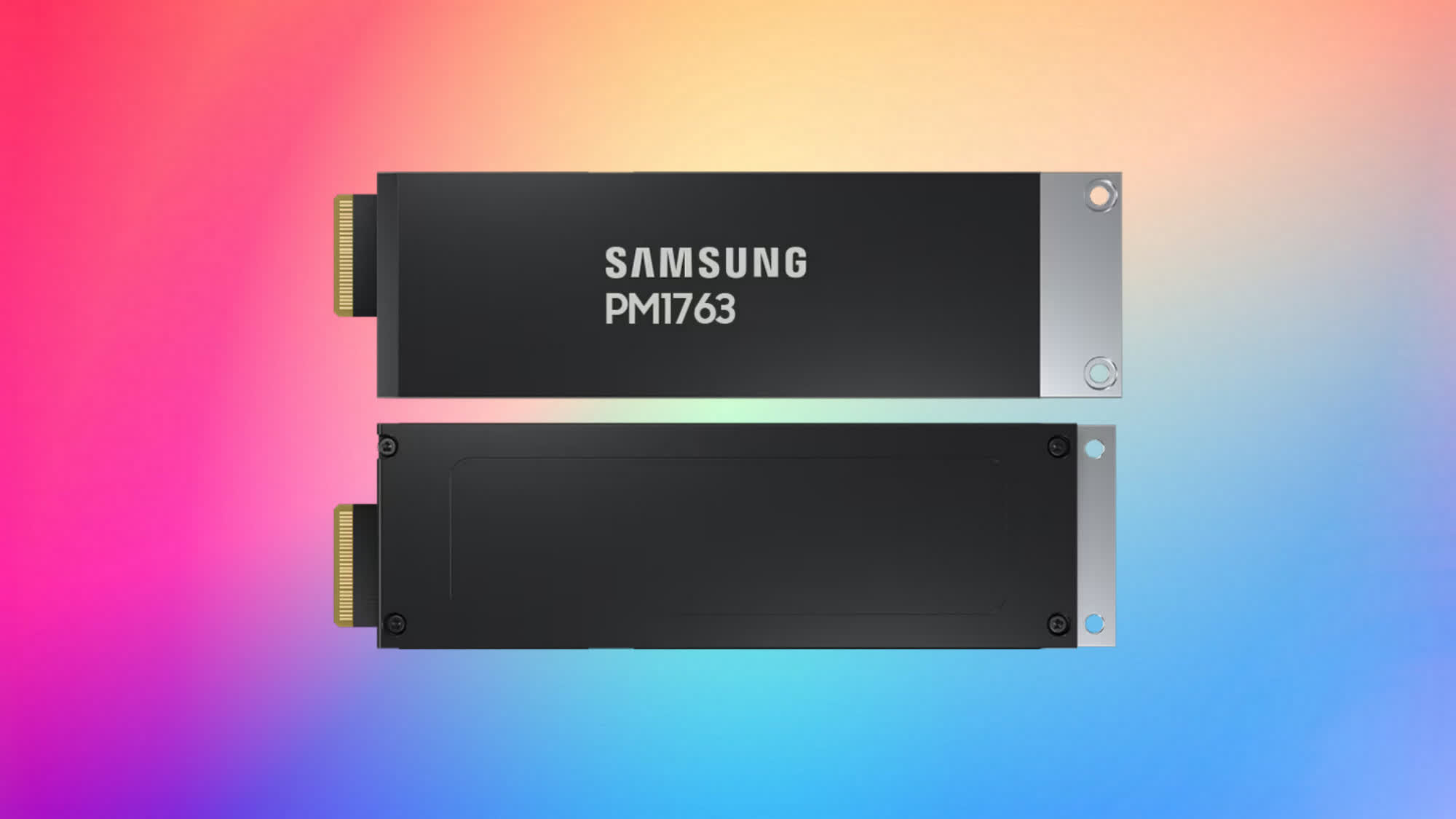
The PM1763 is available in 4TB, 8TB, and 16TB configurations at launch, but Samsung has also listed "30.72TB" and "61.44TB" capacities on its official product page, suggesting that the lineup could expand to include 32TB and 64TB models in the near future. All new drives are available in 2.5-inch E1.S and E3.S form factors and comply with NVMe 2.1 and OCP 2.6 standards.

The PM1763 SSDs incorporate the latest security protocols, including post-quantum cryptography algorithms designed to protect against future quantum computing threats. This represents a major addition to the PM1763's security features, as quantum computers are expected to eventually break traditional RSA encryption and elliptic curve cryptography far more efficiently than conventional systems.

The new drives also support the SPDM open standard and TDISP security architecture. While SPDM enables hardware components to securely authenticate and verify each other's identities, TDISP allows encrypted virtual machines to directly access hardware components while establishing secure data pathways between the guest VM and the device.

The PM1763 is Samsung's latest enterprise-class PCIe Gen 6 SSD lineup, delivering significantly faster data transfer speeds and improved power efficiency compared with PCIe 5.0-based drives. However, these drives are unlikely to remain the fastest storage solutions for long, with PCIe 8.0 expected to debut in 2028 with up to 1TB/s of bidirectional bandwidth.

Permalink to story:

 
In light of the current ridiculous market prices on Gen 5 SSDs I welcome this good news. All the SSDs that data centers are hoarding are gonna be slower than what you can buy soon. Which means the value on all last Gen SSDs should fall very quickly.

Good Game AI Data centers, you lose!

Of course, I'm sure the prices of these will be 10x ridiculous as Gen 5 SSDs are right now. But still, just out of curiosity, will these Gen 6 speeds be trickling down to consumer Gen 6 SSDs? I hope so, just for the cause of eventually becoming affordable. However long that may take.
 
Last edited:
I'm curious if the hyper investment going on with data centers, will we see a "1960s space race" rush of technology come to us consumers.

Will we see generations come sooner?
 
Why is the LLM part relevant? Presumably it can transfer any large file that fast.
Exactly, I guess they're trying to appeal to AI Data Centers who have already gobbled up all the Gen 5 SSDs in the universe. At least, that's the way the story goes, as to why everyday consumers are paying double and triple for the same SSDs that cost half just a couple of years ago.

And yet, as one wise person noted, there's never a supply shortage of these SSDs that are in such high demand. Go figure!

"You pay double...you get SSD tomorrow! Yes, Yes!!" :)
 
And yet, as one wise person noted, there's never a supply shortage of these SSDs that are in such high demand. Go figure! :)
Skipped economics in school, eh? In a free market, prices float to equalize supply with demand. If SSD prices had remained unchanged, demand would have indeed outstripped supply, and the shelves would run bare. Conversely, when a store has too much of a product, it marks prices down to "clearance" levels, to increase demand to match that oversupply.
 
Skipped economics in school, eh? In a free market, prices float to equalize supply with demand. If SSD prices had remained unchanged, demand would have indeed outstripped supply, and the shelves would run bare. Conversely, when a store has too much of a product, it marks prices down to "clearance" levels, to increase demand to match that oversupply.
ooops........better than being born a sociopath perhaps?...............ooops...........
 
ooops........better than being born a sociopath perhaps?...............ooops...........
A competent and clear-cut retort. I particularly love the explanation surrounding the mechanics of market-clearing prices as a psychological diagnosis, which is just spot-on. I am very much looking forward to your forthcoming economic treatise on how balancing scarcity through the power of wishful thinking will lead to utopian prosperity.
 
Skipped economics in school, eh? In a free market, prices float to equalize supply with demand. If SSD prices had remained unchanged, demand would have indeed outstripped supply, and the shelves would run bare. Conversely, when a store has too much of a product, it marks prices down to "clearance" levels, to increase demand to match that oversupply.
I didn't skip economics but I didn't major in it either.

The scenario you describe might be accurate in a market where everything was on the level. So, I think you missed the point I was trying to make. Price collusion going on behind the scenes.

You talk about stores floating prices to control their stock. But isn't it actually the SSD manufacturers who are the ones making record profits. Aren't they the ones setting the prices...mostly?
 
You talk about stores floating prices to control their stock. But isn't it actually the SSD manufacturers who are the ones making record profits. Aren't they the ones setting the prices...mostly?
Not merely 'mostly', but all the time: producers always choose the price of the goods they produce. So why is it that (inflation aside) prices fall as often as they rise? Economics teaches us that (as long as MR>MC) it's in a business's own self-interest to sell all it can produce, and to set a price to ensure that production is fully sold.

Right now, memory makers are running their production lines 24x7 and selling every chip they can, months in advance. The fact that their production is being fully sold tells us the price is -- by definition -- a fair market price, given the demand.

By late 2027-early 2028 memory prices will return to 'normal' ... and sometime around 2029-2030 they'll crash to new lows far below any yet seen. Not because of altruism on the part of memory makers or action on the part of regulators. But because the laws of economics dictate their best course of action -- continue to increase production to meet current demand.
 
I didn't skip economics but I didn't major in it either.

The scenario you describe might be accurate in a market where everything was on the level. So, I think you missed the point I was trying to make. Price collusion going on behind the scenes.

You talk about stores floating prices to control their stock. But isn't it actually the SSD manufacturers who are the ones making record profits. Aren't they the ones setting the prices...mostly?
It is 100% valid to scrutinize how massive corporations maximize advantages in an effort to protect their margins. And, yes, they absolutely do influence prices by controlling wholesale costs and production levels.

However, corporations cannot dictate prices in a vacuum. Even the largest companies are ultimately constrained by global demand and supply bottlenecks. When demand spikes against capped supply, prices skyrocket naturally. This means record profits are often a realistic symptom of basic economic cycles, not automatic proof of corruption or manipulation.

Without actual evidence of collusion, assuming or claiming corruption has no basis in fact. It is well within reason that the current market is indeed simply a normal economic supply-and-demand reality.
 
I'll have a need for gen 6 NVMe when gen 8, 9 or 10 come out. It's moving so fast for HPC, not for us.

I'm more than good with Gen 3 currently. A single Gen 5 drive in a computer makes no sense for the average gamer. Two or more make sense if you do a lot of local file transfers. We don't even need Gen 4 for Direct Storage (meh). Gen 3 is supported.
 
I'll have a need for gen 6 NVMe when gen 8, 9 or 10 come out. It's moving so fast for HPC, not for us.

I'm more than good with Gen 3 currently. A single Gen 5 drive in a computer makes no sense for the average gamer. Two or more make sense if you do a lot of local file transfers. We don't even need Gen 4 for Direct Storage (meh). Gen 3 is supported.
You say that but any time spent waiting on something to load is lost time. Gone are the days of going to make a cup of coffee while Windows boots. But Windows still takes longer than it should to load in my opinion. Until it's instantly loaded I know I won't be completely satisfied. Especially, when you have to boot up multiple times daily to troubleshoot your system.
 
And this mad AI memory chase, can memory be designed so it can be repurposed? The connectivity issue might be a clever design away? It seems like a lot of very valuable memory is going to be discarded my AIs only wanting the fastest. And with a severe shortage of chips, if those could be repurposed, it can make things better consumer level.
 
Back