Looking ahead: Sunlight has been used to generate entangled photon pairs, offering an early look at how quantum technology could reduce its reliance on power-intensive lasers. Researchers at the University of Ottawa and the Max Planck Institute for the Science of Light in Erlangen, Germany, used focused sunlight to produce entangled photons, which are essential to many photonic quantum computing and quantum communications systems.

The research, which was published in Optica, does not suggest that sunlight can replace laser-based quantum sources. Those systems remain more precise and produce stronger results. But the study shows that the light used to create entangled photons does not necessarily have to come from a laser, challenging the long-standing assumption that it does.
Entangled photons are pairs of light particles with linked quantum properties. Measuring one particle can reveal information about the corresponding measurement of the other, even when the two are separated. That behavior makes entangled photons useful for quantum encryption and other forms of quantum information processing.
Most systems generate these pairs through spontaneous parametric down-conversion. In that process, a laser shines through a special crystal, producing photons with correlated quantum properties. Researchers have favored lasers because they generate coherent light, meaning the waves maintain a consistent phase and typically operate within a narrow range of wavelengths.
Sunlight is not coherent. It contains many wavelengths and reaches Earth from different directions, making it seem like an unlikely candidate for generating entangled photons.
The Ottawa and Max Planck researchers had previously explored the question through theoretical work and experiments using light-emitting diodes. Their work suggested that incoherent light could generate entanglement if the relevant quantum property did not depend on the light's wavelength or direction.
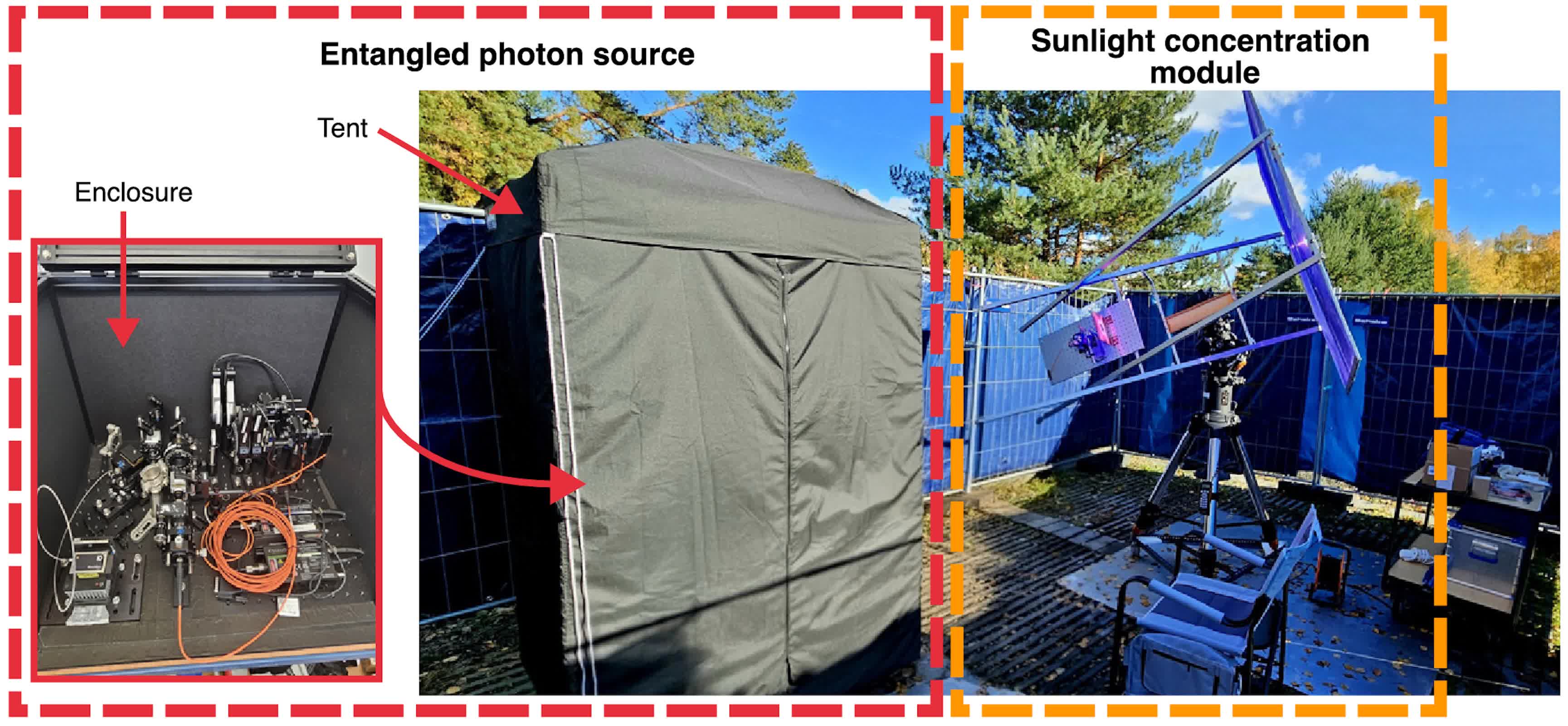
Experimental setup for generating polarization-entangled photon pairs with sunlight. The solar concentrator is at right; the photon source and electronics are housed in a light-blocking tent at left. Inset: The source's optical components and avalanche photodiodes.
For the solar test, the researchers needed to concentrate sunlight tightly enough to direct it into a small crystal. Hanieh Fattahi's team at the Max Planck Institute built a glass, cone-shaped concentrator that collected light from a window-sized Fresnel lens and funneled it into a thin optical fiber.
The team tested the system outdoors at the institute over three days. The resulting photon pairs achieved about 94% fidelity with a perfectly entangled state. The experiment also violated Bell's inequality, a test that helps establish whether correlations between particles are genuinely quantum rather than explainable by classical physics.
The Bell violation was limited, which the researchers partly attributed to weak seasonal sunlight and passing clouds. The entanglement quality also did not match the best results from laser-driven systems. Cheng Li, who co-led the research as a graduate student at the University of Ottawa and is now at Lawrence Berkeley National Laboratory, said the shortfall was likely caused by distortions in the optical components rather than the nature of sunlight itself.
He called it a proof of principle.
The researchers are now working to improve the brightness of the source and the quality of the entanglement. A more capable system could eventually be used outside the laboratory, including in remote locations or on satellites.
That prospect is part of the technology's appeal. Laser-based systems require electricity, stabilization, and cooling, while much of their energy is lost as heat. A source powered directly by sunlight could eliminate the electrical-to-optical conversion step.
Li said satellite systems could one day use the sunlight already available in orbit to produce quantum encryption keys. The idea remains far from deployment, but the experiment points to a different approach to building quantum infrastructure.
Scientists found a way to generate quantum entanglement using sunlight, not lasers


