Slime mold meets encryption in a radical art experiment

Alfonso Maruccia

Posts: 2,561   +951
Staff
Through the looking glass: Artist Stephanie Rentschler recently unveiled SlimeMoldCrypt, an interactive installation where art meets science by using biology to generate stronger encryption keys. Rentschler designed the piece to produce encryption schemes resistant to computational decryption, explaining on her website that biological behaviors are inherently chaotic.
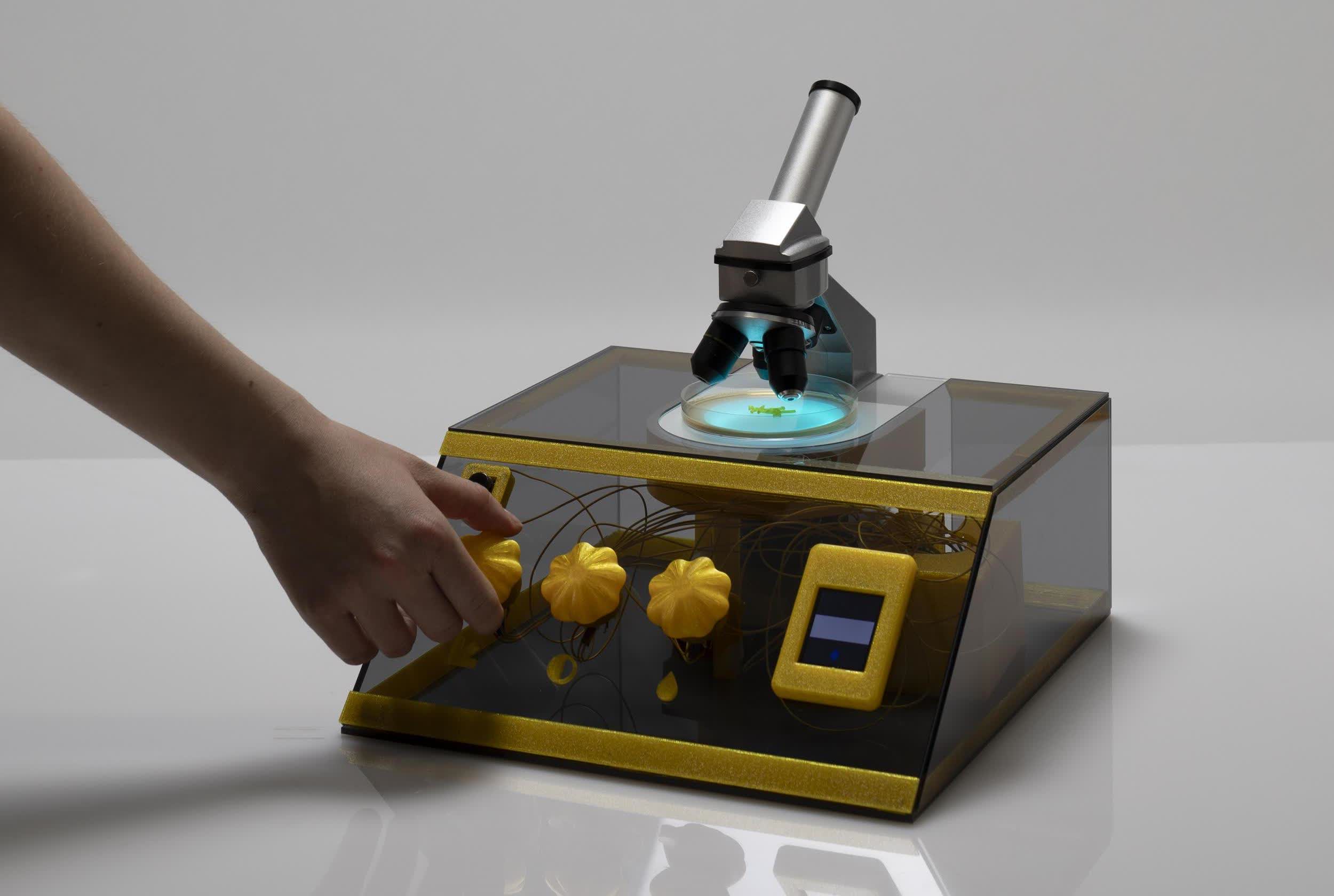
Encryption technology underpins today's digital world, but trouble may be looming. Practical quantum computers threaten secure communications based on traditional algorithms, and researchers are racing to develop novel approaches and applications that could withstand this theoretical quantum assault.

SlimeMoldCrypt reimagines computer security as a biological process, leveraging the microscopic lives of Physarum polycephalum (PP). This single-celled, intelligent slime mold develops a constantly changing network of tendrils and responds "instantly" to its environment. The system then converts this biological chaos into digital data for use in encryption algorithms.

Rentschler did not provide a detailed explanation of the process. Hackster.io speculates that the device captures images of the slime mold's activity through a microscope and converts it into numbers based on its growth. These quasi-random values seed an encryption algorithm instead of using a random number generator. Researchers have previously used slime molds' behavior to simulate complex systems, such as traffic networks.
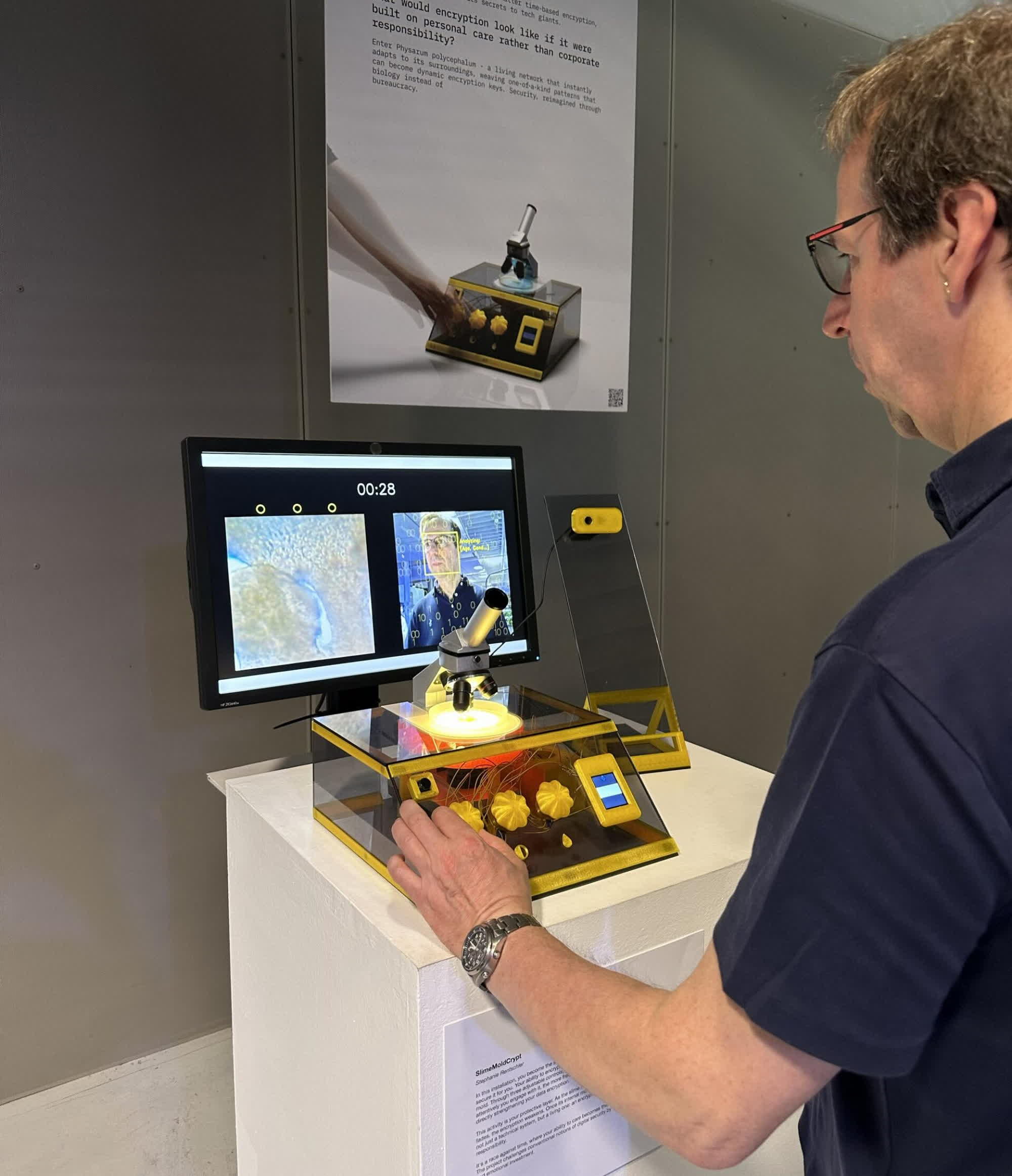
Three knobs guide the slime mold's movement, each linked to an "environmental control" regulating light, humidity, and food. A Raspberry Pi Pico at the heart of the device modulates the mold's vitality, increasing or decreasing cellular activity. A more active mold produces more chaotic patterns, boosting the entropy of the resulting encryption key.

If the mold's activity stops entirely, the encryption protection halts, potentially exposing sensitive information. Rentschler says she intended to use SlimeMoldCrypt to challenge traditional notions of passivity in digital security. The design offers a radical alternative, where the encryption process requires both empathy and responsibility.

"In a world chasing speed, it invites you to slow down, and protect with care," the designer said.

Rentschler is a Design Investigations student at the University of Applied Arts in Vienna, focused on creating immersive experiences and speculative designs that challenge conventional perceptions.

While biology-based encryption is likely too impractical for real-world products or industrial applications, the risk of compromised digital transaction security is real. Researchers are exploring various methods to strengthen security, with "true" random number generation seen as a key solution.

Image credit: Stephanie Rentschler

Permalink to story:

 
This article is missing a few details.

What is "true" random number generation, how do we achieve it, and why has it not been implemented so far?

Why can't the biological process be combined partly with pseudo-RNG schemes? Why does it have to be one or the other method? Is there a technical reason for this?
 
This article is missing a few details.

What is "true" random number generation, how do we achieve it, and why has it not been implemented so far?

Why can't the biological process be combined partly with pseudo-RNG schemes? Why does it have to be one or the other method? Is there a technical reason for this?

Look up the USSR's one time pad system from the 70's and 80's.
It used radio static from a radio telescope to generate random letters and numbers from the full russian alphabet.

It was said to be rather weird in that you could get people's first and last names in the feed (though not together).

radio static is the most common source of RNG that I know of, though a cool one is live video of a bunch lava lamps.
 
This article is missing a few details.

What is "true" random number generation, how do we achieve it, and why has it not been implemented so far?

Why can't the biological process be combined partly with pseudo-RNG schemes? Why does it have to be one or the other method? Is there a technical reason for this?
AFAIK, the closest you can get to a "true", hardware-only RNG is using some kind of radioisotope and a geiger counter. The randomness of fission provides a good "seed" to feed into an encryption algorithm.

The issue with pseudo-RNGs is that computers by their very nature aren't random. They can't be. You can tell it to spit out a "random" number, but that number is still being picked out of state that was generated by non-random actions. If you can reconstruct the actions leading up to the state the computer was in when the "random" number was generated, you can significantly reduce the pool of candidates from "infinite" to "not infinite" (millions or billions of candidate numbers).

IMO, this piece is more art than science, meant to get people to think more about encryption just in general. Others have done something similar before, by calculating random numbers from video feeds from an entire wall of lava lamps, or a video feed of a room of cats, where the state of each lava lamp or location of each cat helps to generate a truly random number - and its a number that changes randomly with time. And in the cases of the lava lamps and cats, it was actual companies and organizations that implimented these into live, production services (IIRC, CloudFlare uses the lava lamps for their encryption).

This slime mold example is really no different, and it is likely not even resistant (never mind being immune) to the coming practical quantum computing wave that is expected to crack all currently known encryption algorithms.
 
Back