What just happened? Spotify is finally delivering on a promise it made years ago: lossless audio streaming. After repeated delays and false starts dating back to 2017, the company confirmed this week that Premium subscribers in more than 50 markets will soon be able to stream music in higher-resolution formats at no additional cost.

Speculation about a Spotify HiFi tier began nearly a decade ago, and in early 2021 the company pledged that lossless streaming would arrive "later this year." By mid-2024, internal interface leaks suggested it was nearly ready... only for more delays to follow. That history left many Premium users skeptical when rumors of an imminent rollout resurfaced this summer.
Unlike earlier reports that hinted at a paid upgrade potentially under names like "Music Pro" or "Deluxe," Spotify has confirmed the new feature will be included in its existing Premium subscription at no extra cost. Pricing across all affected markets will remain unchanged.
The first countries to receive the update include the US, the United Kingdom, Australia, Germany, Japan, and several others across Europe and Oceania. Spotify says Premium listeners will see a notification in the app once the option becomes available to them, with rollout scheduled to continue through October.
Once enabled, users can activate lossless streaming by navigating to Settings - Media Quality and selecting Lossless for Wi-Fi, mobile data, or downloads. Playback indicators in the Now Playing bar and Spotify Connect menu will confirm whether a song is streaming in the higher-resolution format.
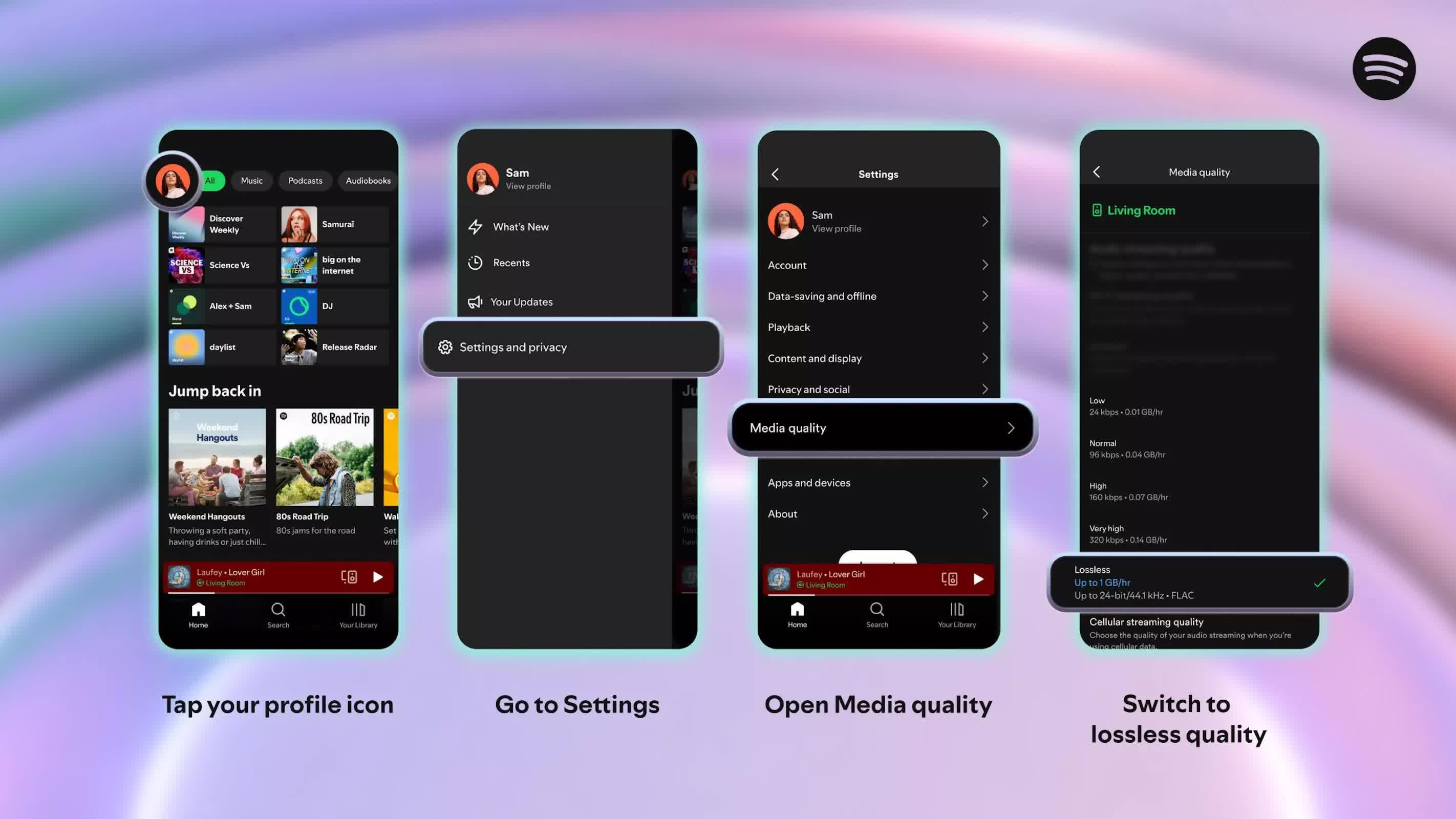
Spotify's new option streams audio files up to 24-bit/44.1 kHz in FLAC format. While this quality surpasses the platform's existing "Very High" setting, it still falls short of Apple Music, Tidal, and Qobuz, which all offer Hi-Res audio up to 24-bit/192 kHz. For most listeners, however, the audible difference between 44.1 kHz and higher sampling rates is marginal unless paired with high-end audio equipment.
High-resolution streaming also comes with practical limitations. Bluetooth connections generally cannot transmit full lossless files without compression, meaning wired headphones, supported speakers, or devices using Spotify Connect are recommended for the best experience. Spotify Connect compatibility includes products from Sony, Bose, Samsung, and Sennheiser, with Sonos and Amazon devices expected to gain support next month.
Lossless files are significantly larger than compressed tracks, increasing storage requirements for downloads and demanding stronger network connections for streaming. To address this, Spotify has added new media quality controls to help subscribers manage bandwidth usage across Wi-Fi, mobile, and offline playback, and has included rough data-consumption estimates with each setting.
With lossless streaming, YouTube Music becomes the only major streaming service without CD-quality or higher audio formats. Despite years of requests, Google has not indicated any plans to add similar functionality.
For Spotify, the long-awaited launch closes a chapter that has frustrated many subscribers while also moving the company closer to parity with competitors. Whether the service will eventually offer higher-resolution tiers – potentially tied to a more expensive plan – remains an open question.
Spotify rolls out long-promised lossless streaming to Premium subscribers


