SteamOS benchmarked on Asus ROG Ally as beta general release nears

Daniel Sims

Posts: 2,460   +74
Staff
Something to look forward to: Valve's SteamOS is expected to become available for third-party devices in the coming weeks, potentially challenging Windows in the PC gaming sector. An early benchmark of the Steam Deck's operating system recently produced intriguing results on the Asus ROG Ally, though many questions remain.

A recent video from YouTuber The Phawx shows SteamOS running on an Asus ROG Ally. Although the unofficial installation isn't flawless, early benchmarks suggest that the upcoming general release could run smoothly on various handheld gaming PCs.

Launching in May, the Lenovo Legion Go S will be the first device besides the Steam Deck to officially support SteamOS. The operating system enables playing PC games through a controller-friendly user interface. Valve plans to open a beta for other devices before the May launch, but 'The Phawx' went ahead with early testing on the Asus ROG Ally – one of the Steam Deck's most popular competitors.

Although SteamOS patch notes have previously mentioned the ROG Ally, this installation of version 3.8 doesn't fully recognize the device. Interestingly, it supports the ROG Ally's VRR and high-refresh-rate capabilities, but some buttons don't work, and performance is limited to 15W.

Benchmarks for games like Batman: Arkham Knight, Half-Life 2, Ratchet & Clank: Rift Apart, Returnal, and Cyberpunk 2077 showed the original LCD Steam Deck and the ROG Ally trading blows at roughly the same wattage. The official SteamOS release – and potential optimizations for the ROG Ally – will likely improve performance by unlocking more of the device's power and efficiency.

Oddly, 'The Phawx' didn't benchmark SteamOS on the ROG Ally against its default Windows installation. While SteamOS's controller-friendly UI is one of its key advantages over Windows (which can feel cramped on smaller screens), many users are waiting to see whether SteamOS also offers better performance and efficiency.
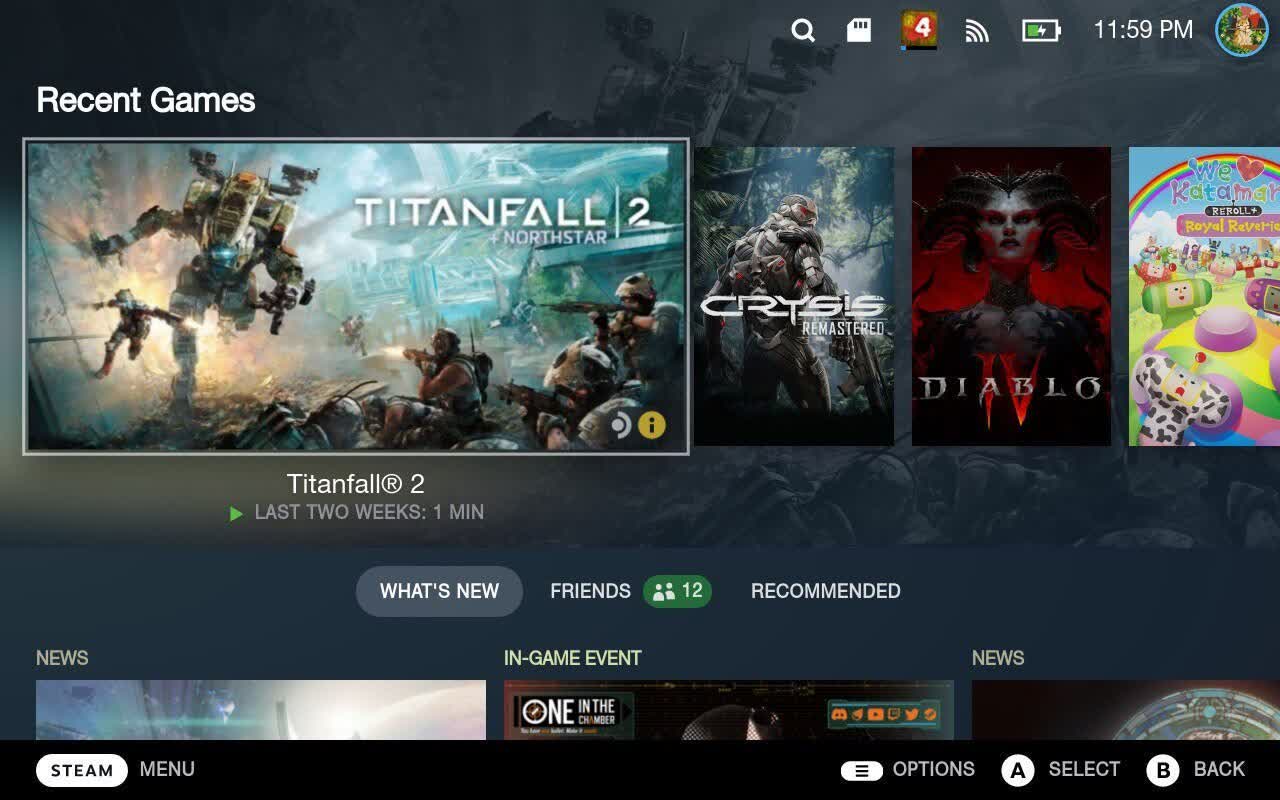
The Windows 11 version of the Legion Go S is already available starting at $729, but customers will be able to choose between a $599 Windows configuration and a $499 SteamOS edition in May. Though it's currently the only licensed third-party SteamOS device, comments in Valve's code and patch notes suggest the company's general release beta is just around the corner.

Once released, SteamOS will likely be tested on numerous handheld PCs – and possibly even desktops – allowing for more direct comparisons against Windows. Microsoft has hinted at a response, suggesting it may "combine" elements of Xbox and Windows for future handhelds, but the company's plans remain vague.

Permalink to story:

 
If SteamOS works well on regular PCs as well as handhelds, the long-awaited Year of Linux will probably be 2026.
Yeah, because that's what Linux is known for... wide, stable driver support for the endless PC hardware that's out there. *roll eyes*
 
If SteamOS works well on regular PCs as well as handhelds, the long-awaited Year of Linux will probably be 2026.
It will never happen. There is never going to be wide spread support for an open source OS. Not in this capitalist dystopia we're all trapped in.
 
Yeah, because that's what Linux is known for... wide, stable driver support for the endless PC hardware that's out there. *roll eyes*
Actually yes.

Just not the latest hardware
But try running your early 2000s joystick, printer, scanner etc and under Linux it tends to just work. Under windows thanks to changes in how drivers work and support stopping at XP if it even got that you simply cannot use the hardware.

Linux is great for old hardware, it's just when you try to run modern hardware and the manufacturer hasn't taken the effort it might be a while.
 
It will never happen. There is never going to be wide spread support for an open source OS. Not in this capitalist dystopia we're all trapped in.
Technically the most wide spread OS is already an open source one.
If Linux is too broad to qualify as a OS then next up is Android - also opensource.

I actually expect Microsoft at some point to give up on developing its own kernel. It's a lot of work and as we have seen with recent AMD and Intel CPU designs Microsoft seems to take a while to optimise for it whilst the Linux kernel is great on day one.
What's stopping Microsoft (other than legacy) from jumping on the Linux bandwagon with their own software stack on top (much like Android). It would be a one time investment to port stuff over and check if it works and from then on save alot of highly specialized (expensive) work.

As Android shows, it can still be pretty dystopian and mostly qualify as opensource.
 
Yeah, because that's what Linux is known for... wide, stable driver support for the endless PC hardware that's out there. *roll eyes*
Actually while the above answer is correct, the answer is even more simple: For most hardware there's about to be literally no officially supported alternative: Microsoft insist on dying on the hill of 'All hardware past our arbitrary cutoff point is useless and you should recycle and buy new'

So by default, Linux is the only way you can actually get some official support for all the millions upon millions of system Microsoft decided are literal garbage since they can't officially run Windows 11 and statistically that's still like 9 out of 10 systems so what are you complaining about?
 
Last edited:
Yeah, because that's what Linux is known for... wide, stable driver support for the endless PC hardware that's out there. *roll eyes*
So due to the rise of Android and many people only having phones as their maincomputers, Almost everything has sometype of Linux driver now. If it works on Android/ChromeOS, it'll work on Linux. Especially Distros designed for compatibility and ease-of-use, Like Mint
 
Yeah, because that's what Linux is known for... wide, stable driver support for the endless PC hardware that's out there. *roll eyes*

Never had a single driver issue on any Linux distro released in the past five years. I guess you just suck at computing.
 
Never had a single driver issue on any Linux distro released in the past five years. I guess you just suck at computing.
Used to be a bit slower getting GPU drivers out for the latest AMD cards (talking about the old HD5000 Cypress and HD6000 GPUs) - but these days AMD are pretty good at releasing new drivers with new cards (drivers released on 6th March support 9070 and 9070XT cards). I have to use windows for work but have home machines already on Linux and another laptop that will be on Linux as soon as support for win 10 ends (a good laptop that is too old for win11).
 
Never had a single driver issue on any Linux distro released in the past five years. I guess you just suck at computing.
Arch, but that distro only exists to satisfy the ego of Linix Wizards. And it's not that the drivers don't exist, it's just that you have to install them via command line

Things like Ubuntu, Mint, Manjaro and Debian haven't had any driver issues for years
 
Most 'PC gamers' are actually Windows gamers. Windows is the platform. If Microsoft were to ever make direct x open source, they would lose a lot of customers.
 
Most 'PC gamers' are actually Windows gamers. Windows is the platform. If Microsoft were to ever make direct x open source, they would lose a lot of customers.

No need since backwards engineering software is completely legal. It's how we ended up with PCs that weren't produced by IBM. The big problem is the effort required and how long it takes to reach a feature stable release. But if people were more willing to fork over a bit of cash so a team could go at it full time? Yeah that's the real problem with open sauce. It's mostly talented (some highly) people coding in their spare time for the fun of it, because it's not much of a paying gig. Unlike coding an OS for M$, Apple, or Alphabet.
 
Back