The 3dfx VoodooX project gets dressed in white for Christmas

Alfonso Maruccia

Posts: 2,576   +956
Staff
In a nutshell: The 3dfx Interactive brand is long gone, but its legacy lives on through custom redesigns like the VoodooX, which pay homage to the legendary PC hardware product line. The creator of VoodooX was forced offline for a few months but is now nearly ready to resume work on the card's design and test whether the latest changes have improved performance.
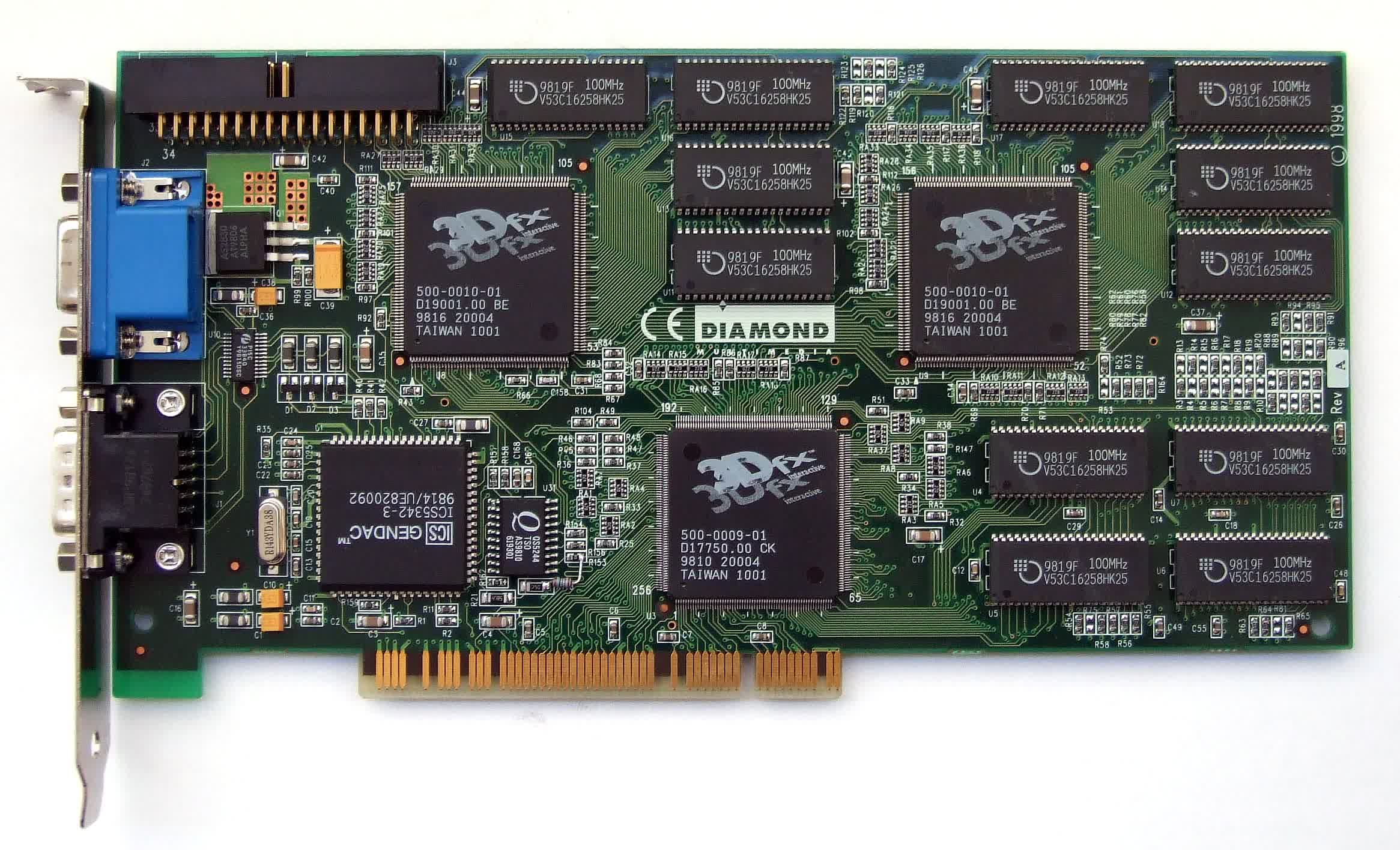
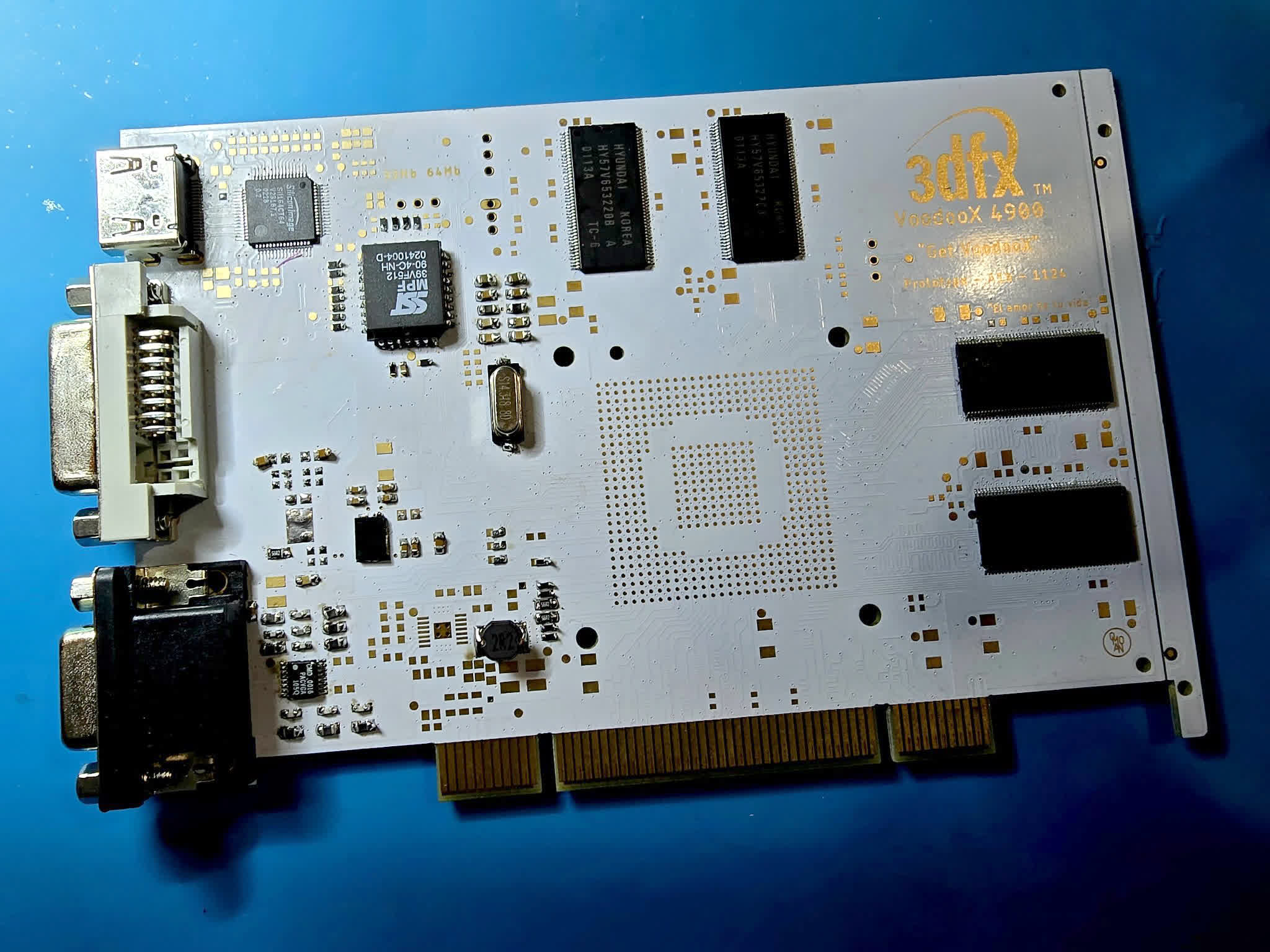
Oscar Barea has been working on the VoodooX card for a few years now. The 3dfx hardware enthusiast aims to design, develop, and build a fully functional Voodoo video card based on the VSA-100 chip – the final 3D accelerator developed by 3dfx before the company was acquired by Nvidia. Barea is one of the few resourceful developers who never forgot 3dfx Interactive, the company that revolutionized PC gaming graphics with its groundbreaking 3D hardware acceleration technology.

For almost a year, Barea had to put the project on hold as he remodeled his house, leaving him without access to his "lab room" for more than eight months. Recently, he resumed work on the VoodooX, building a new version of the card featuring HDMI, DVI, and VGA interface support. The updated design also boasts a sleek white PCB, which Barea describes as a fitting "Christmas design" in one of his latest tweets.

With the latest build, Barea managed to fix minor bugs in the VoodooX design and rerouted the memory signal for improved performance. Barea now plans to test the updated 3D accelerator to ensure it works as intended and to evaluate its performance using demos and games.

Barea began designing and testing his VoodooX card in 2022, using brand-new VSA-100 chips that had never been used in pre-existing graphics cards. Earlier this year, he mentioned testing a switch to toggle the memory configuration for each VSA-100 chip between 32MB and 64MB. Official VSA-100 specifications reportedly support up to 64MB per chip.

The VSA-100 chip – where VSA stands for Voodoo Scalable Architecture – was the most powerful 3D accelerator ever developed by 3dfx. The company intended to compete with Nvidia's GeForce line of GPUs, but the few VSA-100 cards that made it to market (Voodoo4 and Voodoo5) failed to sell enough units to keep the company afloat.

Nvidia completed its acquisition of 3dfx's assets and intellectual property in 2002, while the original company officially declared bankruptcy on October 15, 2002. Nvidia refused to provide technical support for 3dfx products, but the community stepped in after the 3dfx driver source code leaked in 2003.

Now, decades later, 3dfx enthusiasts like Barea are still finding new ways to revive and innovate with this once-obsolete graphics technology. Meanwhile, PC emulators such as PCem, 86Box, and DOSBox-X offer a quick and "easy" way to run classic 3dfx-compatible games within properly emulated Windows or DOS environments.

Permalink to story:

 
Seems to be doing pretty well for himself to pause life for a year to remodel his home. Telling people he's been "forced offline" is slightly misleading in the direction of additional drama. He made a choice to not work on it for a while.
 
Getting a PCB (or technically the solder mask) made in white doesn't require anything special btw. I was looking into getting a PCB made a while ago and it's literally just selecting the colour on the site of the PCB manufacturer (black, blue, red, white and of course classic green are common options).
The manufacturer might charge a little extra for it.

Just figured I'd mention it as some random trivia for those who've never looked into this stuff before.
 
3dFx was so much more interesting than nvidia and amd and came up with plenty of independent innovation. That level of creativity in GPUs died with 3dFx vs the rigid lock-step minimum effort from Nvidia.
 
3dFx was so much more interesting than nvidia and amd and came up with plenty of independent innovation. That level of creativity in GPUs died with 3dFx vs the rigid lock-step minimum effort from Nvidia.

Not really. Nvidia brought us 2D and 3D in a single solution. Much faster 3D that is.
3DFX died for a reason. Good nostaltica trip but dead and gone due to NOT innovating fast enough. Voodoo 3, 4 and 5 were massive failures or never even launched.

ATi did better vs Nvidia before AMD bought them. AMD is a CPU company first and foremost. CPUs are their prime focus. Can't expect them to compete in GPU market.

ATi was all GPU and it shows today. Nvidia is all GPU and owns all GPU markets, except the ones they don't care about (low-end). AMD spends 90% of their R&D money on CPUs because that is their prime business, which means Nvidia pretty much have no clear competition, while being worth more than AMD and Intel combined, times ten or more.

Intel and AMD can fight over low-end GPU market or a tiny fragment of AI and Enterprise market. AMD can maybe compete in mid-end, if Radeon 8000 launch is good (and cheap), however it is not like AMD makes big money on selling cheap GPUs, which is probably why they don't really bother.

Radeon 6000 series first sold well when prices skydropped after GPU mining died out. Some picked them up during mining craze tho. They lost 75% of their money buying at MSRP or even higher. Resell price for AMD GPUs are very low, so you should never buy at MSRP.

Radeon 7000 sales numbers are pretty low. 4090 alone outsold entire Radeon 7000 series for example.

If Radeon 8000 is not a succes, AMD might leave mid-end too. Sadly. They officially left high-end, Radeon 7900 series did not sell well at all. So Radeon 8000 won't get any high-end offerings. Expensive AMD GPUs simply don't sell well. Never did. People expect AMD GPUs to be cheap.
 
Last edited:
3dfx had a solid and groundbreaking start but faded into the transition to quick iteration and volume shipping, they went too quickly to try to build a top-to-bottom stack (like Apple) for a niche product, and although at the time it could have seen like an opportunity, they failed in a lot of places that eventually carved their demise. Buying STB was a mistake when they could sell a lot more chips for higher % revenue and establish a bigger base, then losing the contract for the Sega Dreamcast prototype by spilling the beans of the project (was secret, Sega got very pissed, cut contract and started legal actions) didn't make them any favors, having their architecture on a mass gaming console could have settled their tech to stay for longer even with the limitations, but above everything they failed to iterate quickly their designs, something akin to the development tools they used for design, because tech wise the concepts they developed were pretty cool and that's the reason why the IP and people was pretty valuable for Nvidia, but Jen company did it quicker and good enough to catch the thunder, and to this day it seems that's the way they still do it, cool ideas, pushing like mad, being the first, selling the concept. Back to 3dfx, VSA-100 was too little too late, but their iterations seemed timid at least, from V2 to Banshee they got 2D right, but 3d engine was the same and also cut down, no new features, from Banshee to V3 they put together what Banshee show have been (a full V2 + 2D), but then no new features, just a speedy all in one card leaving a lot on the table feature wise, for V4-V5 they barely put together what V3 should have been, and they never actually released the next step, only a few ES that were getting fixed and tested on their last days as a company, the next gen that never came was interesting at least, but trailing behind Geforces on execution-iteration, on getting stuff done, had a render chip for the regular stuff (scalable to multiple ones), and an optional second chip for a programmable T&L engine, that would have been the first gen for a programmable pipeline that later Geforce3 bring to the public, but for Geforce Nvidia got a fixed function one working properly, on a single chip, and their render units worked fine from the previous design (TNT2), so they keep adding to what was already a good work and built a solid solution. S3 also tried to built a fixed function T&L engine and failed miserably, Savage 2000 could have been a pretty cool single chip if just they could have got that right. ATI didn't fail, Radeon was very good, solid from the get-go, and enabled them to keep alive for the next fight. Enough rant. Still pretty cool to assemble an archaic 2000s computer with a Voodoo, and if its brand new even better, people enjoy RGB, so this is actual hardware, is better!
 
The stuff that guy owns is just a delicacy if your into hardware.

Ex909oHXIAEdwXH


You won't find that on your average Ebay. He got his hands on it through a former 3DFX engineer.

Imagine ramped up memory clocks and latency's.
 
The stuff that guy owns is just a delicacy if your into hardware.

Ex909oHXIAEdwXH


You won't find that on your average Ebay. He got his hands on it through a former 3DFX engineer.

Imagine ramped up memory clocks and latency's.
I've got 2x Voodoo 2 1000s, Voodoo 3 2000, Voodoo 3 3000, Voodoo 4 4500, and a Voodoo 5 5500 ; those cards and Glide are fantast.
 
Back