This 3D-printed 15-fan side panel drops CPU temps by 20 degrees

Skye Jacobs

Posts: 2,025   +59
Staff
In a nutshell: YouTube channel Major Hardware has taken PC cooling to an extreme by turning a case's side panel into a 3D-printed "Superdome" packed with 15 Noctua NF-A12x25 fans. In tests, this custom airflow assembly replaces the standard panel and cuts CPU temperatures by a wide margin.

In place of the usual tempered glass, the Superdome forms a bulbous structure that concentrates intake across the entire flank of his Lian Li O11 case, effectively turning the side panel into a dense grid of pressure-optimized fans. The design is a direct response to viewer feedback on his prior Fanhattan Project, which used a dome of tiny fans and led viewers to ask for a version built around full-size Noctua NF-A12x25 120mm fans.

"I dropped about 20°C just by putting the Superdome on the front of my PC," the TechTuber said during testing. "This is pretty incredible, and it's not even loud."

The Superdome grew out of a viewer-inspired challenge. After showcasing the Fanhattan Project, comments rolled in urging him to try the same idea with full-size fans. Each NF-A12x25 retails for around $40, bringing the total well past $600 – until Noctua stepped in to supply the hardware, along with matching spools of 3D printer filament for the custom housing.
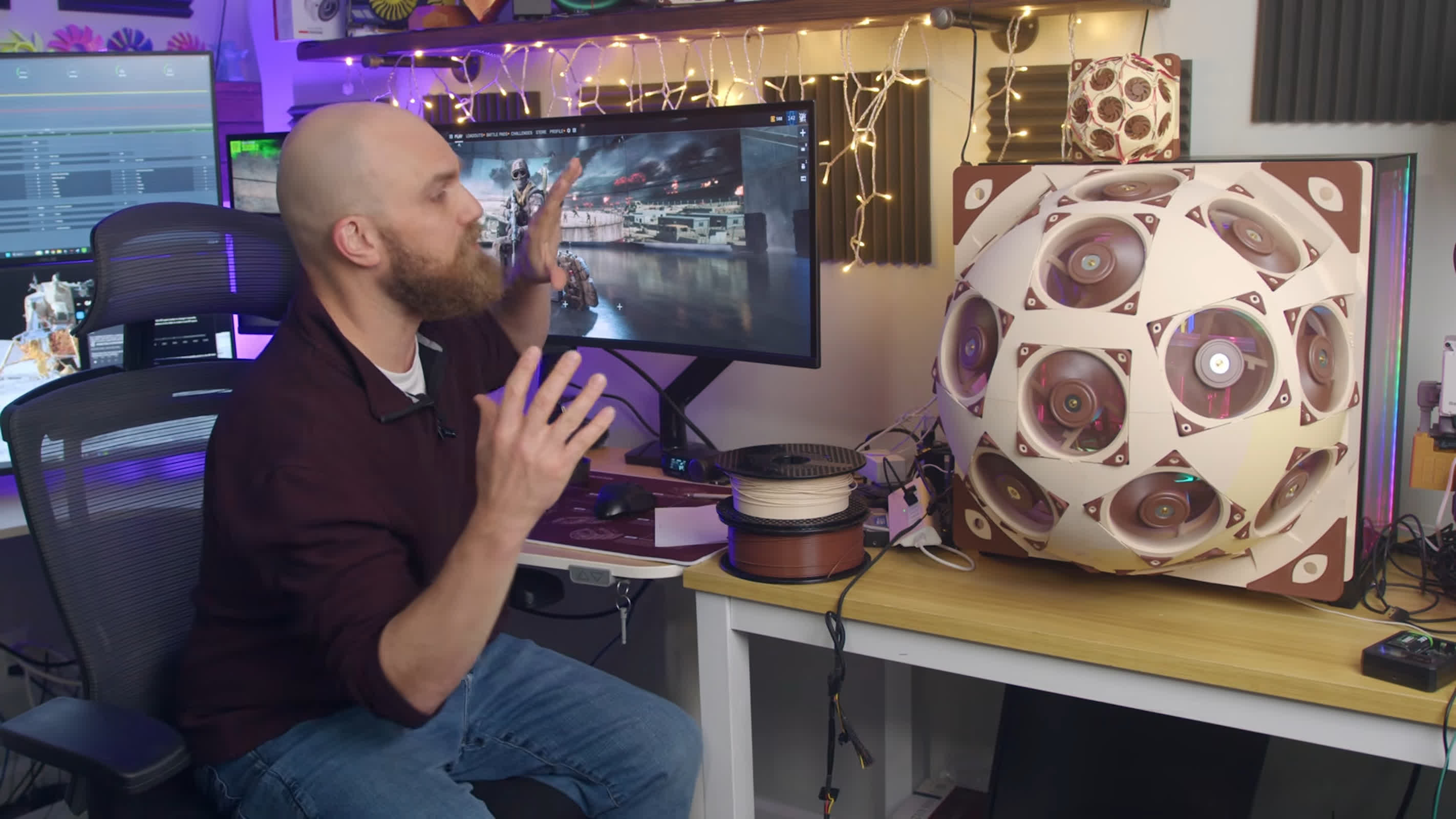
Major Hardware then designed the dome to fit 15 fans: one at the top, surrounded by five in the midsection and nine forming the base ring closest to the PC case. The intricate design had to balance symmetry, airflow, and the limitations of his 3D printer's build volume.

Printing alone consumed several days. Using Bambu Lab H2D and H2S printers, he managed to fabricate the dome with minimal splitting, though the process pushed his tools to their limit. The result, once assembled, resembled a compact wind tunnel – a spherical surface of spinning Noctua blades feeding directly into the computer chassis.

Once mounted to the side of his Lian Li O11 case, the Superdome transformed the system's airflow. All 15 fans were configured as intakes, creating noticeable positive pressure inside the case. "Honestly pretty quiet," he observed, though he admitted that cable management was "a little bit of a disaster." Any cable shift near the blades could turn serenity into chaos.

Testing with Battlefield 6 provided stark results. Using a standard glass side panel, CPU temperatures topped out around 86°C, as measured through AMD's Ryzen Master software. Swapping the glass for the Superdome dropped temperatures to roughly 67°C under identical conditions. The cooler readings are largely due to how much fresh air the dome pulls into the case. Sitting next to the setup, he noted, produced "a constant breeze."

The Superdome's significance extends beyond one creator's build. By publishing the 3D-printing files on Thingiverse, Major Hardware effectively opened the design to the broader maker community. Anyone with a compatible Lian Li O11 case – and an abundance of fans – can replicate or refine the experiment.

Permalink to story:

 
I used to overclock to high heaven all the time way back when - at some point though I realized besides the nerd-fun it often makes the box problem-prone in exchange for meager performance gains.
My current main box can be overclocked but I know I won't actually notice the increased performance in my daily routines. So I don't.
Sure if I pump it a bit AND run an FPS counter I can see the difference in games. Without the counter/benchies I don't. ¯\_(ツ)_/¯
And it won't matter if I add 15 fans to my AIO watercooler except that it'll produce jet fighter noise.
Go ahead kick me out of the nerd community hahaha.
 
I used to overclock to high heaven all the time way back when - at some point though I realized besides the nerd-fun it often makes the box problem-prone in exchange for meager performance gains.
My current main box can be overclocked but I know I won't actually notice the increased performance in my daily routines. So I don't.
Sure if I pump it a bit AND run an FPS counter I can see the difference in games. Without the counter/benchies I don't. ¯\_(ツ)_/¯
And it won't matter if I add 15 fans to my AIO watercooler except that it'll produce jet fighter noise.
Go ahead kick me out of the nerd community hahaha.

Then you get older, get your own place, pay your own electric billz and start to strive for a nice underclock haha
 
I, for one, can't stand fan noise. This thing has to sound like a jet going thru your room 24/7. Why not just put the entire PC in a fridge and let it go at that.
 
I, for one, can't stand fan noise. This thing has to sound like a jet going thru your room 24/7. Why not just put the entire PC in a fridge and let it go at that.
Why? With that many fans, you could probably run them at 250 RPM and still get a nice airflow - at 250RPM Noctuca fans are pretty much noiseless.

But, the case looks like it just farted in a balloon - interesting experiment, not very pretty or practical.

Next project should be "A circular PC shaped like the deathstar!" ...which would be a total nightmare to make, but would be endlessly entertaining to behold
 
I used to overclock to high heaven all the time way back when - at some point though I realized besides the nerd-fun it often makes the box problem-prone in exchange for meager performance gains.
My current main box can be overclocked but I know I won't actually notice the increased performance in my daily routines. So I don't.
Sure if I pump it a bit AND run an FPS counter I can see the difference in games. Without the counter/benchies I don't. ¯\_(ツ)_/¯
And it won't matter if I add 15 fans to my AIO watercooler except that it'll produce jet fighter noise.
Go ahead kick me out of the nerd community hahaha.

LOL the last CPU I overclocked was the Celeron 300A, to a WHOPPING 450mhz! ;)
It's just not worth the effort to me any more.
 
And that kids is why we invented liquid cooling loops instead.
CPU Cooler 1 - pipe into liquid cooler 1 - pipe into liquid cooler 2 - pipe back into CPU cooler gets 10% drop in CPU max temp, but is a very wimpy design, what I want to test is an industrial Exhaust fan pulling air out in a sealed case and a large Passive cooler with tons of fins due to the fact fins work well when mixed metal copper and aluminium, heat extraction seems to be what so many forget, once you pull heat out it can only be replaced with cooler air.
 
I used to overclock to high heaven all the time way back when - at some point though I realized besides the nerd-fun it often makes the box problem-prone in exchange for meager performance gains.

The thing is that silicon is pushed much closer to the limit and is much smarter these days. Assuming you keep it at a reasonable temperature you're more than likely getting 90+ percent of the possible performance in most scenarios. For better or worse, pending how you spin it, gains from tweaking/overclocking are a fraction of what they were 'back in the day'.
 
I did one a few years ago but not as many fans. they are expensive :(
128-347hmd-K.jpg
130-Q9-Q4ocq.jpg
132-r-HPDxr-L.jpg
133-Lia-Ys-Zf.jpg
134-u-DOSy9-G.jpg
 
I, for one, can't stand fan noise. This thing has to sound like a jet going thru your room 24/7. Why not just put the entire PC in a fridge and let it go at that.
What about those Peltier-based laptop coolers? I bet you could adapt one to fit the side of a PC case. Might be quieter too.
 
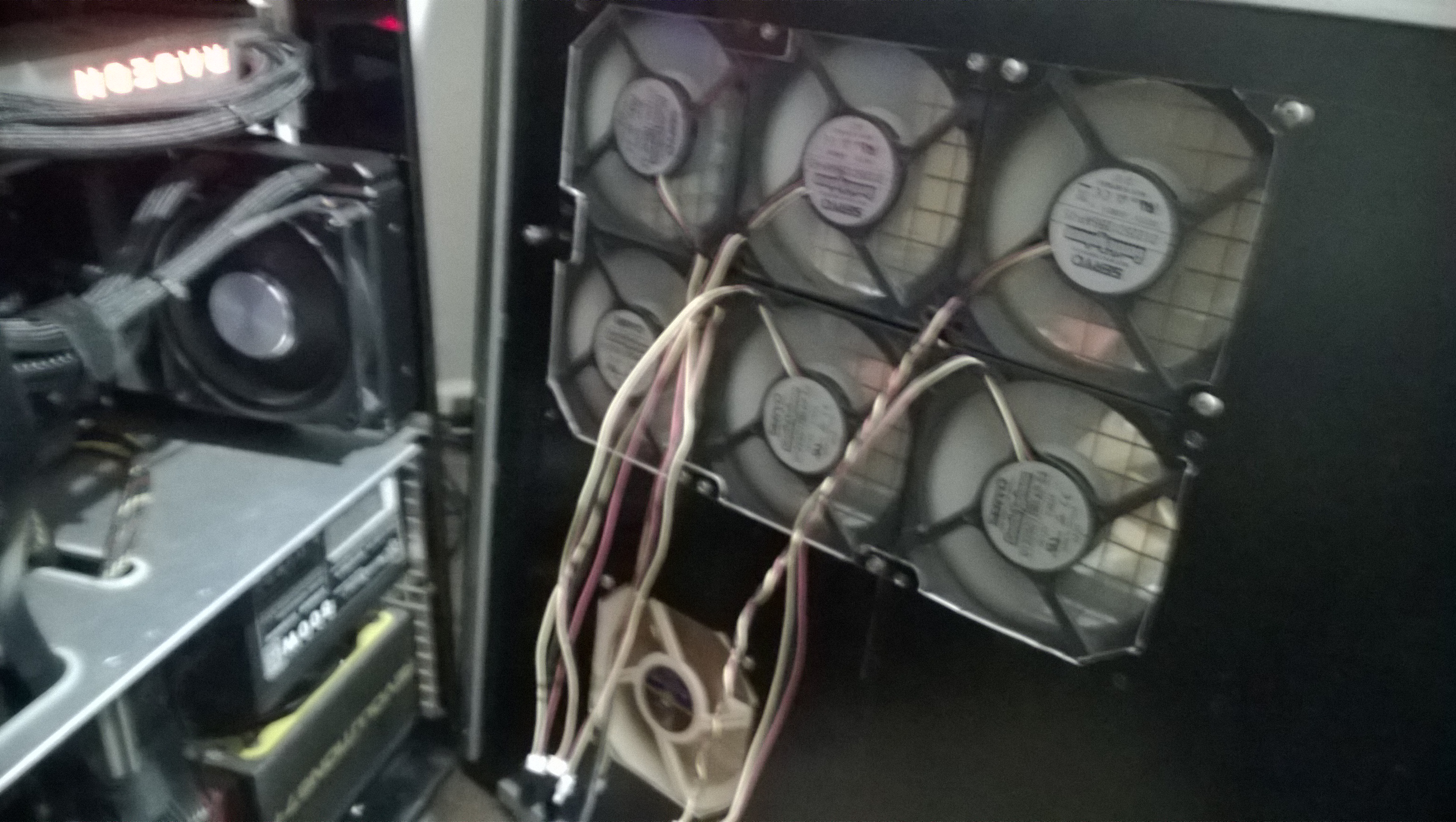
I've literally jury-rigged a Ford Fiesta radiator fan to the side of a PC. Make sure you put a guard on it though as it'll take your fingers off. The noise was no more oppressive than the air conditioning unit in my room but it wasn't for everyone.
 
"I dropped about 20°C just by putting the Superdome on the front of my PC,"

Oh, I didn't know that the side is now called front?
 
Back