This gorgeous fanless RTX 5080 PC turns passive cooling into a thermal nightmare

midian182

Posts: 11,710   +177
Staff member
WTF?! We've seen PC builds that prioritize performance, ones that focus on silence, and those that look like they belong in a cyberpunk art gallery. Billet Labs' latest project falls firmly into the latter – as usual. It's a custom passive water-cooled gaming PC with no fans, lots of copper, and enough heat to make its creator admit the internet might have had a point.
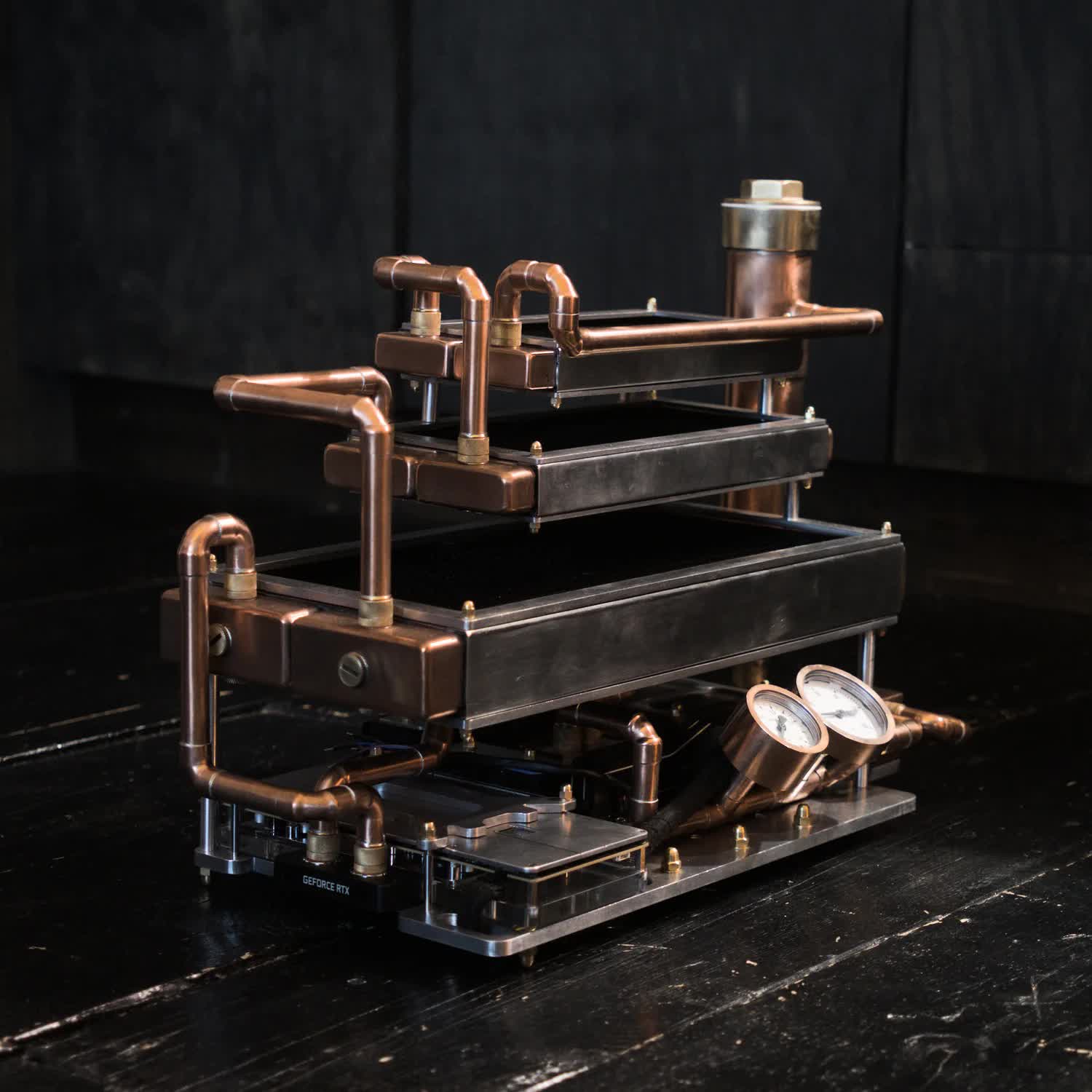
The build comes from Felix at Billet Labs, who set out to answer the question: can you cool more than 500W worth of modern PC hardware without any fans? The internet's usual answer to passive water cooling is that it is pointless and inefficient, but that wasn't going to stop someone who previously turned a century-old cast-iron radiator into a PC cooler.
This new system uses many of the same core parts as that earlier "Raddy" project, including a Ryzen 7 9800X3D, an RTX 5080, a Gigabyte Aorus Pro B850 motherboard, 32GB of RAM, 2TB of storage, and a 600W Flex ATX PSU. Raddy looked amazing, but it weighed around 100kg (220 pounds), needed regular flushing, and was not truly passive as it still had three fans.

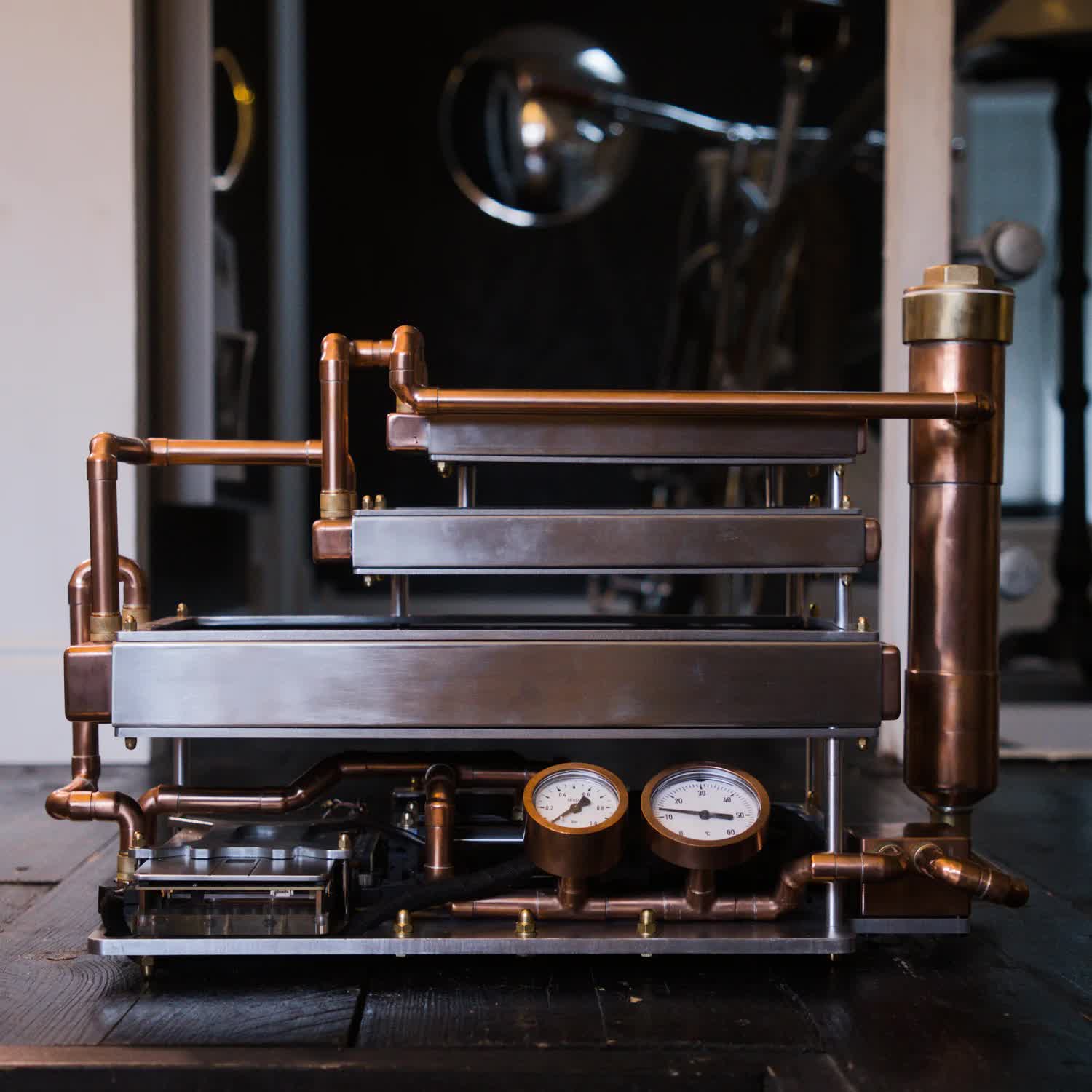
For the new machine, Felix used three radiators: a 120 x 240mm unit, a 140 x 280mm radiator, and a much larger 200 x 400mm model. They were stacked above the components in a tapered tower designed to use the convection chimney effect. Hot air rises through the large lower radiator and continues upward through the smaller ones, theoretically pulling more air through the system without mechanical assistance.

The components sit on an 8mm aluminum base plate, while the loop uses polished copper pipework, brass fittings, a custom reservoir made from 54mm copper pipe, temperature and pressure gauges, and a prototype Billet Labs CPU block.

Felix even tried to turn the motherboard fully fanless by transferring heat through thick thermal pads into the aluminum base.
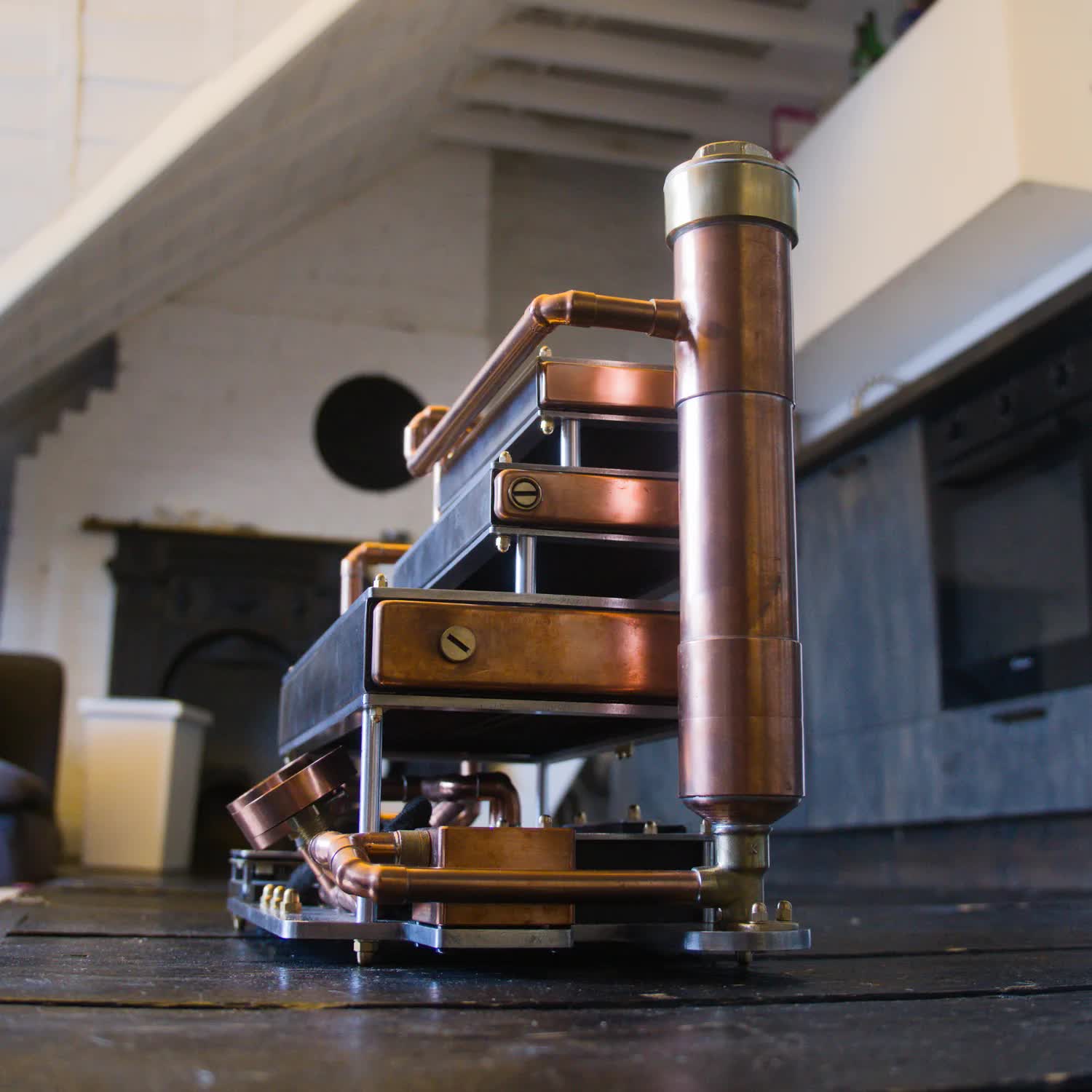
As is often the case with these ambitious custom builds, there were problems. One radiator was ruined when the mounting screws pierced its water channels, forcing Felix to strip and prepare a replacement.

Once assembled, filled, and running, the system was impressively quiet, with the pump becoming the loudest component once the motherboard fan was disabled and the pump speed was adjusted to around 80%.

The thermal testing started well enough. After around 30 minutes of idling, the water temperature settled in the high-20s Celsius, while lighter workloads such as Peggle were not enough to trouble the system. Cinebench was more demanding – after roughly half an hour, coolant temperatures climbed to just under 40C, while the Ryzen 7 9800X3D's cores averaged close to 90C.

Fan-less gaming PC - 5080/9800x3d/32gb/2tb - Yes I'll probably add fans next
by u/Billet_Labs in pcmasterrace

Gaming pushed the passive setup much harder. Halo 3, Clair Obscur: Expedition 33, and Cyberpunk 2077 all showed that the system could run real games without the RTX 5080 throttling, but the CPU was less comfortable, occasionally hitting 95C or more. Cyberpunk 2077 pulled close to 400W from the wall, with the CPU reaching the low-80s and the GPU sitting in the mid-70s.

The worst-case scenario came from running Cinebench and FurMark at the same time. That torture test pushed total system draw beyond 450W, sent coolant temperatures past 60C, and again caused the CPU to throttle. That 60C-plus water temperature is around the maximum rated level for the pump used in the build. The GPU still avoided throttling, though it reportedly reached the low 80s under the heaviest load.
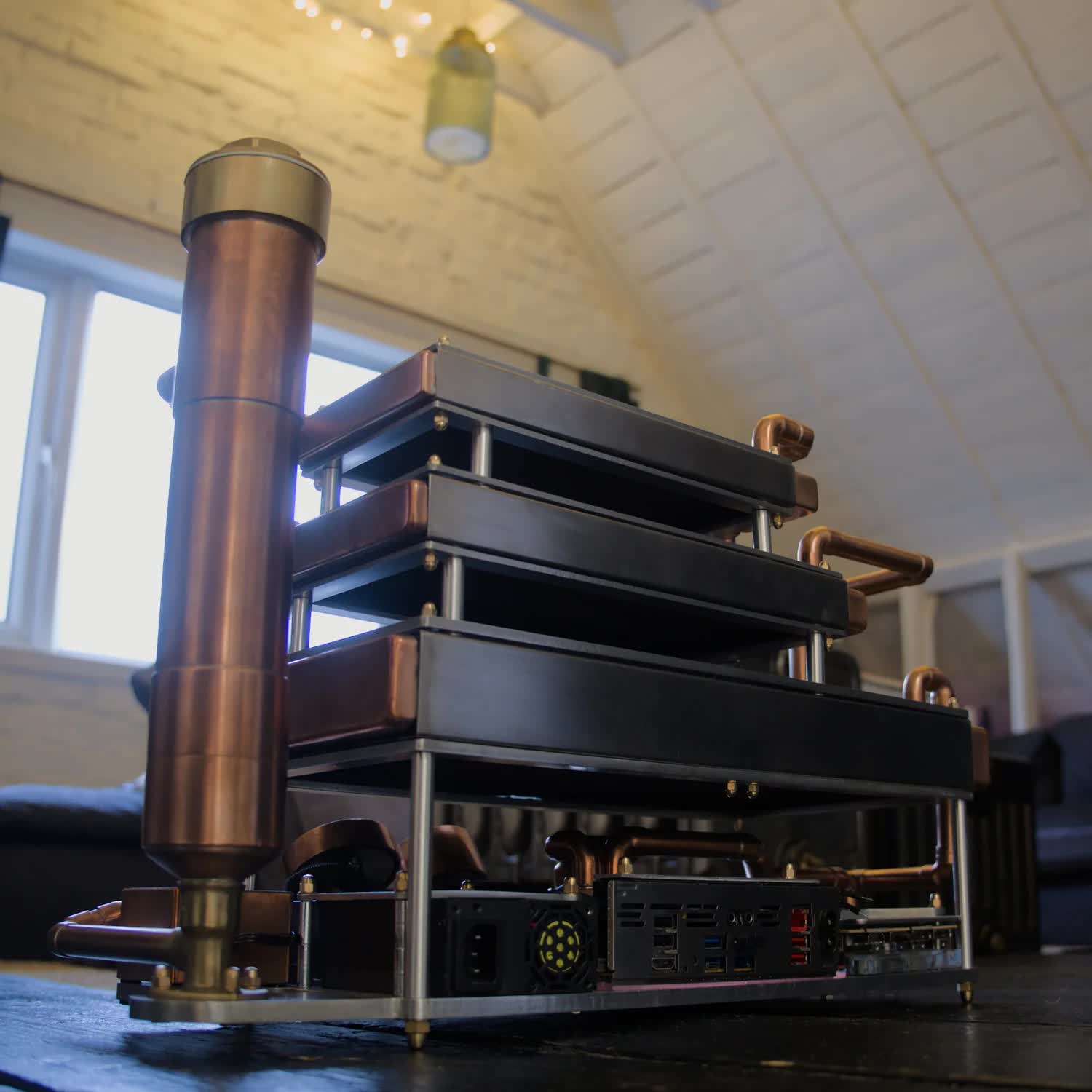
Felix concluded that while the system technically worked, he had "failed to make a passive PC" he would want to use every day. He also suspects the smaller radiators might have hurt performance due to their denser fins, and plans to add a single 120mm fan in a follow-up.

If you're interested in other Billet Labs creations, check out this miniature RTX 4090-powered PC that looks like an old alcohol distillery.

Permalink to story:

 
That is a really weird attempt to make a thermal energy being removed from the system. There is no need for water as water is rather slow in transferring energy from the pipes to the top radiator. Radiators as well have really limited working surface. The cooling is achieved only by delivering the heat asap from the system to the air around. Put there a 5kg of copper fins connected via heatpipes and this will work better than water and radiators designed for fans...
 
That is a really weird attempt to make a thermal energy being removed from the system. There is no need for water as water is rather slow in transferring energy from the pipes to the top radiator. Radiators as well have really limited working surface. The cooling is achieved only by delivering the heat asap from the system to the air around. Put there a 5kg of copper fins connected via heatpipes and this will work better than water and radiators designed for fans...
Its very odd indeed as water has a great specific heat capacity (energy required to raise a given amount of the substance by one degree kelvin / celsius for anyone curious) and can transfer a lot of thermal energy, but it is not a great thermal conductor and it takes a while to dissipate said large amount of transferred thermal energy out of the system, so having a wster based system without fans to help drive a greater thermal gradient and drive out the heat better from it just means it will take longer to overheat and throttle
 
That is a really weird attempt to make a thermal energy being removed from the system. There is no need for water as water is rather slow in transferring energy from the pipes to the top radiator. Radiators as well have really limited working surface. The cooling is achieved only by delivering the heat asap from the system to the air around. Put there a 5kg of copper fins connected via heatpipes and this will work better than water and radiators designed for fans...
Replacing the water with heat pipe material wouldn’t change the bottleneck. 5kg of copper fins wouldn’t necessarily perform better, since copper is denser you’d have less surface area.
 
Replacing the water with heat pipe material wouldn’t change the bottleneck. 5kg of copper fins wouldn’t necessarily perform better, since copper is denser you’d have less surface area.
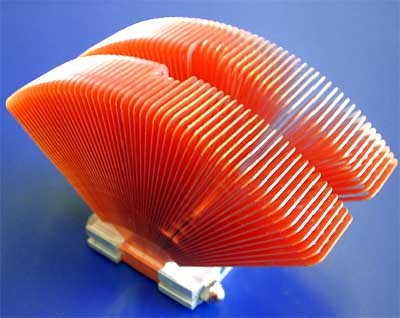
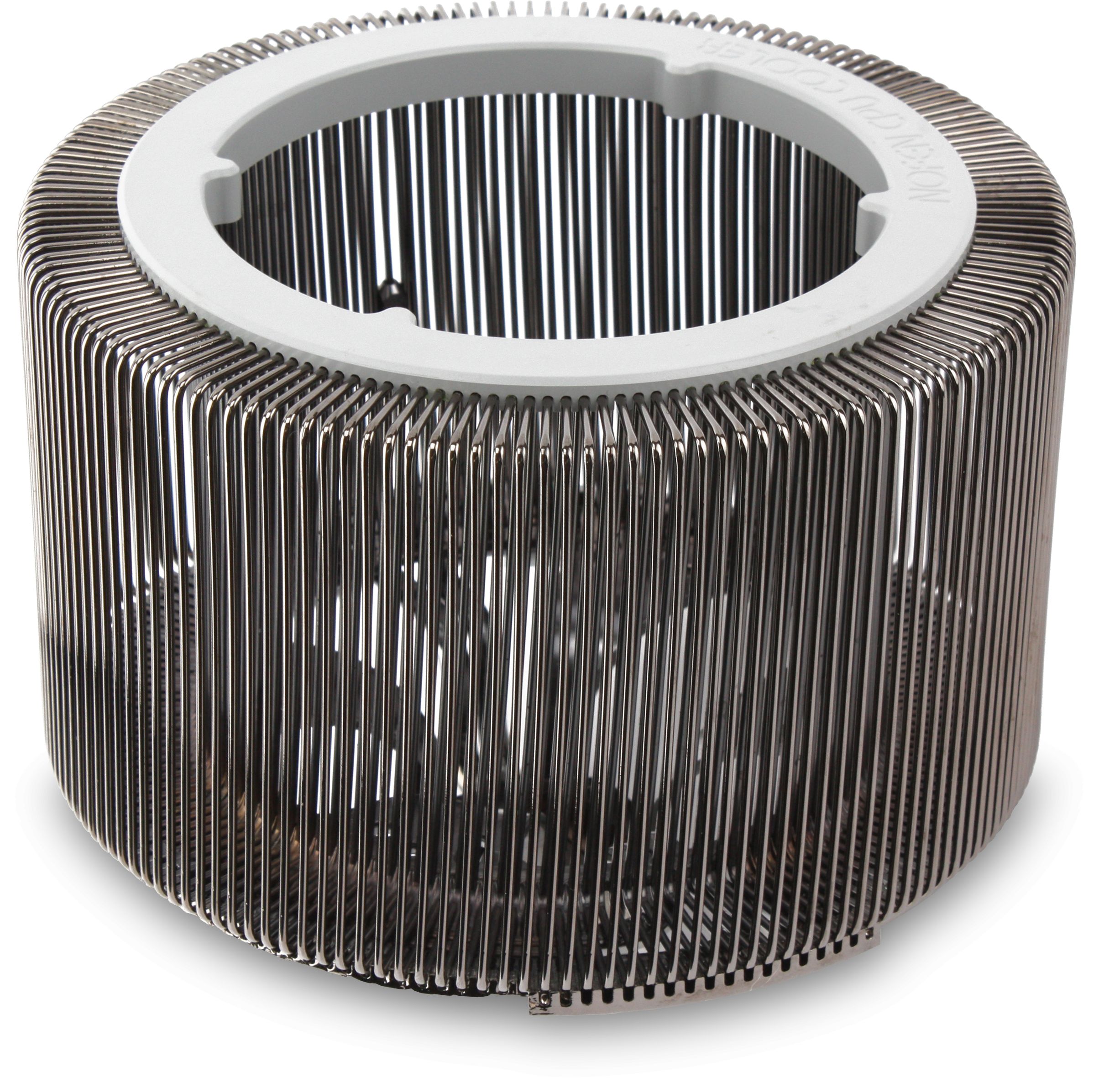
Water thermal capacity, density and conductivity is much less than copper. Density is better for heat conductivity as well. And I specifically wrote 'copper fins' instead of copper block, which will make the surface area dramatically better than those limited radiators. Something like this:
DDfkAzfg7frxdxMPeu9ozD.jpg

or this:
nof-cr-95c-pearl-large.jpg


Create thin, escellent heat coductors with a mass and surface, use the conductive materials (all 5kg of it or whatever calculations will propose) like a pure copper or heat pipes, and in every potential use it will be better than a water and 3 small surface heatsinks and inefficient heat transfer from a metal to liquid twice, and then metal to air.
 
A lot of hassle that a modern water cooling system would handle with ease. Don't understand the avoidance of fans, my system has four large case fans and a tower CPU cooler w/ fan and I rarely hear or notice it. Spent more on copper and additional radiators than a modern cooling system would cost. Too each their own.
 
Is it truly passive if it has a pump?
"Once assembled, filled, and running, the system was impressively quiet, with the pump becoming the loudest component once the motherboard fan was disabled and the pump speed was adjusted to around 80%"

As I began reading, I was wondering if it had a pump or not. It does which makes me wonder why
it still can get so big. I managed to cool both gtx 1080ti and a core i5 CPU with only 2, 120mm, section radiator from Germany, in a full water loop once.
As a result, looking at this "monument," I am surprised to see it getting so hot while it hass an active element that runs water around THREE radiators. We need more info. How powerful is the pump, for example. If it barely pushes water through, that could the bottleneck.

In conclusion, I refuse to call this a passive cooled PC. It is a pump, a pump is not passive.
 
A lot of hassle that a modern water cooling system would handle with ease. Don't understand the avoidance of fans, my system has four large case fans and a tower CPU cooler w/ fan and I rarely hear or notice it. Spent more on copper and additional radiators than a modern cooling system would cost. Too each their own.
I had full waterloops running for years without cleaning. Yet, the fans running provide more than enough of cooling effect. That is one reason for lazy people to have a fully watercooled PCs--you don't need to clean them.
 
Did the article author, or anyone else naysaying, watch that video? My guess is no..
 
The radiators need to be enclosed to allow the chimney/stack effect to draw the air through each radiator and the heat out the top. At the moment all three radiators are prone to air currents in all directions, so heat dissipation is omni directional.
 
The radiators need to be enclosed to allow the chimney/stack effect to draw the air through each radiator and the heat out the top. At the moment all three radiators are prone to air currents in all directions, so heat dissipation is omni directional.
That would likely work. He did conclude himself that the smaller radiators were not optimal and obstructed airflow. If he doubled up on the 200mm x 400mm radiator like he mentioned the whole thing would work much better. He also mentioned installing a silent fan to help, which might work well. There are some good fan options that are very silent and yet push a good amount of air.
 
If the cooling requires moving parts (pump) then by definition it is not passive. Just like you can't be half pregnant, you can't be half-passive, or passive-friendly, or whatever.

I'm all for doing things because you can, but saying you are something you are not is just dishonest. Passive watercooling requires that the water flow happens passively, usually through convective flow (hot water is less dense and rises, cold water sinks).
 
Last edited:
Water thermal capacity, density and conductivity is much less than copper.
Eh? The specific heat (thermal capacity) of water is more than ten times higher than copper on a mass basis, and even on a volumetric basis it's higher, despite copper having a 9:1 density advantage. But the real advantage of water is that, as a fluid it can convect heat rather than simply conduct it.

Copper's thermal conductivity is several hundred times better than water ... which is why an optimal design would passively convect water to copper fins, for transfer to the air.
 
Back