This retro enthusiast forced Windows 11 to run on a Core 2 Quad Q6600 and AGP graphics

Alfonso Maruccia

Posts: 2,583   +972
Staff
Retro Windows: Ancient hardware can be surprisingly resilient against modern software environments. Microsoft has heavily invested in Windows' backward compatibility, and even the troublesome Windows 11 generation appears to follow that same principle, despite its completely reworked system requirements.
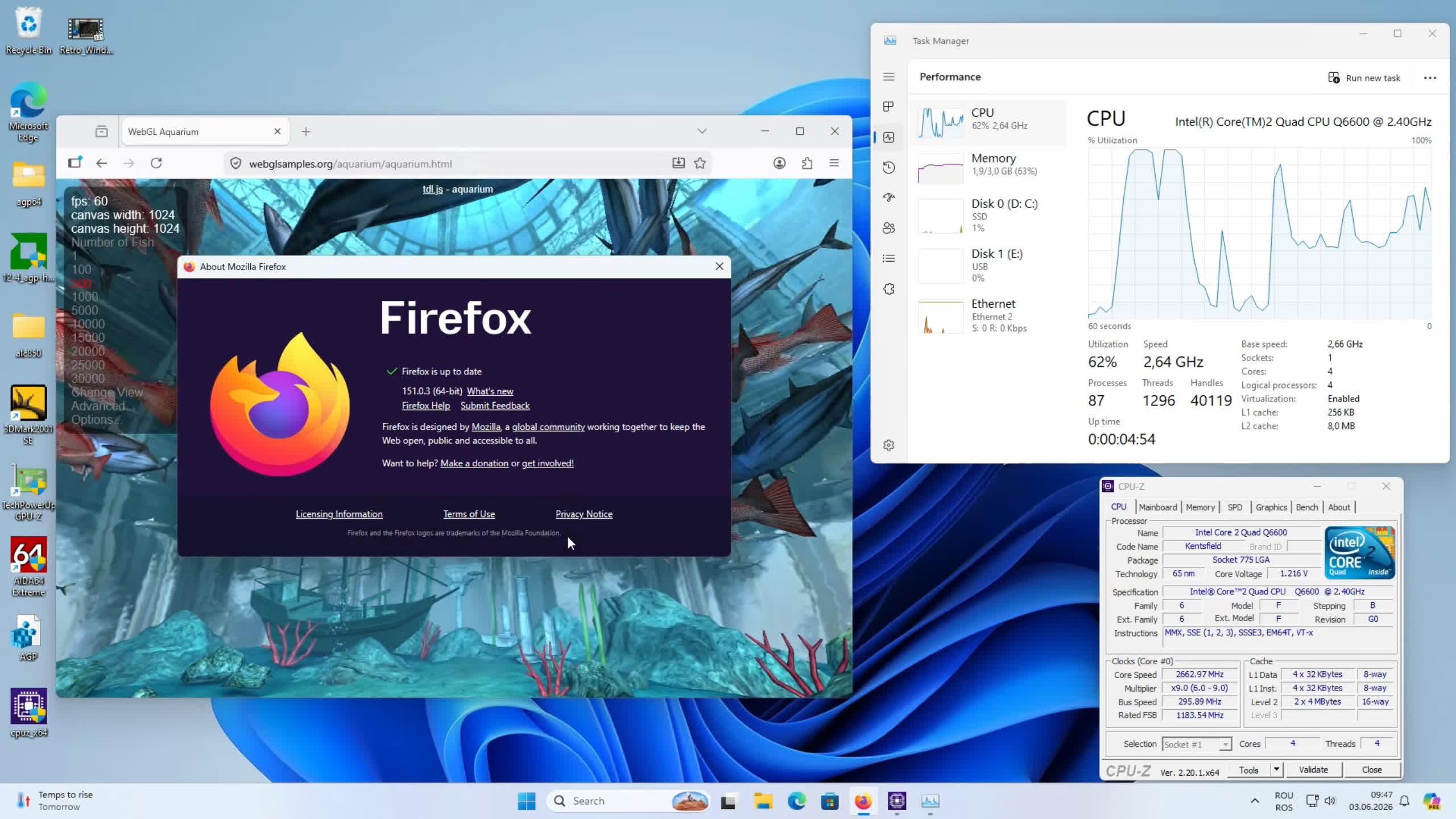
Can Windows 11 run on a 2003 motherboard, an AGP GPU (for those not old enough, that's the slot that predates PCI Express) with no official drivers, and a slightly newer CPU rocking four 65nm cores? A retro-hardware enthusiast named Omores recently proved that it can, even as Microsoft would much rather customers upgrade to the latest genAI machine to get the "best" out of its agent AI-ready operating system.

Omores said he was able to install and run Windows 11 on an Asrock ConRoe865PE motherboard, built around the Intel i865PE chipset that dates back to 2003. The board uses DDR1 memory modules but can also support "legendary" Core 2 Quad CPUs, including the Core 2 Quad Q6600. Released in 2007, the Q6600 packs four "physical" cores running at a 2.4 GHz clock rate.

As it turned out, the motherboard and other basic components weren't the real obstacle in this retro Windows 11 build. The trouble was the GPU: the ConRoe865PE only offers five "classic" PCI slots and a single AGP 8X slot, and Microsoft abandoned AGP support during the Windows 10 era, leaving no straightforward path to loading Windows 11 on AGP-based hardware.

Windows 11 on a DDR1 motherboard, with AGP support enabled
by u/O_MORES in windows

Getting there took a bit of "hacking." Omores tracked down the driver that provided early AGP support in initial Windows 10 builds, pulled it out (Intel's AGP440.sys), and edited the right "inf" file to trick Windows 11 into recognizing the AGP-compatible chipset. From there, he installed a "high-end" AGP GPU, a Radeon HD 4650, using AMD's last 64-bit Windows 7 drivers from 2012 to get the card properly running.

The payoff: Windows 11 recognized everything, ran in a "rock stable" state, and delivered a complete PC environment capable of loading the latest browsers and some "light" gaming from the AGP era. Firefox even leaned on hardware acceleration for H.264 decoding, though the motherboard's 3GB of DDR1 RAM put a hard ceiling on how many tabs could stay open at once.

Despite lacking any UEFI firmware or other modern platform standards, the old motherboard showed that many of Windows 11's backward-compatibility limits are really just "soft" blocks, ones that can be bypassed with enough patience and elbow grease.

Omores stuck with Windows 11 version 23H2 for the build, since 24H2 introduced a "hard" block against CPUs lacking the SSE4.2 instruction set. As far as retro tinkering goes, that's the wall: there's no known tweak, Registry edit, or bypass method that can make truly old PC hardware compatible with the latest editions of Windows 11.

Permalink to story:

 
Despite the demands of coders and corporations, old hardware is still perfectly capable of doing basic tasks. Goes to show how long computers have been "good enough" for non power users.
 
It is a crime to dishonor that classic CPU with legendary AGP card by running the abomination called Win11 on them.
 
Puts proof to M$ lying about requirements of Win11. Makes it an arbitrarily forced spend. Should be good for a class action lawsuit.
 
All clueless or fanboy comments.
11 25H2 requires POPCNT from SSE 4.2 yet either some cheer that they can run "modern" Windows (can't anymore actually), or complain they can't run it in their 18 y/o trash or if Windows doesn't get faster/stable/secure, for example by using said instructions that are now required.
 
11 25H2 requires POPCNT from SSE 4.2 ...
SSE4 is hardly recent. Win11 spec'd requirements are for TPM2.0, standardised in 2022, amongst others. That's new enough to use AVX512 instructions. Besides, the use of any SIMD instructions is entirely an optional choice for M$. Win11 can easily not use them, as it hadn't earlier.

M$ is blatantly running scam.

BTW: What are we meant to be fans of?
 
All clueless or fanboy comments.
11 25H2 requires POPCNT from SSE 4.2 yet either some cheer that they can run "modern" Windows (can't anymore actually), or complain they can't run it in their 18 y/o trash or if Windows doesn't get faster/stable/secure, for example by using said instructions that are now required.
I would guess that Windows can be compiled to target a lower instruction set; or, if POPCNT is being explicitly used, it could be changed at runtime to choose between that and more general code.
 
SSE4 is hardly recent. Win11 spec'd requirements are for TPM2.0, standardised in 2022, amongst others. That's new enough to use AVX512 instructions. Besides, the use of any SIMD instructions is entirely an optional choice for M$. Win11 can easily not use them, as it hadn't earlier.

M$ is blatantly running scam.

BTW: What are we meant to be fans of?
Tpm 2.0 was drafted in 2013 and standardized in 2015.
 
Puts proof to M$ lying about requirements of Win11. Makes it an arbitrarily forced spend. Should be good for a class action lawsuit.

Windows 11 can run on pretty much everything if you do a custom install.
Some of us actually knows how to tweak and do custom Windows installs.

Microsoft does not lie. Stock Windows 11 has security and hardware requirements. Just because you disable these and install anyway, has nothing to do with Microsoft being liars.

You actively turn off the security to make it work on old hardware = Own responsibility, you will loose instantly in court, go ahead (stop being stupid pls)

My tweaked and optimized Windows 11 Pro install, has less shite running in the background than a LTSC version, while not using a subpar build.
 
Last edited:
Maybe Win11 is a more of a different animal than I believed, but I have windows 10 running on a Q6600 with AGP graphics. I don't remember doing anything at all special to get it going. This was years ago and the box is sitting in the attic now, but it worked fine when I put it there. Is 11 that much different from 10?
 
My tweaked and optimized Windows 11 Pro install, has less shite running in the background than a LTSC version, while not using a subpar build.
Builds 26100 and 26200 seem to be from the same codebase; it is just that client 26200 has more features enabled.
 
Which makes the TPM2.0 requirement, for example, a big fat lie.
No, you just downgrade on security, your choice.

If you bypass the TPM 2.0 check, which is easily possible and have been possible since day one, same for CPU requirements, Windows 11 will still install and boot, but you lose Microsoft’s support guarantees and may run into update or compatibility issues later.

Security is downgraded. Many don't care and do it anyway. It's your own decision.

You have exactly 0% chance of winning in court.
 
If the installation process automatically adapted itself, then your argument would have merit.

PS: And I'm talking about basic home edition of Windoze.
 
The q6600 build I had, had a newer mainboard than this that had 2 16x pcie3 slots and 8gb ram.

Ran windows 7 64bit really well.

Really nice 3.2ghz overclock too.
 
What? Why only 3GB? A 32-bit version of Windows runs well with 4GB, taking advantage of almost another half GB. Or 8GB, if the mobo supports it could run a 64-bit Windows, probably creating more difficulties for drivers. Gets me thinking about what I can do with an old Quad Core LGA 775 mobo here, if only I had time to spare.
 
The q6600 build I had, had a newer mainboard than this that had 2 16x pcie3 slots and 8gb ram.

Ran windows 7 64bit really well.

Really nice 3.2ghz overclock too.
The newer mobo handling 8GB makes a lot of difference. And SSD would, too.
 
Back