Tim Berners-Lee urges decentralized web to counter AI exploitation and ad-driven abuse

Alfonso Maruccia

Posts: 2,570   +956
Staff
The big picture: Sir Tim Berners-Lee, the original creator of the World Wide Web, says he hardly recognizes his invention today. The computer scientist is calling for a drastic shift in how people use the internet's most popular information system, warning that the free and open web must be protected from exploitation by AI and private corporations.
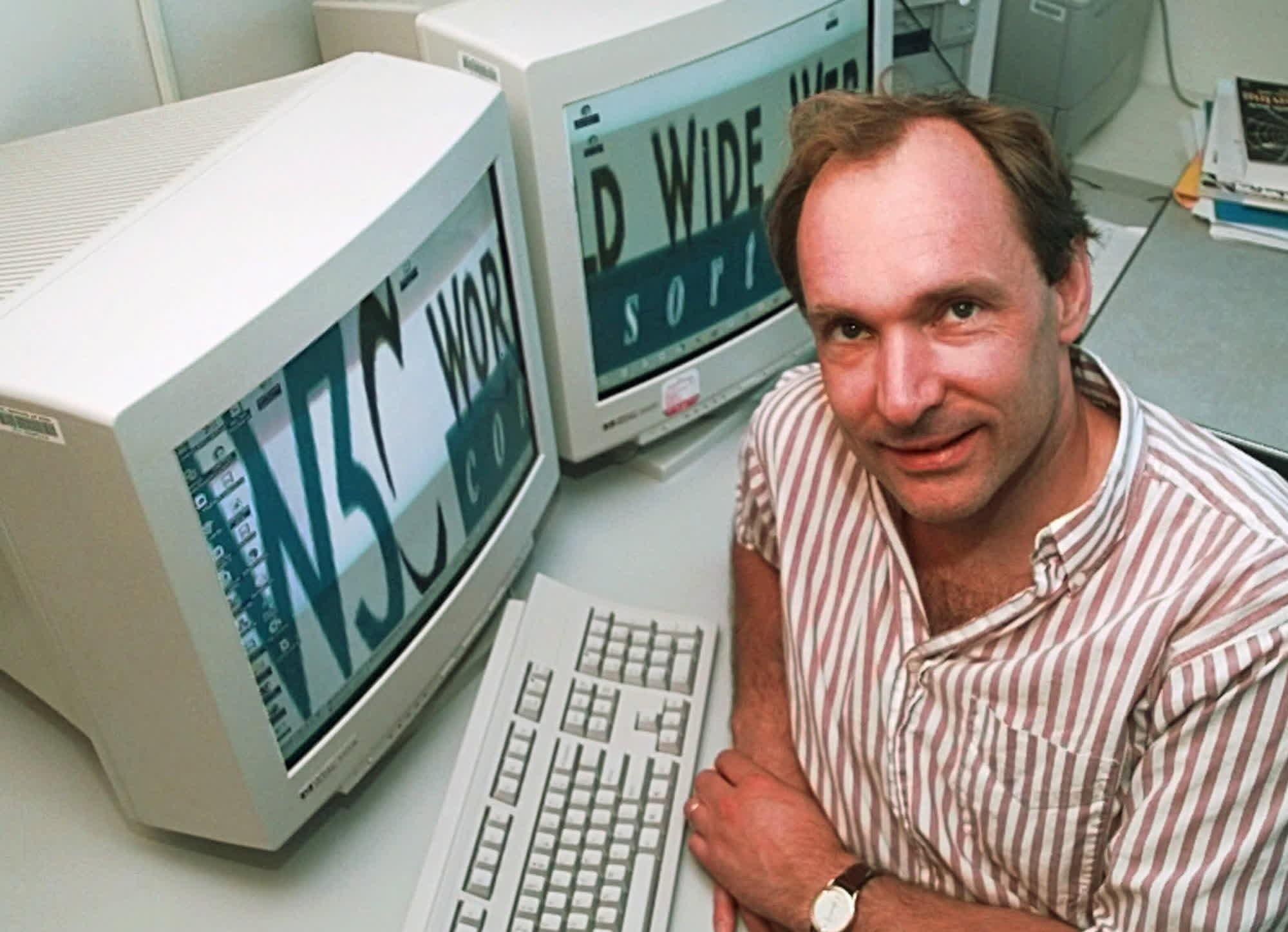
More than 30 years after its creation, the web is a very different place. In a recent op-ed for The Guardian, Tim Berners-Lee warned of the ongoing abuse of a technology he designed to bring people together. He argues that the web now stands at another turning point, and that alternatives to Big Tech exploitation do exist if enough users are willing to embrace them.

Berners-Lee reflected on the web's origins, which he first envisioned as a 34-year-old engineer at the European Organization for Nuclear Research (CERN). At the time, his bosses dismissed the idea as "eccentric," he recalled, but eventually allowed him to pursue it. The web emerged as a fusion of two existing technologies: the internet and hypertext.

"I believed that giving users such a simple way to navigate the internet would unlock creativity and collaboration on a global scale. If you could put anything on it, then after a while, it would have everything on it," Berners-Lee said.

In 1993, he finally convinced CERN to release the web into the public domain. By giving it away freely, Berners-Lee ensured the system could truly function as a global information network connected through hypertext links.

Looking at today's web, Berners-Lee vents his disappointment. Much of the system is no longer free, he argues, with a handful of dominant platforms harvesting user data for sale to commercial brokers or even repressive governments. Algorithms have been engineered to create digital addictions, while harmful content is deliberately inciting violence, spreading misinformation, and undermining social cohesion.

"Somewhere between my original vision for web 1.0 and the rise of social media as part of web 2.0, we took the wrong path," Berners-Lee said.

With the growing dominance of AI services, the web now faces another crossroads. The global community must decide whether AI will serve society or merely enrich a few billionaires until the bitter end. Berners-Lee doubts policymakers will help, pointing out that governments already failed to adapt to the social media revolution.

As an alternative, the scientist is once again promoting Solid, a project he co-developed with a team at MIT more than a decade ago. Solid seeks to decentralize information sharing through peer-to-peer networking, ensuring that individual users retain ownership of their data, with others having to request permission to access it.

Berners-Lee recalled how he first developed the web in a small office on a single CERN computer. CERN itself had been founded in the wake of the second World War, when European governments joined forces to foster major scientific breakthroughs.

By contrast, he noted, it is now almost impossible to imagine a Big Tech company sharing a disruptive invention like the web for the common good. This, he argued, is why the world needs not-for-profit institutions – akin to CERN – to advance international research in AI and other emerging technologies.

"It's not too late," we can still take the web back, Berners-Lee stated.

Permalink to story:

 
This AI everywhere, all the time nonsense is getting troublesome. AI is useful, but it doesn't need to be everywhere. I recently purchased a Google pixel and it is by far the worst user experience I've ever had. I'm sure some people have noticed a drop in the quality of my posts recently. This phone will go back and "correct" things I've written. I don't see auto correct as an issue, but I do see AI autocorrect correcting my posts incorrectly as a problem. It'll change my formatting, remove things like commas and apostrophes and there is no way to turn it off.

I was talking with someone at work about this who is apple user and I was considering switching echo systems and she said many of the things I was complaining about have also started happening to her on her iPhone so I don't know where to go
 
You mean Al Gore didn’t create the Internet? /s. DARPA created the internet, much like Lifelog because Facebook, on the same day, no less.

I’m all for the decentralized web, but until it ceases to operate on centralized ISPs, DHCP, and HTTP protocols we’d pretty much have to build it from scratch.
 
We do need a decentralized net before the megacorps and governments take full control of the centralized web.
I'm fairly certain we have one called tor, I even have one of my servers hosting a node. I'm sure that's not what he meant, but we do have a decentralized net if the need ever truly arises
 
Tech companies are screeching for ROI at the moment and not seeing enough of anything come back. I've just been eating popcorn while I watch them inflate this giant bubble. Should be a good show.
 
We do need a decentralized net before the megacorps and governments take full control of the centralized web.
It sounds like a noble goal, but it ignores why the web became so centralized in the first place. As the modern web has become more complex and people move to platforms instead of coding their entire site from scratch, that naturally leads to more centralization.

Like, you could host your own public facing webserver today, that you access via IP address from a browser. You can effectively make a BBS that runs on the clearnet. Nobody could find it, of course, without those centralized resources, but nothing is stopping you from hosting a web 1.0 style site today. Except for security. And payment if you want to make any money off of it or facilitate any type of transaction. Only a true coding savant can make a new system from scratch, and using any premade templates or platforms means you give up your "decentralization" dream.
I'm fairly certain we have one called tor, I even have one of my servers hosting a node. I'm sure that's not what he meant, but we do have a decentralized net if the need ever truly arises
Tor works but has major issues with discoverability compared to the clearnet. Of course, if you ever developed a Google for Tor, it would just become centralized around said Google clone and whomever maintains it.
 
It sounds like a noble goal, but it ignores why the web became so centralized in the first place. As the modern web has become more complex and people move to platforms instead of coding their entire site from scratch, that naturally leads to more centralization.

Like, you could host your own public facing webserver today, that you access via IP address from a browser. You can effectively make a BBS that runs on the clearnet. Nobody could find it, of course, without those centralized resources, but nothing is stopping you from hosting a web 1.0 style site today. Except for security. And payment if you want to make any money off of it or facilitate any type of transaction. Only a true coding savant can make a new system from scratch, and using any premade templates or platforms means you give up your "decentralization" dream.
There is already a decentralized web out there. It exists. It just isn't mainstream.
 
Back