US PC market slipped in the second quarter despite continued upgrade push

Alfonso Maruccia

Posts: 2,571   +956
Staff
TL;DR: Despite Microsoft's efforts to refresh the PC market by setting a final deadline for Windows 10 support, customers aren't rushing to upgrade or purchase new systems. Pre-tariff inventory has already been depleted, and many consumers are prioritizing essential expenses before investing in additional computer hardware.
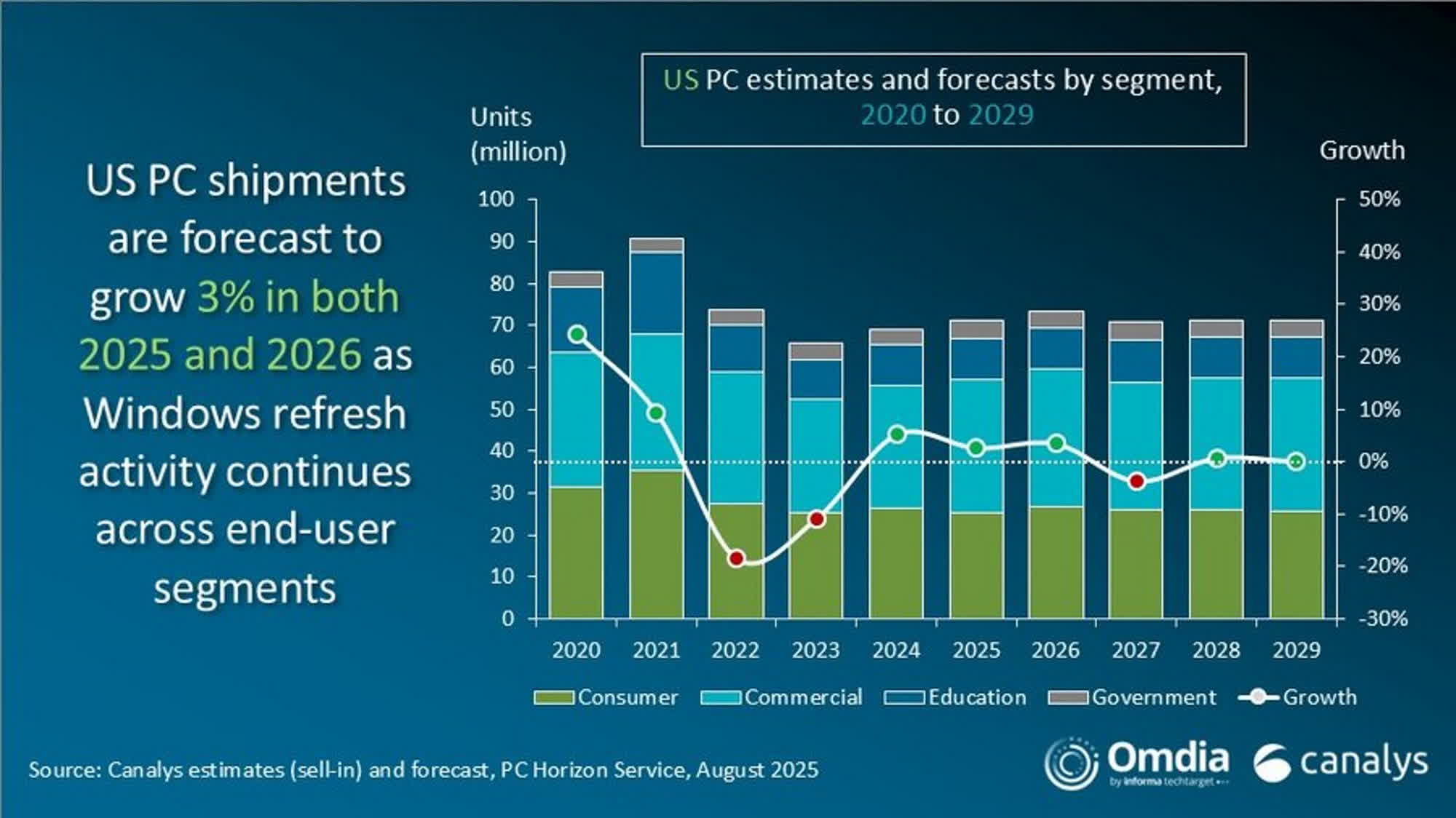
As Canalys predicted a few months ago, the US PC market has entered a new stagnant phase. In the second quarter of 2025, PC shipments fell 1.4 percent year-over-year to 18.6 million units. Despite the slowdown, the market research firm still forecasts "modest" growth in the PC business over the next couple of years.

According to Canalys, the "muted" performance in Q2 was partly due to unusually high inventory levels earlier this year. Many companies rushed to acquire computer hardware in anticipation of import tariffs introduced by the Trump administration, limiting the impact on their supply chains.

The commercial and enterprise segment grew four percent in Q2 but the consumer market stagnated. Meanwhile, Microsoft and OEM partners are actively reminding customers that Windows 10 PCs will soon become "obsolete." Analysts expect the transition to Windows 11 to drive PC shipments up by three percent in both 2025 and 2026.
PC manufacturers are putting a strong emphasis on AI-capable systems as part of the Windows 11 upgrade cycle. Enterprise and business adoption of AI solutions has more than doubled over the past two years, including a 50 percent increase this year alone. However, the growth rate is already slowing, as many organizations still struggle to find practical, large-scale applications for AI beyond experimental pilot programs.

"As businesses begin to encounter problems with integrating AI into workflows, AI-capable PC vendors must demonstrate the value-add their devices could bring," Canalys analyst Greg Davis explained.

Economic conditions also remain a major factor. Davis noted that Trump's tariffs and other recent policy changes will "likely" affect both enterprise and consumer spending through the end of the year. Inflation, weaker-than-expected job reports, and other domestic pressures will further limit the disposable income available for electronics and computing purchases.

Canalys added that the looming end of Windows 10 support may not significantly improve market conditions either. Most consumers are expected to continue using their older PCs until the hardware fails or performance drops below what is tolerable for everyday tasks.

Permalink to story:

 
I think the biggest factor is the lack of need for better hardware outside of gaming. Old PCs can effectively do what is needed for the vast majority of users. Email, web browsing, streaming video, the only reason they need to upgrade is this superficial windows 11 requirement. Then again, Linux is a viable switch for some of us.
 
People aren't interested in localized AI. Sure, you can install a local AI model on your PC if you know what you're doing, but you aren't going to suddenly have a billion people installing their own AI from GitHub just because everyone is pushing "AI hardware".

Further, for arguing with strangers on the Internet and watching YouTube, a 10yr old PC is fine, which is what MOST people do.

For 99% of people, a PC is a way to use a browser to access the Internet.
 
Most people already upgraded.

There's fear mongering over unsupported PCs, but the oldest PCs that are fully supported are 8 years old, and most tech guys can make stuff as old as sandy bridge run 11 without issue. A LOT of people also bought new PCs during *unspecified virus of unknown origin* so the market is saturated.

Those how are still using even older windows 7 era hardware are unlikely to buy another PC, most I know buy ipads or just use their phones and keep the old PC to write one word document per year.
 
Most people already upgraded.

There's fear mongering over unsupported PCs, but the oldest PCs that are fully supported are 8 years old, and most tech guys can make stuff as old as sandy bridge run 11 without issue. A LOT of people also bought new PCs during *unspecified virus of unknown origin* so the market is saturated.

Those how are still using even older windows 7 era hardware are unlikely to buy another PC, most I know buy ipads or just use their phones and keep the old PC to write one word document per year.
Windows 7 actually dropped pretty quick when windows 10 was released because, at the time, windows 10 was actually a really good OS,. especially compared to 8.1 which noone talks about.

We're no longer in an era of where everyday computing sees an upgrade every few years. We kinda platued in our performance needs right around when windows 10 came out. Old hardware can easily meet the requirements of people who all they do is stream video and browse social media.

There are numerous reasons to be unhappy about it, but enough people want to upgrade and can't for a single hardware requirements that's already been cracked. People are looking at it saying "my hardware is fine, you're shits already been cracked, why are you forcing me to upgrade my hardware?"
 
Back