Valve's Steam Frame could launch any day now, and it might cost $1,200

Daniel Sims

Posts: 2,529   +76
Staff
What we know so far: Data mining and recently leaked videos suggest that Valve might release its standalone VR headset any day now. One VR game is already set to launch alongside the device, but memory shortages and an impending Snapdragon price hike could leave the Steam Frame with a shocking price tag.
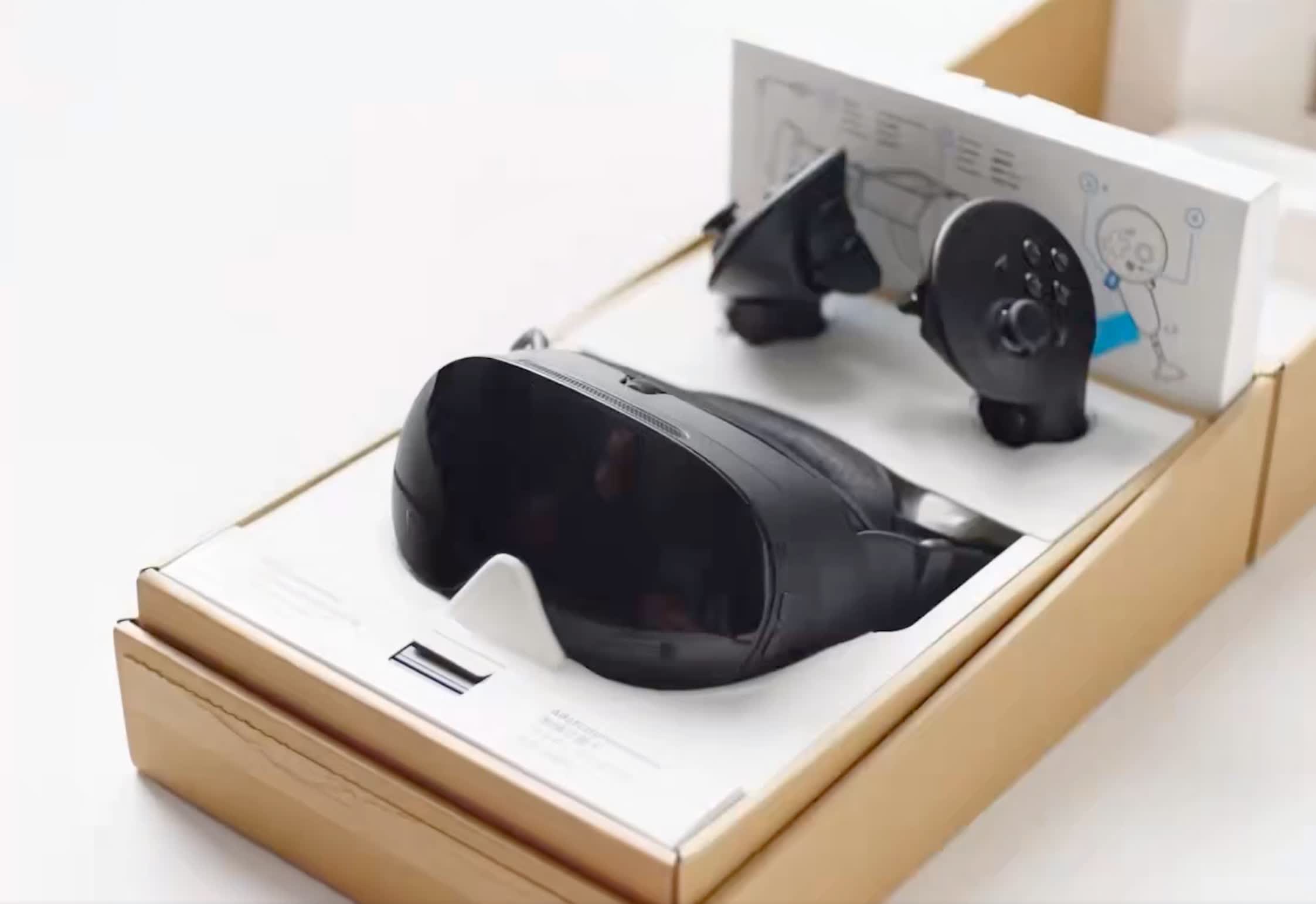
An X account covering Valve hardware recently shared several leaked videos showing the company's official instructions for using the Steam Frame. The unboxing guide and numerous other details uncovered over the past few weeks suggest that the standalone VR headset's release is fast approaching.

The brief clips walk users through the initial setup steps, including charging the device, booting it up, connecting it to a PC, adjusting the head strap, and logging into Steam. The headset ships with split wireless controllers, a vision guard, a wireless adapter, and a USB-C cable. A prior rumor claimed that an enthusiast package also includes a hot-swappable battery.

Valve's guides also show off a few unique hardware details. For example, the wireless adapter can connect to the Steam Frame using its proprietary wireless signal, a Wi-Fi network, or both simultaneously to maximize bandwidth. Meanwhile, the easiest way to sign in to Steam on the VR headset is to click "Add an Account" on SteamVR's main page, then tap "Sign into a Steam Frame" while logged into the Steam mobile app. The app can also scan a QR code displayed on the headset lens.

Featuring 2,160 x 2,160-pixel LCD displays and a 144Hz refresh rate, the standalone headset supports PC games, both VR and non-VR, without needing to connect to a standard PC, similar to the Steam Deck. Still, Valve recommends streaming more demanding games from a PC. Also like the Steam Deck, the Steam Frame is not limited to Steam games, allowing users to access PC software and potentially Android apps via multiple compatibility layers.

The company released its Lepton and FEX layers earlier this month to enhance compatibility across PCs, the Steam Frame, and, eventually, mobile devices. While Lepton runs Android apps on Linux distros, FEX translates x86 code for Arm processors, and Proton runs Windows code on Linux.

Despite delays due to industry-wide RAM shortages, Valve pledged to release the Steam Frame this year but has not provided further details. Keen-eyed observers have reported on shipments of the device to Valve's warehouses and FCC approval over the past few weeks, suggesting its launch is imminent.

Furthermore, the developer of the recently unveiled standalone edition of Gunman Contracts claimed that the Steam Frame is "around the corner." The shooter, originally a Half-Life: Alyx mod, will be available on launch day.

The Steam Frame's price is likely the most concerning detail yet to be announced. Early estimates landed around $1,100 or $1,200, roughly double the cost of the Meta Quest 3, but a planned September price hike impacting the headset's Qualcomm Snapdragon processor could push the MSRP higher.

Permalink to story:

 
I've never looked into how modern VR headsets actually work. Given the rather insane resolution, in the spec, that the eye can't possibly perceive in a single frame ... but since the eye can pivot the total resolution has to be spread out well beyond a single view. Now that immediately poses the idea that not all the VR display needs to be rendered to at any one time, or at least not all of it at high quality. Only where the eye is looking needs full quality rendering ... so do these headsets have internal eye trackers then?
 

I've never looked into how modern VR headsets actually work. Given the rather insane resolution, in the spec, that the eye can't possibly perceive in a single frame ... but since the eye can pivot the total resolution has to be spread out well beyond a single view. Now that immediately poses the idea that not all the VR display needs to be rendered to at any one time, or at least not all of it at high quality. Only where the eye is looking needs full quality rendering ... so do these headsets have internal eye trackers then?
The technology term is "foveated rendering" - rendering in high fidelity only where the eyes is looking and the display around it rendered in decreasing fidelity. But I can't answer your question if the steam frame has this. Honestly, I didn't even know Steam had a next gen HMD coming.
 
Another $1,200 VR headset with no games to play.

VR folks keep telling us the VR revolution is here... but always tomorrow.
My friend has a VR headset and he plays games sitting down with a controller. That kind of appeals to me and is cool, but he has mod regular games and edit files to get it to work as more of a 3D display. VR seems dumb but the 3D display thing was cool. I only got to play Skyrim and Doom with his setup.
 
Another $1,200 VR headset with no games to play.

VR folks keep telling us the VR revolution is here... but always tomorrow.
If they can retrofit everything in your library then gamers will likely show interest imo. Unfortunately it relies on 3rd party apps and implementation is weak at best from what I've seen. Even Vermintide 2 has a vr standalone, but it failed because it seems boring as fudge compared to base game that some gamers including myself has 1000s of hours playing.

One alternative currently on Kickstarter is trying to get steam VR support with its ar glasses is urxr 2440 x 2064p per eye @ 90 hz microoled pancake lenses glasses.
The whole thing looks light and has 6 way tracking without the need of peripherals. Also costs fraction of the price. FYI.

URXR One: Lightweight Spatial Display Glasses by Unseen Reality » URXR One: Lightweight Spatial Display Glasses by Unseen Reality — Kickstarter https://share.google/oP7SieUTiz8XeImTx
1000075266.png
 
Last edited:
I think people are being a bit negative. I was an early adopter of the HTC Vive. I later bought an Index. I even bought an Oculus Rift. I partly bought a PS5 because I was considering their VR device as well. I was really into VR. During the pandemic I spent an hour each day playing bootleg Beat Saber maps and playing this Fortnite ripoff - Population: ONE. I lost interest partly because the devices were not really evolving. I made a very clear decision to not buy any more devices until the next Steam VR device. I was looking for something that could connect to a PC wirelessly and did not need lightboxes and could be played like an Oculus. I wanted more comfort and a more stable device - Both the Vive and Index could be a bit buggy. I wanted better lenses and I wanted to be able to either wear my glass underneath or get fit lenses with my prescription.

The issue with games is valid, but if I can wear these for a long period of time and the overall experience is better I will gladly give up the 65 inch TV I use as a monitor. The thing about good VR games is that they are replayable. I loved jumping on to a game of Populatrion One, but the game developers ruined their own game.

As a for newer games... I suspect many game developers have also been waiting for the next gen devices. Sony deciding to kill physical games for the PlayStation and possibly the device itself just opens the possibility up for VR even more. Sure, you are still buying digital games, but I trust Steam way more than Sony...
 
Back