Yann LeCun says xAI is "kind of a failure" – and the whole AI industry might be headed for a reset

Skye Jacobs

Posts: 2,012   +59
Staff
Big quote: Yann LeCun isn't buying the current AI boom – or at least not the way it's unfolding. In a recent interview with CNBC, one of the "Godfathers of AI" and AMI Labs founder took aim at both the business model and the underlying technology of today's leading AI companies, suggesting the industry could be headed for a correction. Along the way, he singled out Elon Musk's xAI as a company facing particular trouble.

LeCun, who previously served as Meta's chief AI scientist, didn't mince words. "xAI is kind of a failure, frankly, because the founding team has" departed, he said, pointing to a steady stream of exits over the past year. Several co-founders have left the company since it launched, leaving open questions about how xAI maintains momentum in an increasingly crowded talent market.

That turnover, he argued, will make it harder for Musk to rebuild. "Elon is now in a position that is very, very difficult for him to kind of hire top people in AI, because he's kind of, you know, not behaved in sort of very good ways toward the ... previous team," LeCun said.

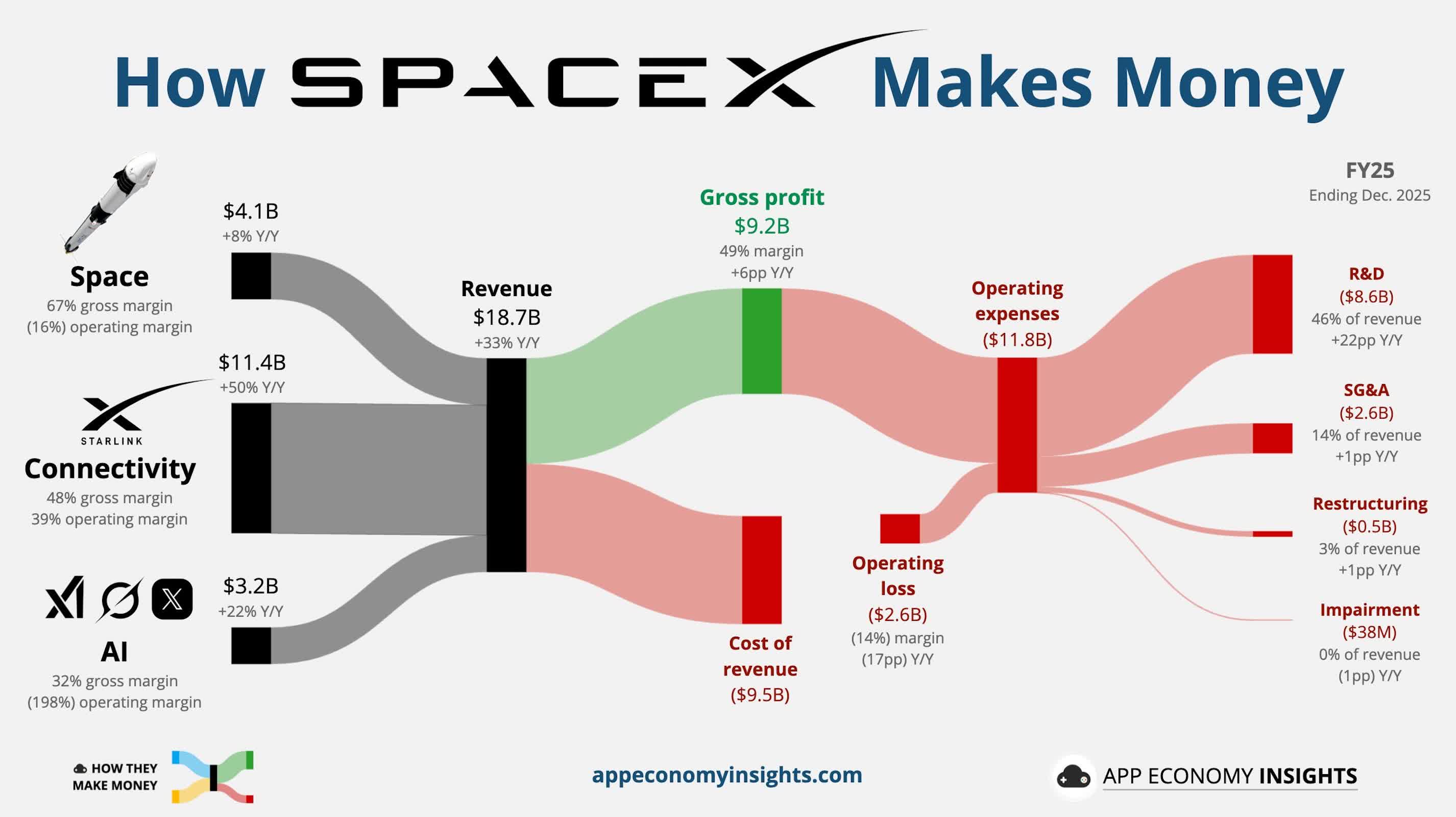
The criticism lands even as xAI has scaled aggressively. Earlier this year, Musk merged the company with SpaceX in a deal that valued the combined operation at $1.25 trillion. Central to that strategy has been heavy investment in computing infrastructure, including the Colossus 1 and Colossus 2 data centers in Memphis. The facilities were built to support large-scale AI training, but they're increasingly doing double duty as a revenue source.

LeCun pointed to that shift as telling. xAI has "huge infrastructure" that it rents out to other companies, he said, "because that's the only way he [Musk] can recoup the cost." Google and Anthropic have both tapped into that capacity – a sign of just how expensive, and in demand, AI compute has become.
Credit: App Economy Insights

Still, the financial strain is hard to miss. In the first quarter, SpaceX's AI segment, which includes xAI, posted a $2.5 billion operating loss. That kind of deficit isn't unique to xAI, but it points to a broader problem: the cost of building and running advanced AI systems remains extremely high, even as companies race to deploy them.

LeCun believes that imbalance is becoming harder to ignore. "The prices are going up of those AI services, but the cost of running them is going down, but not nearly fast enough. And so all of those companies are losing money, and basically, the use for most people is funded by the investors. That can't go on for a very long right?" he said.

If that dynamic continues, he expects a reckoning. "Labs like OpenAI and Anthropic are going to have to increase prices, they're going to have to cut costs, or there's going to be a big bubble explosion."

Beyond the financial concerns, LeCun's critique cuts to the core of how AI is built today. Most leading systems rely on large language models, which excel at generating text and handling tasks like coding and structured reasoning. But he argues the approach has limits – especially when it comes to building systems that can reliably operate in the real world.

His alternative is what he calls "world models," systems designed to understand how environments actually function: capturing cause and effect, physical interactions, and context in a more grounded way. "I personally don't think we're going to have generalized reliable agentic systems until they're based on world models," he said.

That puts him somewhat at odds with the current direction of the industry, where companies like OpenAI and Anthropic are pushing toward more capable AI agents built on LLM foundations. LeCun doesn't dismiss those systems outright, but he questions whether they can scale economically. He says that the expense of operating these high-performing systems remains far above what users are generally willing to pay.

AMI Labs is betting on the alternative path. The company raised about $1.03 billion earlier this year at a reported $3.5 billion pre-money valuation, with a focus on building world model-based systems.

For now, demand for AI systems and infrastructure remains strong. But LeCun's comments reflect a growing unease among some insiders – not just about who wins, but whether the current model of building and funding AI is sustainable at all.

Permalink to story:

 
Demand is artificially strong. It's being used by most consumers because it's free and there is no paywall. Employers, in some cases, are being forced to use it even if it doesn't make sense for their application. Companies are putting AI in everything even if it doesn't make sense and Companies are trying, and failing, to replace employees with AI to increase their numbers.

AI is useful, but the whole AI, everywhere, all the time thing doesn't make sense. Once we have to start paying the real costs to use AI we are going to start seeing a lot less of it.
 
Demand is artificially strong. It's being used by most consumers because it's free and there is no paywall. Employers, in some cases, are being forced to use it even if it doesn't make sense for their application. Companies are putting AI in everything even if it doesn't make sense and Companies are trying, and failing, to replace employees with AI to increase their numbers.

AI is useful, but the whole AI, everywhere, all the time thing doesn't make sense. Once we have to start paying the real costs to use AI we are going to start seeing a lot less of it.
That’s where Anthropic is different. They actually have a $50B/year revenue run rate. People actually get work done with Claude. And Anthropic doesn’t own or build most/all of its data centers. That puts whoever Anthropic pays for hosting in a great position.
 
That’s where Anthropic is different. They actually have a $50B/year revenue run rate. People actually get work done with Claude. And Anthropic doesn’t own or build most/all of its data centers. That puts whoever Anthropic pays for hosting in a great position.
The data centers are where the problem is. The data centers are being subsidized with investor money(and the residentsnear them). Claude is going to skyrocket in price once the cloud services they use to power it start to need to charge the real cost of time on their servers. If it was cheaper to build a data center than rent it, they would and have the resources to do that. I'm not saying Claude is bad, but there is no AI business model that doesn't currently have a weak link.
 
Once we have to start paying the real costs to use AI we are going to start seeing a lot less of it.
The AI bubble needs to pop sooner or later.

IMO this perspective only holds true when limiting the scope of AI to consumer-facing (B2C/B2B) applications, where free tiers and subscription models create unstable revenue loops.

The real economic AI shift is happening away from public view in asset-heavy medical, industrial, and infrastructure automation. In those sectors, capital is being permanently converted into proprietary datasets, custom operating systems, and physical infrastructure. Even if the consumer software hype faces a correction, the underlying technology is solidifying into a permanent industrial foundation that will be capable of handling projects too ambitious for traditional human labor alone (e.g. speeding up or taking on projects that would otherwise be considered too large to reasonably accomplish). The "bubble,” if it pops, will be localized to consumer software; the core utility is structural.

Additionally, on the B2C/B2B side, a market correction I think would likely mirror the dotcom era—a temporary reset before companies figure out how to make it profitable. Regardless, the tech is here and it’s not going away.
 
IMO this perspective only holds true when limiting the scope of AI to consumer-facing (B2C/B2B) applications, where free tiers and subscription models create unstable revenue loops.

The real economic AI shift is happening away from public view in asset-heavy medical, industrial, and infrastructure automation. In those sectors, capital is being permanently converted into proprietary datasets, custom operating systems, and physical infrastructure. Even if the consumer software hype faces a correction, the underlying technology is solidifying into a permanent industrial foundation that will be capable of handling projects too ambitious for traditional human labor alone (e.g. speeding up or taking on projects that would otherwise be considered too large to reasonably accomplish). The "bubble,” if it pops, will be localized to consumer software; the core utility is structural.

Additionally, on the B2C/B2B side, a market correction I think would likely mirror the dotcom era—a temporary reset before companies figure out how to make it profitable. Regardless, the tech is here and it’s not going away.
I'm not saying AI is useless, or should go away, AI has its uses and isn't anything new in the medical industry or for automation.
The consumer facing AI hype, with AI being shoved into anything and everything isn't sustainable, the amount of datacenters being built doesn't seem to be either with at least half of them sitting empty.
When the bubble pops companies will have to figure out how to make it more useful than regurgitated search term answers or hallucinated results.
 
IMO this perspective only holds true when limiting the scope of AI to consumer-facing (B2C/B2B) applications, where free tiers and subscription models create unstable revenue loops.

The real economic AI shift is happening away from public view in asset-heavy medical, industrial, and infrastructure automation. In those sectors, capital is being permanently converted into proprietary datasets, custom operating systems, and physical infrastructure. Even if the consumer software hype faces a correction, the underlying technology is solidifying into a permanent industrial foundation that will be capable of handling projects too ambitious for traditional human labor alone (e.g. speeding up or taking on projects that would otherwise be considered too large to reasonably accomplish). The "bubble,” if it pops, will be localized to consumer software; the core utility is structural.

Additionally, on the B2C/B2B side, a market correction I think would likely mirror the dotcom era—a temporary reset before companies figure out how to make it profitable. Regardless, the tech is here and it’s not going away.
I understand that AI is being used in places where we can't see it, but I stand by my opinion that the "AI, everywhere, all the time" business model is unsustainable. Even if the industries you mentioned have permanently allocated funds to AI, those industries are still dependent on "cheap AI". Those funds aren't going to go as far, they won't be able to apply it as liberally as they have been.

I AM NOT saying that AI is going away, but we are still in the "customer acquisition" phase of AI. The profitable companies depend on cheap AI to be profitable and data centers depend on investors, loans, tax breaks and consumer subsidies to be cheap.

The business models of AI data centers is so fundamentally flawed that I honestly believe that when the era of cheap AI comes to an end, companies that depend it will have a mainframe like model and they pay a software like license to run models locally. Once a model is trained, they don't require many resources run relative to training. A hospital could have a rack or a couple racks full of dedicated AI hardware and it would be cheaper than the real costs that we currently aren't experiencing. Further, cloud AI hasn't solve the privacy concerns that many industries will require. We are likely under utilizing AI in the medical industry because cloud AI violates HIPPA privacy laws
 
If they can afford the cost of human QC on the results in addition to the computing costs without losing solvency throughout the volatility of the maturation cycle. The cost is precision and reliability in every instance. Research is fuzzy. Accounting is not.
 
LLMs are a ludicrous way to fake a parlour-trick form of intelligence. The energy and environmental cost to create these models and run them at the speeds required to produce results in good time are eye-watering. The models don't really have any true 'understanding' of what you ask they will always hallucinate periodically. Its such a dead end. I feel in the last couple of months it has really started to reach a tipping point. It's so over-inflated now the end is inevitable soon...
 
LLMs are a ludicrous way to fake a parlour-trick form of intelligence. The energy and environmental cost to create these models and run them at the speeds required to produce results in good time are eye-watering. The models don't really have any true 'understanding' of what you ask they will always hallucinate periodically. Its such a dead end. I feel in the last couple of months it has really started to reach a tipping point. It's so over-inflated now the end is inevitable soon...
I agree but I would say humans do the same thing. In reality, both should freely share their confidence level in their response when it’s not 100% and they never do.
 
Demand is artificially strong. It's being used by most consumers because it's free and there is no paywall. Employers, in some cases, are being forced to use it even if it doesn't make sense for their application. Companies are putting AI in everything even if it doesn't make sense and Companies are trying, and failing, to replace employees with AI to increase their numbers.

AI is useful, but the whole AI, everywhere, all the time thing doesn't make sense. Once we have to start paying the real costs to use AI we are going to start seeing a lot less of it.
I already discovered a paywall at GPT after asking it like 6 questions in a day. I think the rest will follow soon. Well maybe not that soon, but eventually when weaker companies can no longer pay for hardware that is getting more and more expensive.
 
I already discovered a paywall at GPT after asking it like 6 questions in a day. I think the rest will follow soon. Well maybe not that soon, but eventually when weaker companies can no longer pay for hardware that is getting more and more expensive.
well the real problem is that most of the hardware is being financed and they, at a minimum, need to pay interest on it. The longer it takes to pay off, the more expensive it gets. There are AI companies with loans in the tens of billions of dollars that need serviced every month.
LLMs are a ludicrous way to fake a parlour-trick form of intelligence. The energy and environmental cost to create these models and run them at the speeds required to produce results in good time are eye-watering. The models don't really have any true 'understanding' of what you ask they will always hallucinate periodically. Its such a dead end. I feel in the last couple of months it has really started to reach a tipping point. It's so over-inflated now the end is inevitable soon...
the shame about LLMs is that they are JUST USEFUL ENOUGH to not be thrown away altogether. They're getting better and calling everything an LLM is somewhat incorrect. I also don't fault AI making mistakes because humans make mistakes. I do see AI as still in Beta but the tremendous investment these companies are making kind of require a revenue stream to pay for their reseaerch
 
I wonder how the in my view overinvestment in current-day hardware is going to pan out. What if something new comes along and ideally requires some otherctype of hardware? You already have the shift from 'we need gpu's' to 'we need cpu's' because of the move to agentic systems. Renting infrastructure now may be costly, but it doesn't lock you in to the hardware as much as owning it.
 
I wonder how the in my view overinvestment in current-day hardware is going to pan out. What if something new comes along and ideally requires some otherctype of hardware? You already have the shift from 'we need gpu's' to 'we need cpu's' because of the move to agentic systems. Renting infrastructure now may be costly, but it doesn't lock you in to the hardware as much as owning it.
The banks stopped lending money to build data centers. nVidias new AI hardware supposidly is 10X more efficent, but everyone is already over leveraged and it hasn't paid for itself yet. 10X sounds good, but if your credit score goes from 800 to 500 because you're $20b in debt and can't turn a profit, it's going to be hard to upgrade you're hardware
 
The entire AI business model is not sustainable. The idea of building more and more data centers to offer the compute power does not seems to consider the cost of running these AI data centers. Cost not just limited to buying the hardware, but also the cost of maintaining and replacing them. In fact, the more people use AI, the more compute power these companies need to throw in to keep the service running. As they keep bidding up prices of hardware, cost keeps going up, and the hardware is getting extremely power and water hungry as compared to what were available just 3 years back. So there is no way you can keep running this way business without incurring substantial cost with no way of making money, especially when there are multiple providers that is competing for the same market. You don't need some AI founder or rocket scientist to figure this out to be honest.
 
The current AI boom is obviously a bubble. The problem for America is that 45% of the value of the NYSE is based on AI valuations. If the AI bubble bursts then America is in for a hard time. The really worrying thing is this isn't the only worrying thing on the horizon for the US.
 
Stating the obvious, but yeah.

Let the zealots that think Musk is the biggest visionary of all time commence.
 
xAI was a part of the greatest IPO ever, they get $2 billion every single month just from Microsoft and Anthropic ... LeCun has a very, very interesting definition for failure.
A big IPO which is uber inflated and a long term scam. And the MS "money" is just regular services on the cloud which are already part of their revenue. xAI is bleeding money like crazy. Last year they lost around 5bil$ NET. Their whole revenue was 3.2bil$ and they are spending something like 30billion this year.

Is AI growth going to be 10x in 1 year? Because they seem to think that they'll be "profitable" in 2027. Pfff hahhahaha. What a big fat lie. This was clearly just another market manipulation statement of the many made by them.
 
I understand that AI is being used in places where we can't see it, but I stand by my opinion that the "AI, everywhere, all the time" business model is unsustainable. Even if the industries you mentioned have permanently allocated funds to AI, those industries are still dependent on "cheap AI". Those funds aren't going to go as far, they won't be able to apply it as liberally as they have been.

I AM NOT saying that AI is going away, but we are still in the "customer acquisition" phase of AI. The profitable companies depend on cheap AI to be profitable and data centers depend on investors, loans, tax breaks and consumer subsidies to be cheap.

The business models of AI data centers is so fundamentally flawed that I honestly believe that when the era of cheap AI comes to an end, companies that depend it will have a mainframe like model and they pay a software like license to run models locally. Once a model is trained, they don't require many resources run relative to training. A hospital could have a rack or a couple racks full of dedicated AI hardware and it would be cheaper than the real costs that we currently aren't experiencing. Further, cloud AI hasn't solve the privacy concerns that many industries will require. We are likely under utilizing AI in the medical industry because cloud AI violates HIPPA privacy laws

I agree that data centers and the cloud are not the only future of AI. Likely something far more hybridized. Yes, the current models, especially for B2C, are unsustainable. I don’t think the broader industry has any illusions about that (gotta break some eggs). Yes, AI will most certainly shift to more localization.

But I don’t think this means we see less of it—unless what you mean by, “we’ll see less of it” is that it’ll integrate to a point where it will become normalized and less sloppy. Right now it’s a tool we are still trying to figure out how to use and is still inefficient; but that will change—even this inefficient tool has produced some pretty incredible results.

From my perspective this means we see more of it, just from a different angle that is more refined and less sloppy. The dotcom bust was a bubble too. But it didn’t reduce the internet or make it less viable; if anything, it accelerated its integration. I see something similar happening with AI use as well.
 
Last edited:
Back