Your gaming mouse could eavesdrop on you, study reveals surprising vulnerability

Skye Jacobs

Posts: 1,977   +58
Staff
The takeaway: Researchers at the University of California, Irvine, have shown that the sensors in high-resolution optical computer mice can detect tiny desk vibrations and translate them into speech. Their project, called Mic-E-Mouse, demonstrates how an ordinary mouse can become a listening device when paired with the right software.

High-performance optical mice – especially those with resolutions of 20,000 dpi or higher and rapid polling rates – are sensitive enough to capture minute surface vibrations. In gaming and graphic design contexts, this sensitivity enables highly precise control.

In Mic-E-Mouse, however, these microscopic movements are reinterpreted as acoustic signals. When a mouse rests on a desk where someone is speaking, vibrations travel through the surface and into its sensor. If the connected computer is running software compromised (or even benign) that can access this raw sensor data, those readings can be collected and analyzed.

The researchers explain that the first step involves extracting raw motion data packets from the mouse and isolating vibrations associated with speech. This signal is then processed using digital signal processing techniques, including a Wiener filter, to remove noise and emphasize speech frequencies.

The filtered signal is passed into a neural network model that reconstructs the waveform with greater clarity. In testing, this process achieved speech recognition accuracy between 42% and 61% – enough to make much of a conversation intelligible.
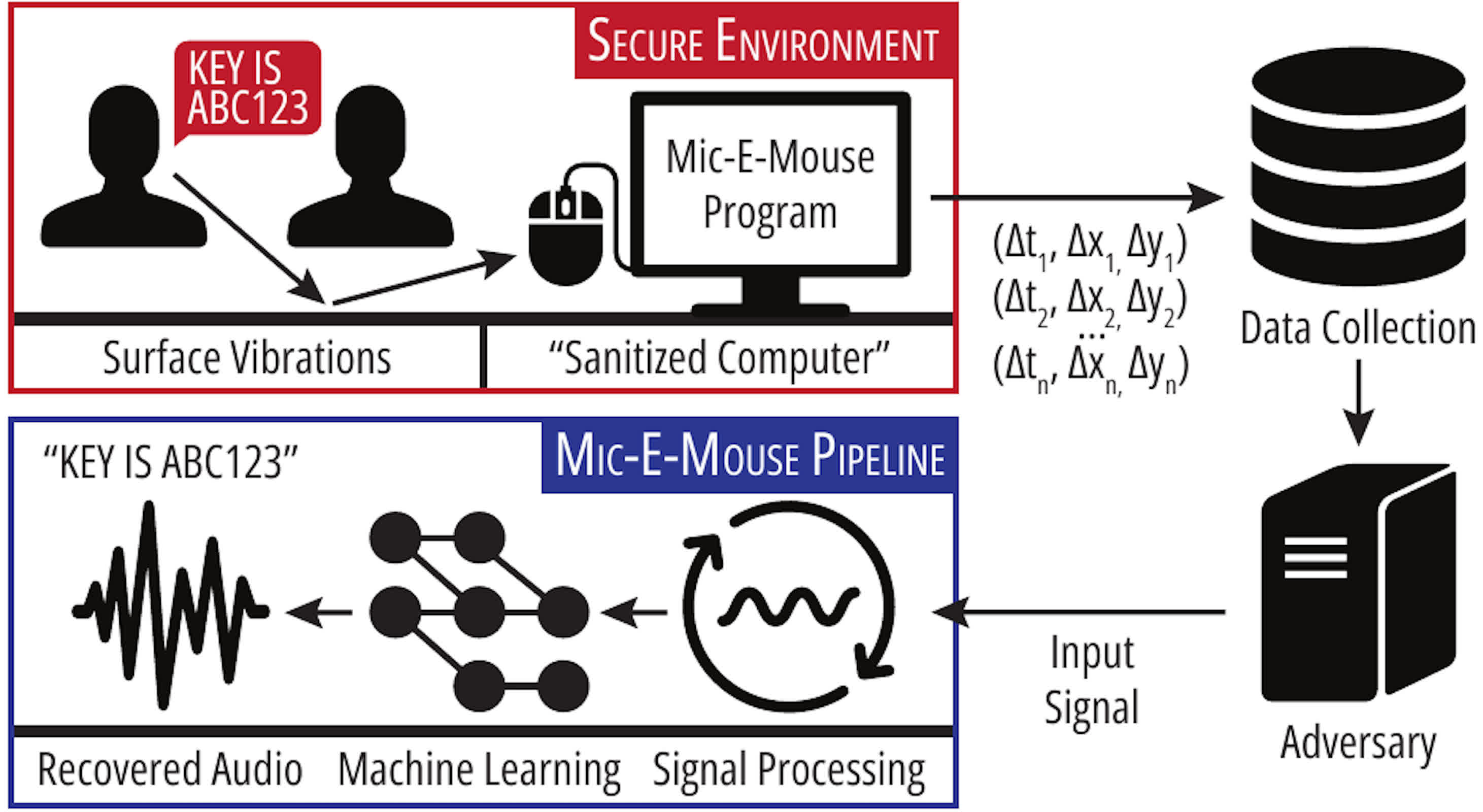
This kind of compromise doesn't require elaborate malware installations. Any application, such as a game or creative software, that legitimately requests high-frequency mouse data could be exploited if compromised. Once captured, the data can be transmitted off-site for analysis, allowing sensitive conversations to be intercepted without any obvious sign to the victim.

The UC Irvine team's work underscores how GenAI and accessible, high-end hardware can create unexpected vulnerabilities in everyday devices.

Though the method requires specific conditions and a compromised system, it broadens the discussion of acoustic privacy risks in an age of pervasive sensors. For now, Mic-E-Mouse remains a research project, but it points to scenarios that once seemed improbable – a world where a standard gaming mouse could double as an eavesdropping tool.

Permalink to story:

 
Any one who is the target of spies will absolutely be the subject of eavesdropping. Using vibrations of glass windows for example is old news. They knew about that back when 2001 Space Odyssey was written. Lip reading can be used too. There are very few people talented enough to target you - but if and when you are targeted, the technology they have at their disposal is usually insurmountable.

They could break in, replace your lightbulbs with microphone bulbs and you'd never know.

 
This is amazing. Terrifying and amazing. But I think wifi and cellular have the best potential for this stuff because 99% of the people use them.
 
Enough stuff is listening to us that this doesn't really worry me all that I think this is actually pretty cool. Not saying it's right, but I've mostly accepted that this is the world we live in.
 
What I love about research like this is how it flips our assumptions — tech made for better control in games or design can also teach us about the hidden ways sound and motion interact. It’s both brilliant and a bit eerie.
 
So, everyone who habitually loudly spills all his/her secrets while using a computer & mouse sitting at a desk is at risk now, right?

Maybe I'm stupid but the whole thing seems extremely silly to me. For that matter, I'm fed up with the security obsession. None of my machines has a password and my disks aren't encrypted and for that matter do not contain secret/private info.
I know several people who lost access to their data thanks to encryption. It's the main reason I find Lunix so annoying...password hell...I'm no d*** secret agent.
[/rant mode off] :)
 
Any one who is the target of spies will absolutely be the subject of eavesdropping. Using vibrations of glass windows for example is old news. They knew about that back when 2001 Space Odyssey was written. Lip reading can be used too. There are very few people talented enough to target you - but if and when you are targeted, the technology they have at their disposal is usually insurmountable.

They could break in, replace your lightbulbs with microphone bulbs and you'd never know.
Yet those people who are targets will not speak openly in closed spaces, because they already know all of that...
 
I guess anything with a predictable EMF pattern can be used to detect movement or vibrations with the right software and ingenuity, I know this has happened with wireless networks and I wouldn't be surprised if they can do this with LED lightbulbs, monitors, a stethoscope to the foundations of your house, but I would've completely overlooked the optical sensor in a computer mouse, that's very very clever.
 
It’s both hilarious and terrifying that the same hardware used to get better headshots in Call of Duty can now technically listen to you talk about your weekend plans. Somewhere out there, a paranoid IT admin is about to start unplugging every gaming mouse in the office “just to be safe.”

 
Back