What just happened? Nvidia has shifted its focus amid the AI boom from its gaming and professional GPU business to AI hardware design, driving its market value to nearly $5 trillion. The company has now unveiled its next-generation AI platform: the Vera Rubin "Superchip," purpose-built for high-intensity generative AI workloads.
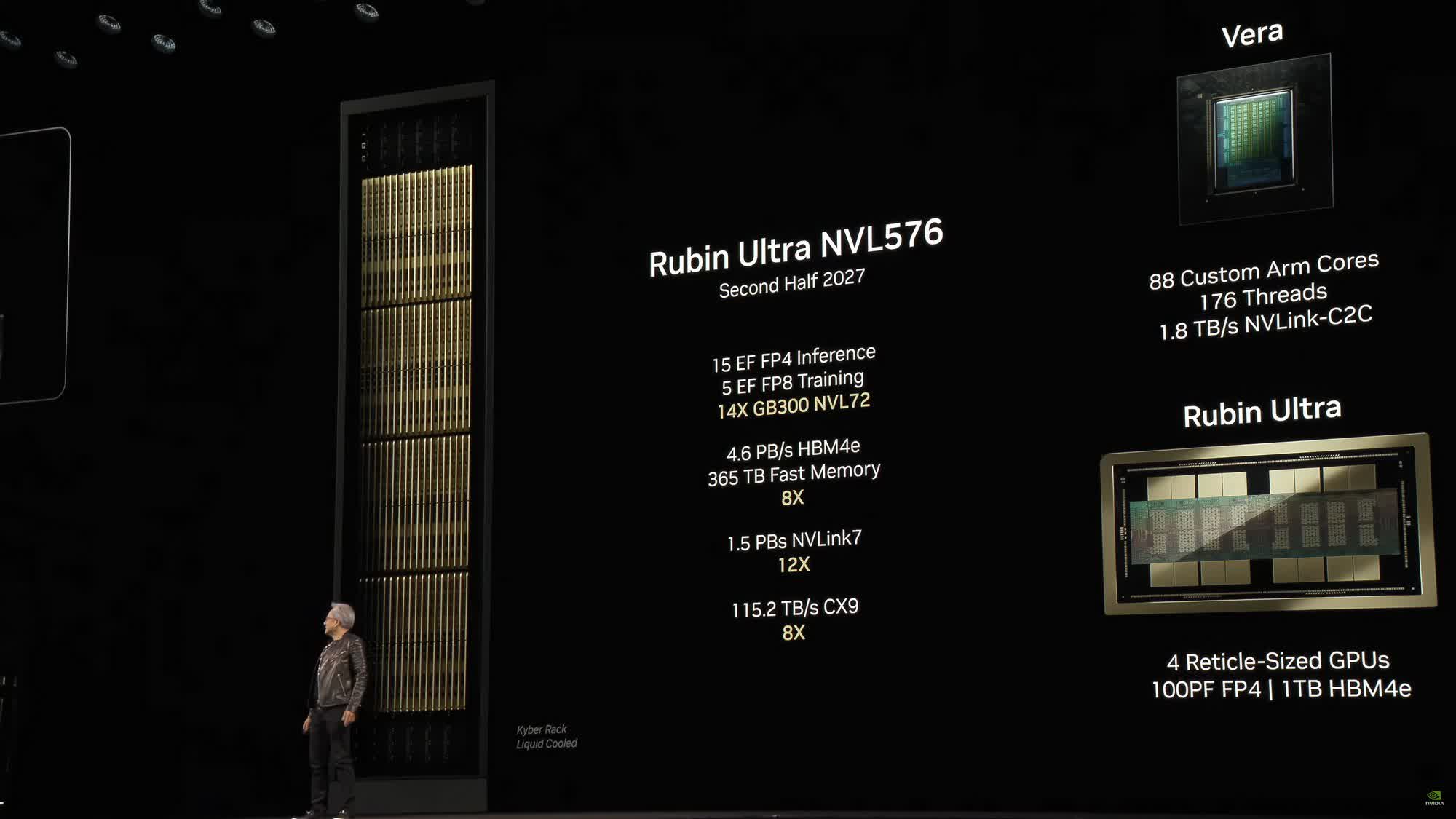
The new hardware was unveiled this week at Nvidia's GPU Technology Conference (GTC) in Washington by co-founder and CEO Jensen Huang. The Vera Rubin platform features a single "Vera" CPU with 88 custom Arm cores and 176 threads, alongside two "Rubin" GPUs, delivering up to 100 petaFLOPS of FP4 compute performance.
Vera Rubin is Nvidia's third-generation LVLink 72 rack-scale computer, following the GB200 and GB300. The liquid-cooled system contains six trillion transistors and hosts 2 TB of low-latency SOCAMM2 memory.
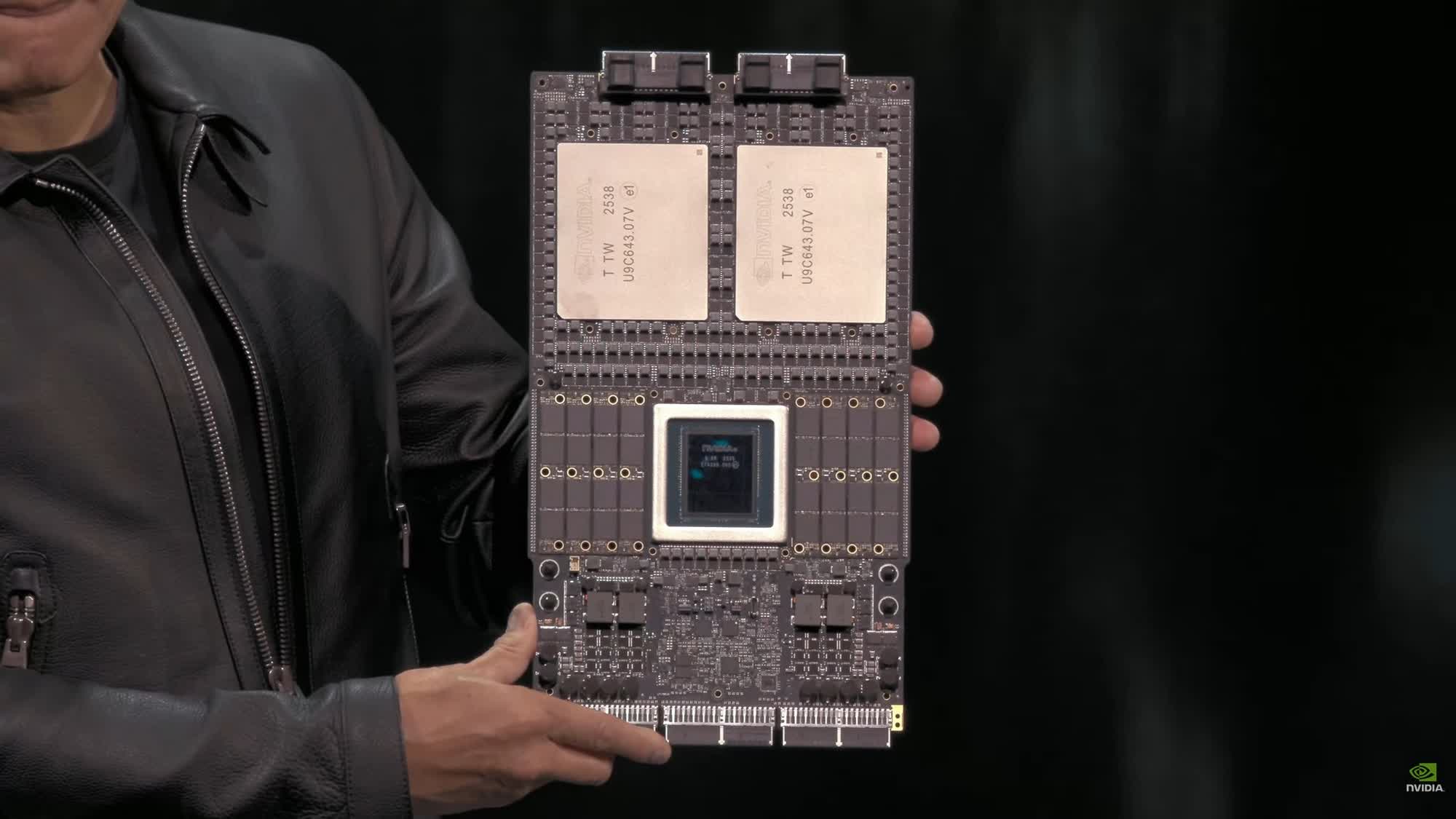
The base configuration delivers roughly 100 times the raw compute performance of the Volta-based DGX-1, Nvidia's first purpose-built platform for deep learning, which offered 170 teraflops of half-precision (FP16) peak performance.
Vera Rubin will be offered in multiple configurations, including the NVL144 and NVL144 CPX. The NVL144 features two reticle-sized GPUs, delivering up to 3.6 exaflops of FP4 inference and 1.2 exaflops of FP8 training performance. The NVL144 CPX is rated at 8 exaflops – 7.5 times more powerful than Nvidia's current-generation GB300 NVL72 systems.
For hyperscale data centers requiring even more processing power for larger model-context workloads, Nvidia will offer its custom Rubin Ultra NVL576 systems. Configured with four reticle-sized GPUs and up to 365 TB of high-speed memory, the NVL576 delivers up to 15 exaflops of FP4 inference and 5 exaflops of FP8 training performance – an 8× increase over the GB300.
Each Rubin GPU comprises two compute chiplets and eight HBM4 memory stacks. The board also includes five NVLink backplane connectors – two at the top and three at the bottom. The top connectors are designed to link GPUs to the NVLink switch, while the bottom connectors handle power, PCIe, and CXL connectivity.
Huang expects Rubin GPUs to enter mass production in the second half of 2026. NVL144 systems are slated to launch either later that year or in early 2027, while NVL576 systems will likely debut in the second half of 2027.