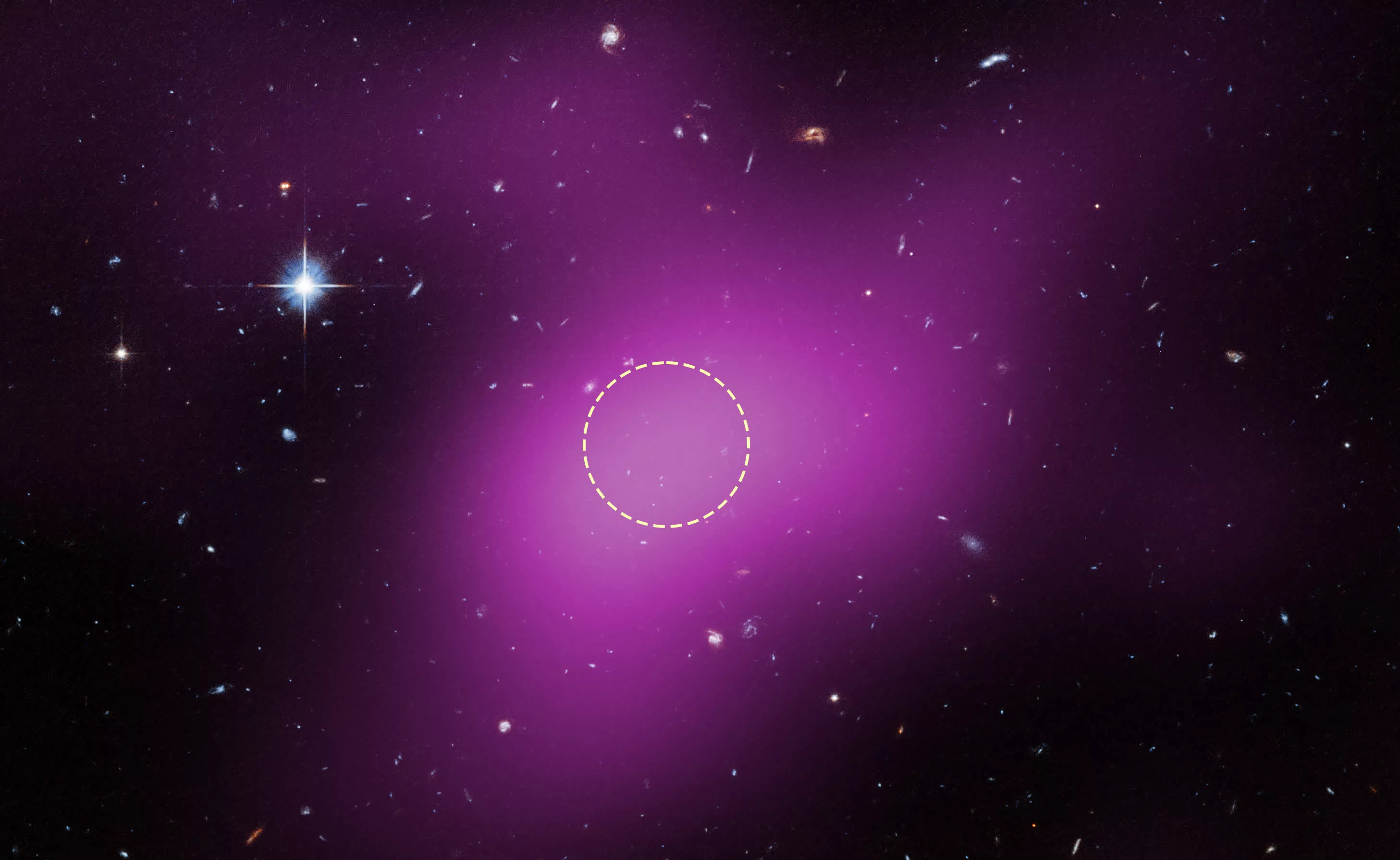
The Cosmic Picture: An international team of researchers has observed the first-ever instance of a new type of celestial object. Dubbed Cloud-9, the structure is a gas cloud composed primarily of dark matter. Unlike typical clouds that collapse to form stars, Cloud-9 never developed into a single star and may offer a unique window into the so-called "dark universe," which is dominated by dark matter.
The researchers describe Cloud-9 as a failed galaxy, a "relic" or remnant of the processes that gave rise to early galaxies. Alejandro Benitez-Llambay suggested that the cloud can be considered a fundamental building block of a galaxy that never fully formed.
Cloud-9 was first detected three years ago during a radio survey conducted with two ground-based radio telescopes. Follow-up observations using the Hubble Space Telescope confirmed that the gas cloud contains no stars and exhibits a compact, highly spherical shape.

Dark matter is a hypothetical, invisible form of matter believed to shape the major cosmic structures in our universe. It does not interact with electromagnetic radiation and can only be detected through its gravitational influence on celestial objects composed of ordinary matter.
The object is technically known as a Reionization-Limited H I Cloud, or "RELHIC." It is composed mostly of neutral hydrogen and spans approximately 4,900 light-years in diameter. By analyzing its radio emissions, the researchers determined that the cloud contains gas with a mass roughly one million times that of the Sun. The gas pressure balances the gravitational pull of the dark matter, implying that Cloud-9 contains around five billion solar masses of the exotic substance.
Cloud-9 is located on the outskirts of Messier 94 (M94), a spiral galaxy about 16 million light-years away from the Milky Way. A 2008 study suggested that M94 contains almost no dark matter, but the new research on Cloud-9 indicates that the two objects are interacting in some way.
Astronomers speculate that RELHICs like Cloud-9 are clouds with high concentrations of dark matter that failed to attract enough gas to ignite stars. Other RELHICs likely exist in the universe, as dark matter continues to influence the formation and evolution of galaxies and other large cosmic structures.
Cloud-9 may eventually develop into a star-bearing galaxy far in the future, but for now, it appears to reside in a "sweet spot" where RELHICs remain stable without forming stars. Thanks to the unprecedented insights gained from studying Cloud-9, researchers are planning new radio surveys to search for additional failed galaxies.