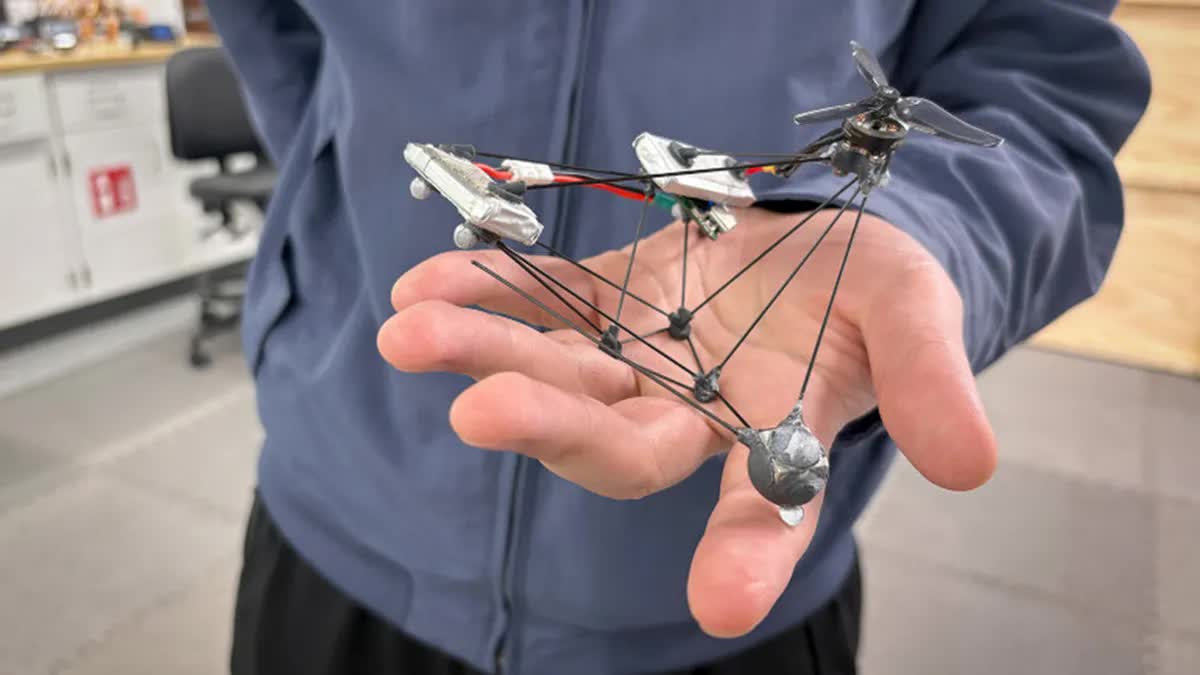
In brief: It's hard to miss a drone. With their spinning propellers and often bulky bodies, they're usually very easy to spot. But Northwestern University engineers have created one that's much more difficult to see coming: Phantom Twist, a prototype that rotates so quickly it becomes little more than a blurry haze.
Rather than using camouflage, transparent panels, or Predator-style light-bending materials, Phantom Twist exploits motion blur and the limits of human vision.
Its body spins between 15 and 25 times per second, causing the eye to average the moving parts with whatever lies behind them. At maximum speed, the aircraft is nearly invisible, appearing as a faint smudge.
Unlike a conventional quadcopter, which has four rotors surrounding a mostly stationary body, Phantom Twist uses a single motor and propeller.
The propeller rotates in one direction while the rest of the aircraft spins the other way, leaving almost no stationary components for the eye to lock onto.
Creating something that could remain stable while also being difficult to see required more than attaching components to a rotating frame. The researchers began with a computational model that generated around 20,000 viable configurations. AI and optimization algorithms then rearranged the motor, batteries, circuit board, counterweight, and other parts to find designs that balanced flight performance with low visibility.
The most promising candidates were simulated while spinning and overlaid across 100 real-world backgrounds. A perception model designed to approximate human vision scored how noticeable each one appeared. The team retained the 500 least visible designs and continued adjusting their layouts until it arrived at the final version.
Its widely separated components sit at different heights and angles, with plenty of empty space between them. This prevents the solid pieces from overlapping during rotation and forming a dark, recognizable shape. According to the researchers' visibility metric, Phantom Twist is around 10 times less perceptible than a similarly sized quadcopter.
There are a few caveats. The current prototype relies on an external optical tracking system, limiting it to controlled environments, while its exposed wires and carbon-fiber support rods remain partially visible. More importantly, it still sounds like a drone, so anyone who fails to spot the hovering blur will probably hear it. Future versions could use quieter propulsion and more transparent materials.
The drone's potential applications include observing wildlife without altering animal behavior, surveying wetlands, and inspecting infrastructure with less visual disruption. A camera mounted on the spinning body might also capture a 360-degree view for navigation.
Similar aircraft designed to be difficult to detect include China's mosquito-sized surveillance drone and Harvard's solar-powered RoboBee. Phantom Twist takes a different approach to the same goal: rather than shrinking out of sight, it moves too fast to see clearly.