
Bottom line: Despite being advertised as the holy grail for businesses, embracing AI doesn't mean a company will automatically experience improvements. A new survey that questioned thousands of CEOs found that more than half admit to seeing no significant financial benefit from AI to date.
Professional services network PwC's latest Global CEO survey was completed by 4,454 Chief Executive Officers across 95 countries and territories.
Unsurprisingly, a lot of the questions are related to AI. Most companies have introduced the technology into their businesses to varying extents, but 56% of CEOs say it hasn't produced any cost or revenue benefits.
Some CEOs said that AI had led to cost or revenue improvements: a third said they had seen increased revenue in the last 12 months, while 26% said they are seeing lower costs – but 22% said their costs had actually increased. What might concern those already worried about AI being a bubble is that just 12% of CEOs reported both these positive changes as a result of implementation.
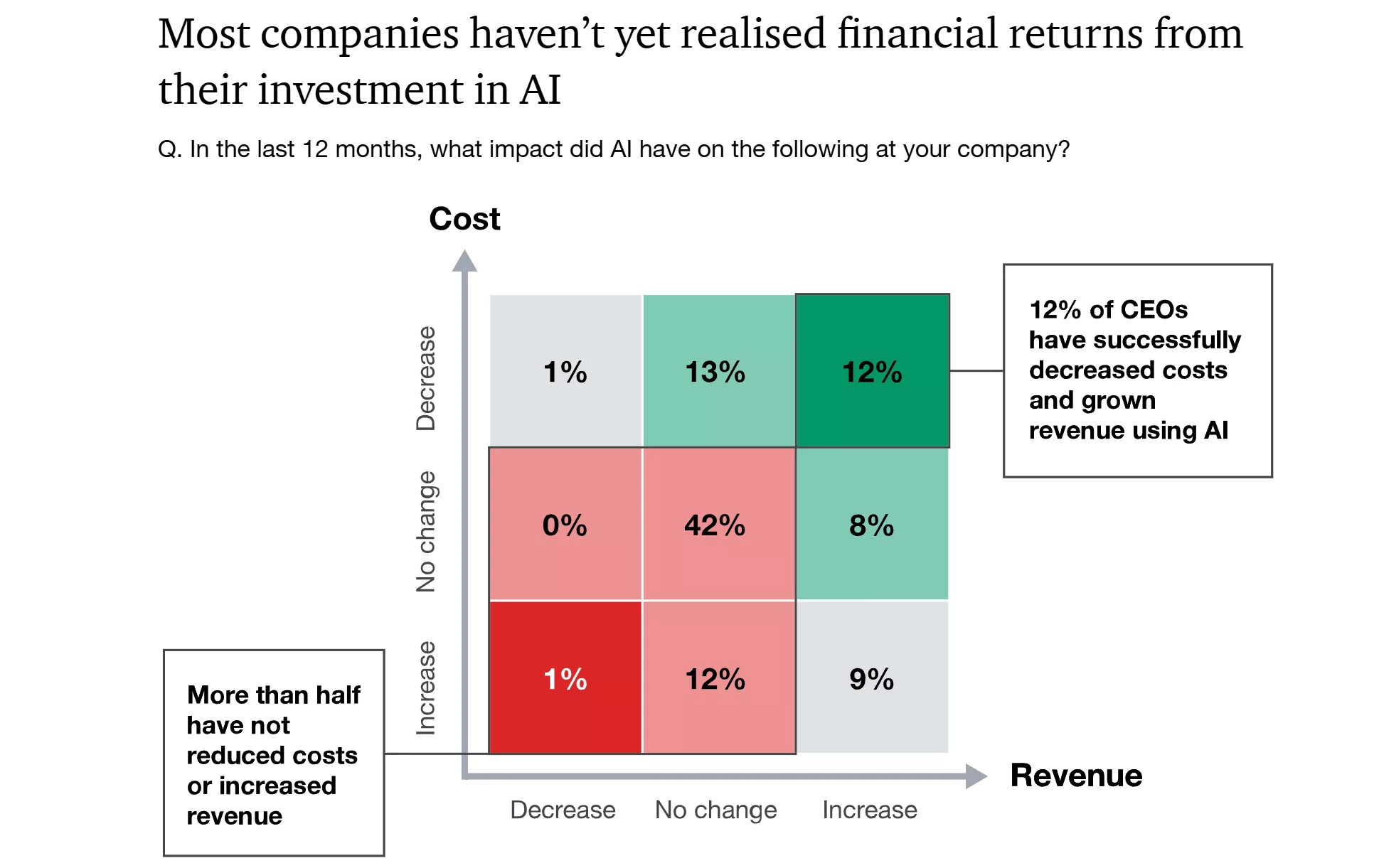
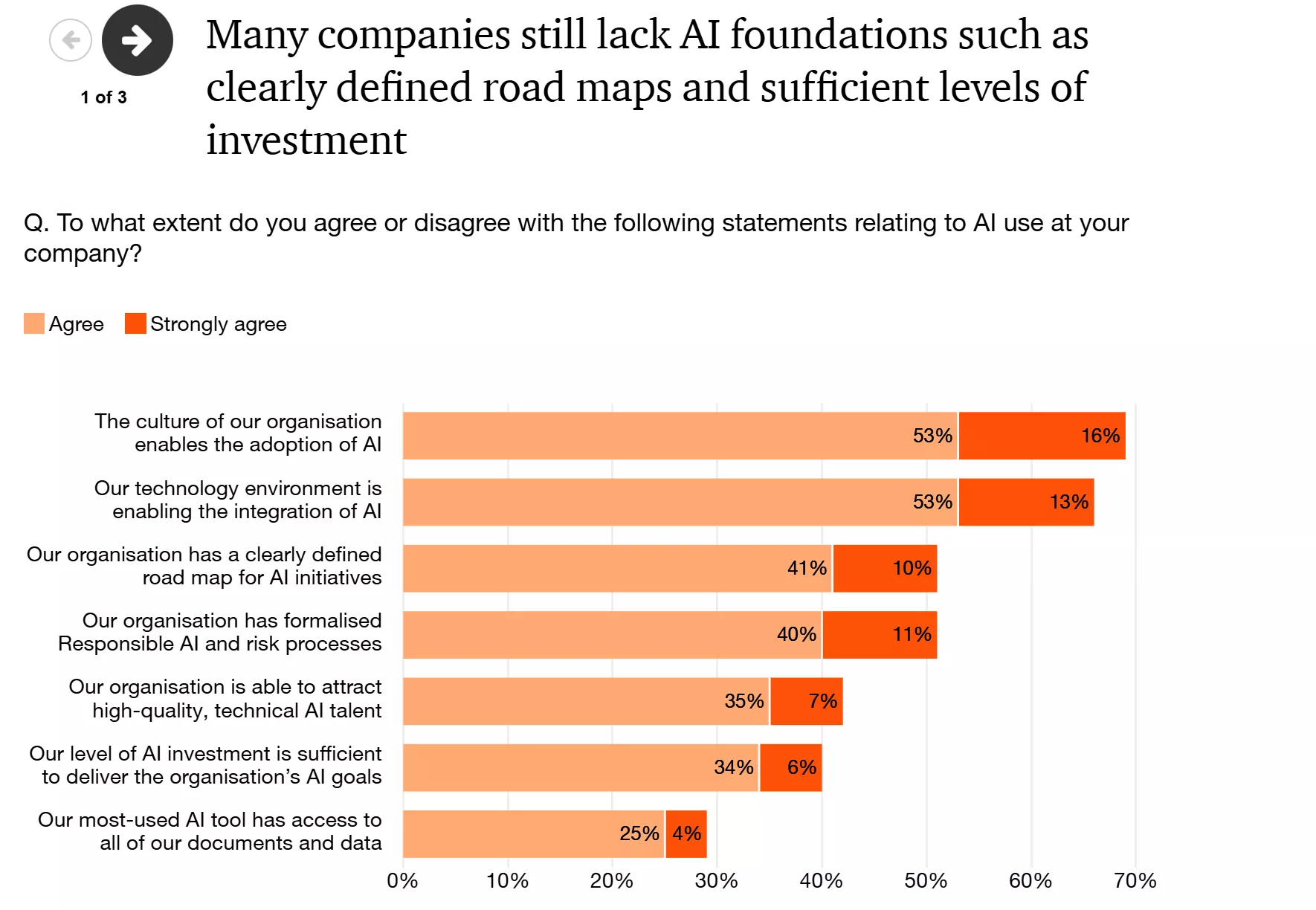
Rather than questioning whether AI is the golden ticket companies like OpenAI claim it to be, PwC's narrative shifts the focus elsewhere: businesses with strong "AI foundations" – including responsible AI frameworks and technology environments that support enterprise-wide integration – are two to three times more likely to report meaningful financial returns, apparently.
In fact, rather than worrying that AI might not live up to the hype, the biggest concern among CEOs is whether they are transforming fast enough to keep pace with technological change.
That anxiety is backed up by some interesting numbers. According to PwC, 69% of CEOs believe generative AI will require most of their workforce to develop new skills within the next three years, yet fewer than half say their companies have a clear plan in place to reskill employees at scale. It appears many leaders are betting on AI-driven transformation while still figuring out how their people will keep up.
Also, while a large majority of CEOs say AI will fundamentally change how their company creates value, only a minority describe their AI initiatives as fully integrated into core business processes. For many organizations, AI is still stuck in pilot projects, isolated tools, or productivity experiments rather than something that reshapes decision-making or operating models.
PwC's data suggests that CEOs aren't losing faith in AI. Nearly three-quarters expect it to significantly boost profitability over the next 12 months, despite the fact that most haven't seen meaningful gains so far. That optimism may help explain why investment continues to accelerate even as results lag behind expectations.
The survey paints a picture of a AI adoption being driven less by proven returns and more by fear of falling behind. CEOs aren't pulling back because AI doesn't work – they're doubling down because the cost of not transforming fast enough feels even riskier. Whether that confidence is justified, or simply another chapter in the long history of tech hype-driven FOMO, is something the next few years will make painfully clear.