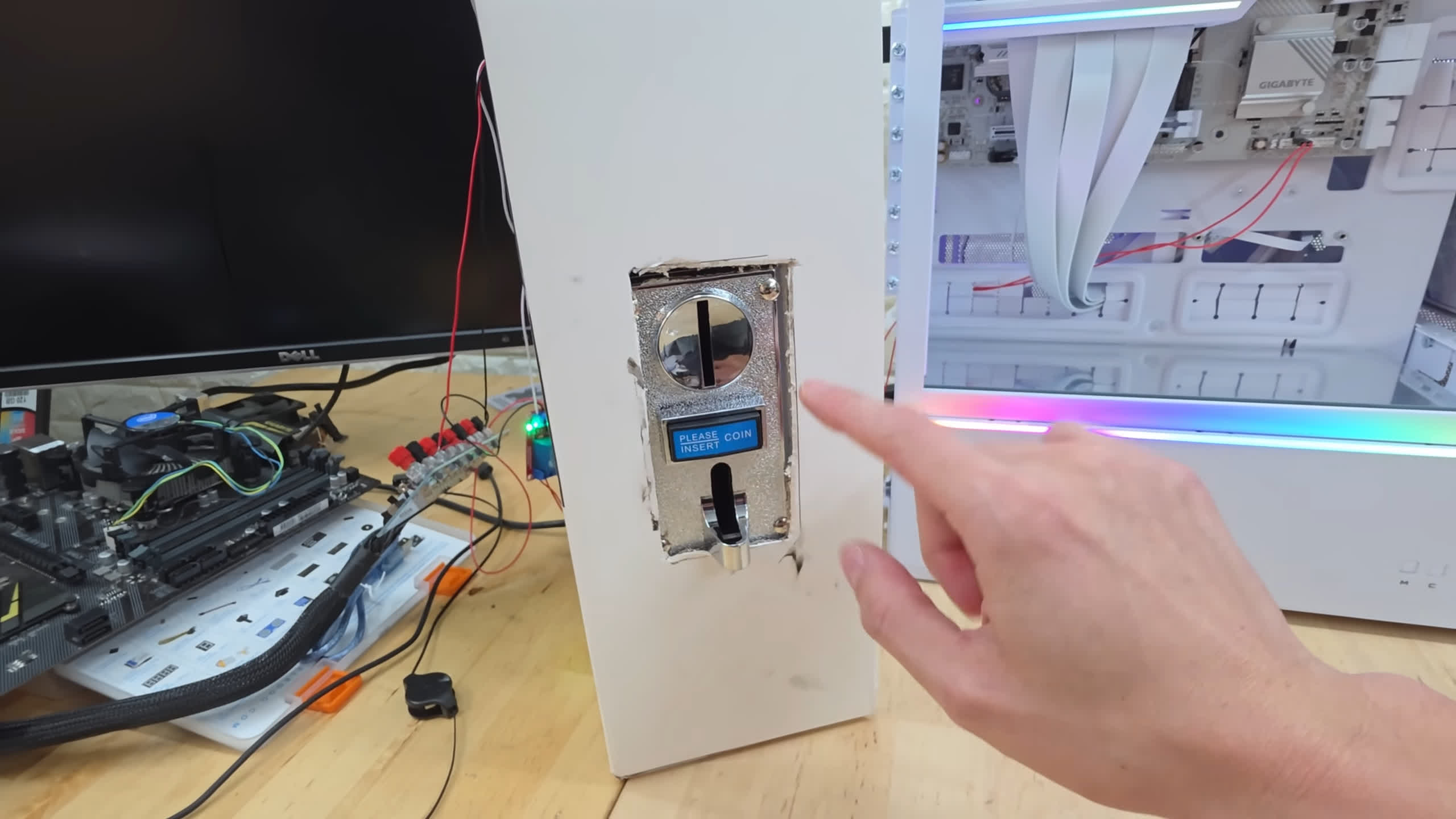
WTF?! Remember the days of inserting a quarter (or several) to play a few minutes of an arcade game? A YouTube channel took on the challenge of moving this transactional system to a gaming PC, complete with an arcade-style coin slot.
Popular YouTube channel mryeester set out to create what is essentially a coin-operated gaming PC and show viewers how to replicate the experiment.
The end result is exactly as ridiculous and charming as it sounds: instead of pressing a power button, you drop a coin into the slot, and only then does the PC spring to life.
Under the hood, though, the project is far more clever than it sounds. The build uses a programmable coin acceptor – the same type found in vending machines and arcade cabinets – which can be trained to recognize a specific coin. In this case, mryeester chose a quarter, repeatedly feeding it through the acceptor so it could learn its physical size, speed, and magnetic properties.
Surprisingly, the core hardware isn't all that expensive. The coin acceptor itself costs around $20 to $25, far less than you might expect for something doing real-time coin analysis with infrared sensors and magnetic coils.
To power it, the project uses a spare ATX power supply connected to a PSU breakout board, which provides easy access to 12V, 5V, and ground without modifying the PSU. A basic breakout board typically runs $15 to $20, assuming you already have an unused power supply lying around.
The key link between the coin acceptor and the PC is a small 12V relay module, usually priced under $10. When the acceptor detects a valid coin, it sends out a brief electrical pulse.
That pulse triggers the relay, which mechanically shorts the two motherboard power-switch pins – exactly the same thing that happens when you press a normal case power button.
There's also a fair amount of wiring involved. The build uses 28-gauge hookup wire, DuPont connectors, and a crimping tool to create a custom front-panel-style cable that plugs directly into the motherboard headers.
If you don't already own the tools, things like a wire stripper, crimper, and extra wiring can push the total cost up quickly. All told, the full project comes in at roughly $130 to $140 in parts and tools, not counting the PC itself.
Once everything is tuned correctly, including relay timing and coin acceptor sensitivity, the system works exactly as intended. Wrong coins are rejected, while the correct ones boot the PC.
Like so many of these YouTube projects, it's impractical, unnecessary, and completely overengineered, which is precisely why it's so entertaining. And judging by the comments joking about renting RAM or charging siblings for PC time, it might be uncomfortably close to a future we'd rather laugh at now.