
Highly anticipated: After over a year of teasing its latest storage technology, Micron is now almost ready to sell its storage breakthrough to enterprise and Big Tech customers. The world's first PCIe Gen6 SSD could become a key piece in the increasingly baffling puzzle of the AI industry.
Micron has announced that the 9650 NVMe SSD has finally entered mass production, hailing the new drive as the first PCIe Gen6 storage product in the world. Like everything else these days, the high-end SSD is largely focused on accelerating AI workloads, and generating hefty returns thanks to Big Tech's voracious appetite for anything with a chip inside.
Micron began demonstrating its PCIe 6.0 technology a year ago, at a time when no compatible hardware peripherals were available. The company says PCIe Gen6 represents a big shift in storage performance, as bandwidth is "generally" doubled compared to PCIe Gen5 drives. That jump, Micron argues, makes the 9650 series particularly well suited for AI companies racing to scale their latest large language model deployments.
According to Micron's official spec sheet, the 9650 SSD can deliver sequential read speeds of up to 28,000 MBps – roughly double the 14,000 MBps ceiling of PCIe Gen5. Sequential write speeds climb to 14,000 MBps, a more modest 40 percent increase. Random performance also sees sizable gains, with read speeds reaching 5.5 MIOPS (+67 percent) and write speeds topping out at 900 KIOPS (+22 percent).
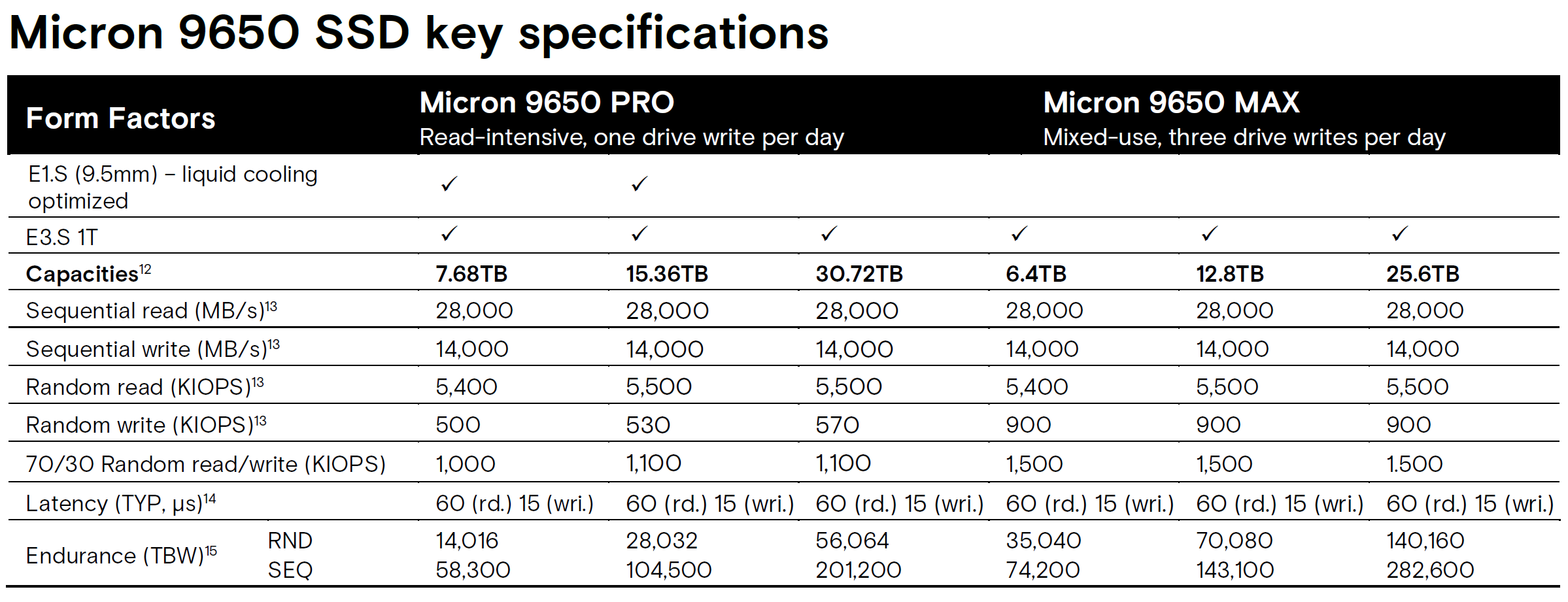
The Micron 9650 lineup spans capacities from 7.68 TB to 25.6 TB and is offered in both E1.S and E3.S 1T form factors. Smaller E1.S models, up to 15.36 TB, are optimized for liquid cooling as well. Micron has not shared pricing details, though the company's enterprise focus suggests these drives will not come cheap.
Micron is also reframing the role of storage in AI infrastructure. According to Vice President Alvaro Toledo, storage is no longer a secondary concern trailing behind compute. Instead, it has become a defining factor in overall system performance, influencing both throughput and efficiency across AI-driven data centers.
"In an AI driven world where data must move continuously, predictably, and at massive scale, storage performance has become a first order design constraint," Toledo said.
Efficiency, Micron claims, is another major advantage. Within the same 25-watt power envelope as PCIe Gen5 drives, the 9650 SSDs can deliver twice the sequential read efficiency. Moving more data without increasing power draw could help data centers inch closer to their often-cited sustainability targets, at least on paper.
The company says it has spent the past 18 months validating interoperability for the 9650 drives, laying the groundwork for broader adoption across the emerging PCIe Gen6 ecosystem. Still, with the memory market under strain, how quickly this next-generation storage finds its footing remains an open question.