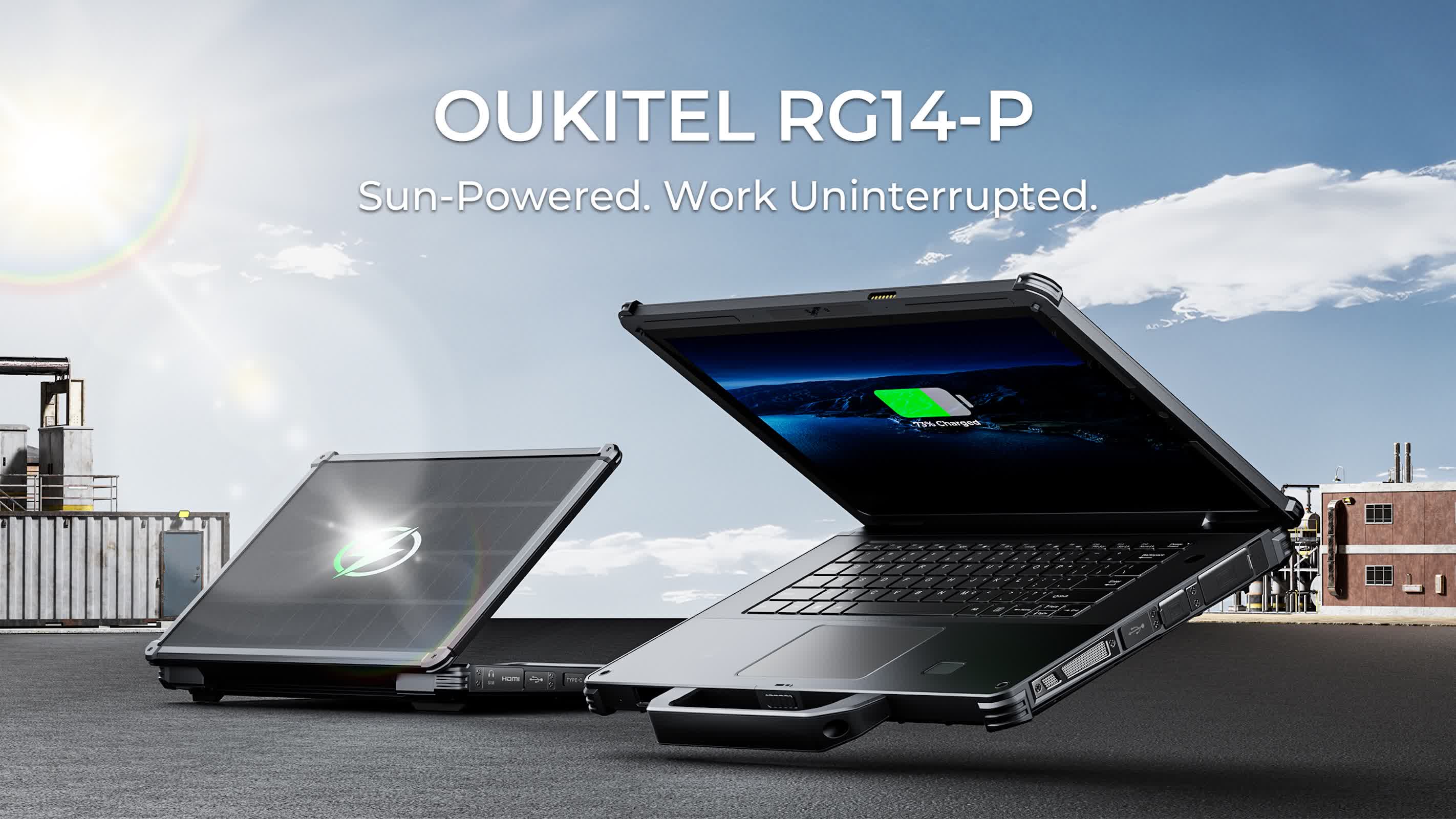
First look: The return of a solar-powered laptop has been a long time coming. Nearly a decade has passed since the tech world last gave serious thought to powering notebooks with sunlight, yet Oukitel, a Chinese manufacturer better known for rugged smartphones, has returned to the field with an unexpected offering: the RG14-P. Marketed as the world's first rugged solar-powered laptop, it takes a pragmatic approach, emphasizing functionality for workers who spend long hours away from reliable access to electricity.
The RG14-P's 14.1-inch touchscreen sits inside a reinforced metal chassis, bolstered by thick rubber edges that absorb shock and resist dust and water intrusion. Even the input/output ports, which include USB, Ethernet, HDMI, and serial connectivity, are hidden beneath protective flaps to shield them from debris in hostile settings such as mines, field sites, or construction zones. A large, fixed carrying handle dominates the front; clearly, this is not a machine meant to live on a desk.
The laptop carries two internal batteries: a 3,000mAh main pack and a 5,200mAh auxiliary battery, both rechargeable via 65-watt fast wired charging when an outlet is available.
The back cover, however, houses its most distinctive feature – a solar panel array integrated directly behind the screen. While Oukitel has not disclosed the panel's conversion rate or wattage, the purpose appears clear: to extend operating time by continuously topping up the charge when sunlight is available. The system is not intended to replace wall charging but to sustain productivity where other laptops would shut down.
To an extent, Oukitel's new entrant challenges the assumption that solar laptops are merely novelties. Past attempts, including Samsung's NC 215S, a 10-inch netbook released years ago, had limited impact. The NC 215S collected enough energy for roughly one hour of use after two hours in direct sunlight, translating to a modest top-up of the battery rather than a full charge. That model vanished quickly and, for a time, solar computing retreated to the realm of concept devices and prototypes.
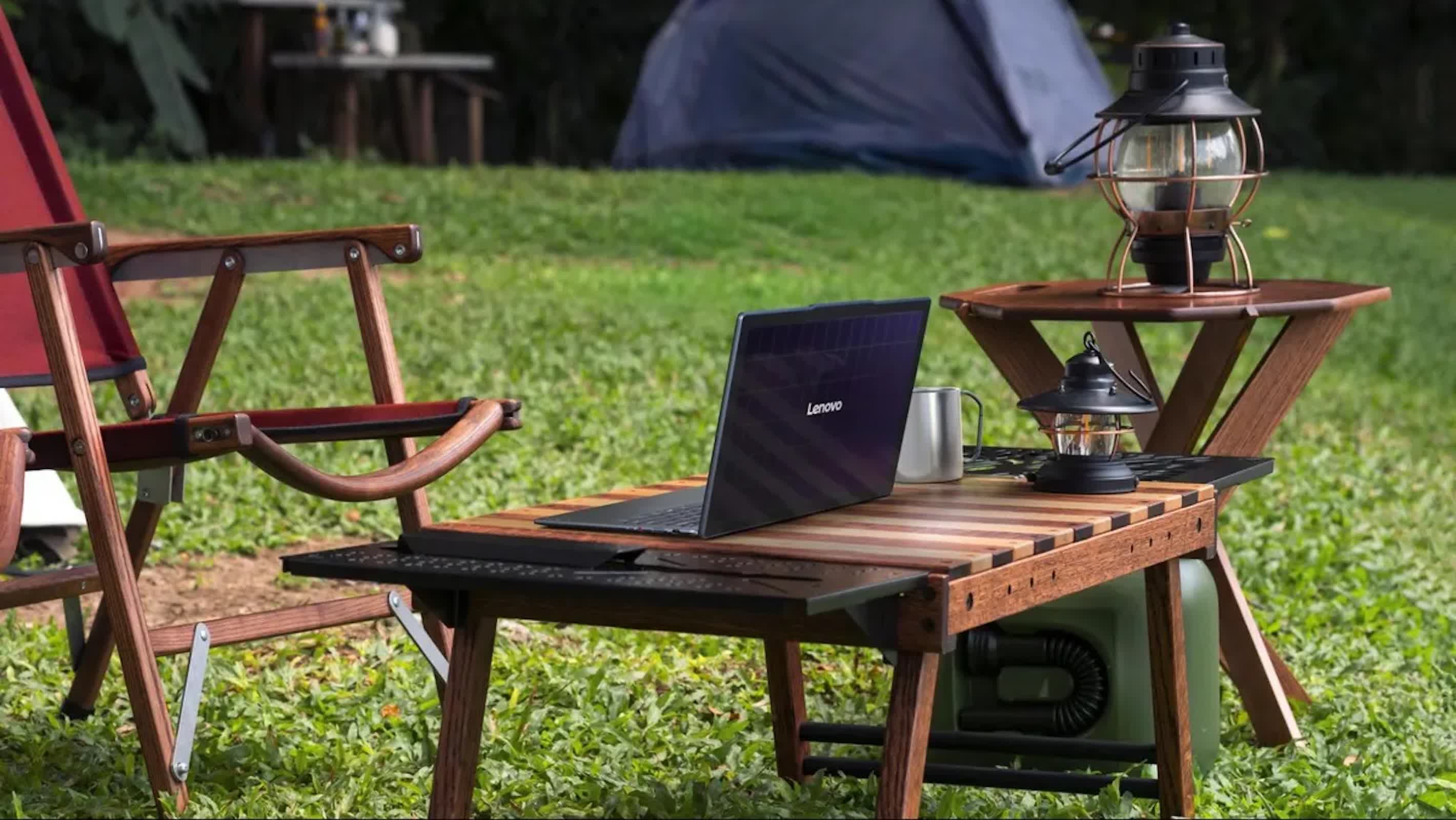
Interest resurfaced only recently when Lenovo showcased a lid-mounted solar panel on its Yoga Solar PC Concept, capable of converting more than 24% of incident light into usable energy. Powered by the "Back Contact Cell" architecture, Lenovo's panel places the electrodes behind the photovoltaic layer to maximize exposed surface area.
It also integrates an adaptive control method – the Dynamic Solar Tracking system – that continuously adjusts charging parameters based on solar intensity to maintain energy efficiency and voltage stability. In Lenovo's testing scenarios, twenty minutes of strong sunlight could yield roughly an hour of local 1080p video playback. The results were impressive but, crucially, remained conceptual: the company did not commit to a release timeline.
While Lenovo's prototype prioritizes thinness and elegance with a 14-inch display, Intel Core Ultra processor, solid-state storage, and a lightweight chassis, Oukitel's focus is on utility over polish. Its machine sacrifices refinement for survivability. Yet the technological premise overlaps: both companies are exploring integrated photovoltaics, a long-standing concept hindered by constraints in panel efficiency, size, and thermal management.
What makes this new wave intriguing is less about instant self-sufficiency and more about hybrid power design: the ability to blend renewable input with conventional fast charging. As energy-harvesting materials improve and processors become more power-efficient, sunlight may eventually become a practical contributor to day-to-day computing, especially for low-duty tasks such as documentation, environmental monitoring, or data logging.