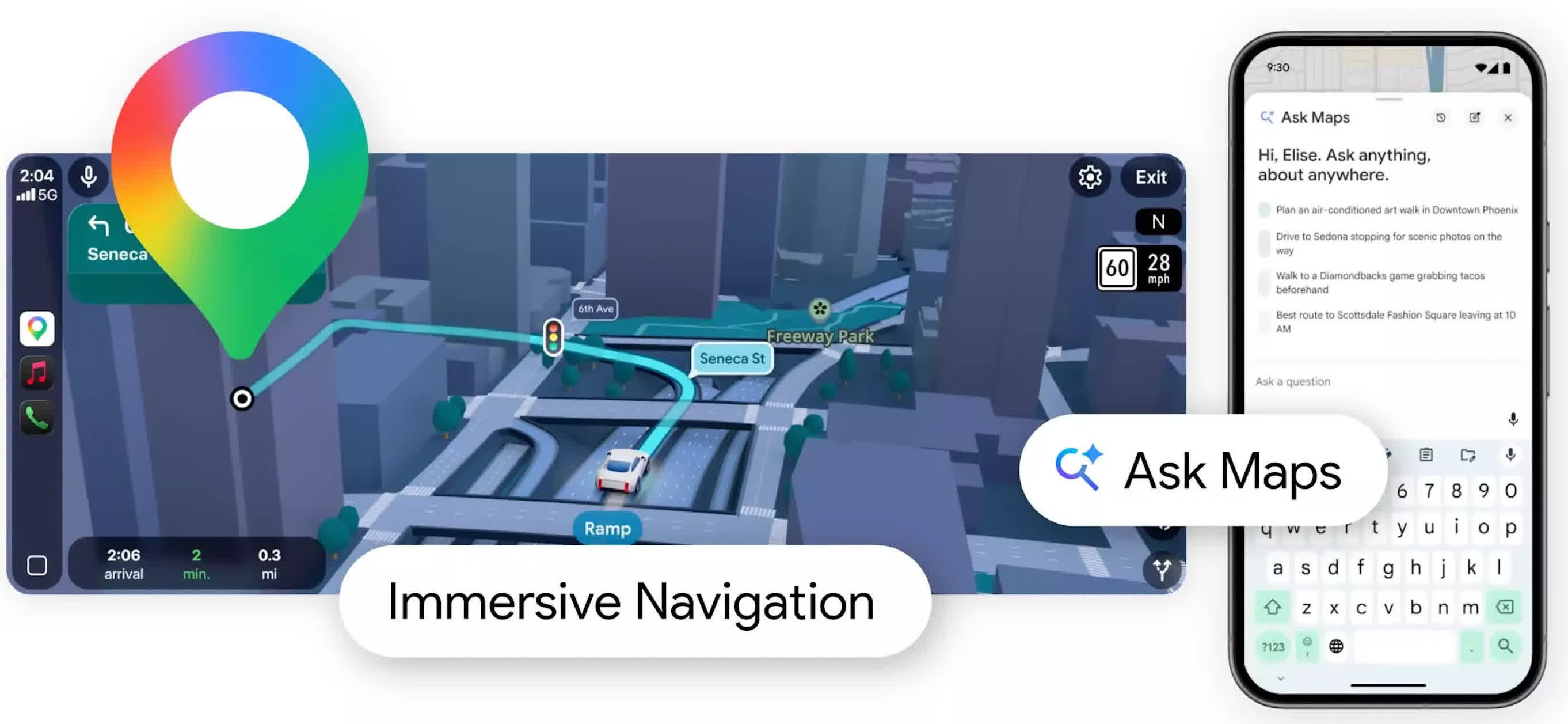
The takeaway: Google is expanding the use of generative AI in one of its most popular products, bringing its Gemini model directly to the heart of Maps. The company is rolling out an AI-powered feature called Ask Maps, designed to handle detailed, conversational queries that go well beyond what the platform could previously interpret.
For years, Google Maps has been able to surface nearby coffee shops and provide turn-by-turn navigation. What it couldn't do was answer complex questions that blend location, preferences, and timing. With Gemini built in, it can now.
During a press briefing, Google product manager Andrew Duchi described how the system interprets requests such as finding "a vegetarian restaurant with a cozy atmosphere and a table for four at seven o'clock," halfway between two locations in New York.
By parsing the prompt, Gemini cross-references Maps data – including reviews, photos, and information about places you've searched for or saved – to generate several options that satisfy the query. If users have favorited places or interacted with similar locations in the past, those preferences feed back into the recommendations. Once a decision is made, Maps can complete the reservation in a single tap.
According to Miriam Daniel, vice president and general manager for Google Maps, Gemini's recommendations are built exclusively from Maps data and not from other Google services like Gmail. Personalization comes only from search or location history linked to Maps itself. Daniel and Duchi both declined to discuss future monetization strategies, but Duchi confirmed that paid listings do not currently affect the AI's ranking or suggestions.
Ask Maps interprets natural-language queries, offering a conversational experience rather than the more traditional search-box interactions of earlier versions. Users can describe their plans in vague or specific terms, and the model will translate that narrative into results.
For Google, this marks another step toward treating its mapping product as an intelligent assistant rather than a static tool. The feature is launching first in the United States and India across Android and iOS, with web support coming soon.
Alongside the conversational upgrade, Google announced Immersive Navigation, calling it the most significant visual overhaul of Maps in more than a decade. The update reimagines how navigation routes are displayed, using real-world geometry and dynamic rendering to better match the environment.
Buildings, highways, and terrain now appear in detailed three-dimensional form, with animated camera movements that shift automatically to emphasize upcoming turns or changes in elevation. The system layers traffic signals, crosswalks, and lane markings into the map view when they're relevant to upcoming maneuvers.
Google says these visual cues, supported by live traffic and user-reported data, can help drivers anticipate what they'll encounter on the road and choose safer, more efficient routes.
The new navigation mode will also make route choices more transparent by explaining why one path is recommended over another – for instance, to avoid construction, bypass congestion, or shorten travel time. Once users arrive, Maps can extend directions to include parking and walking routes.
Immersive Navigation will begin rolling out in the US next week, with broader availability planned later. It will run on Android and iOS devices and integrate with Apple CarPlay, Android Auto, and cars that use Google's built-in systems.