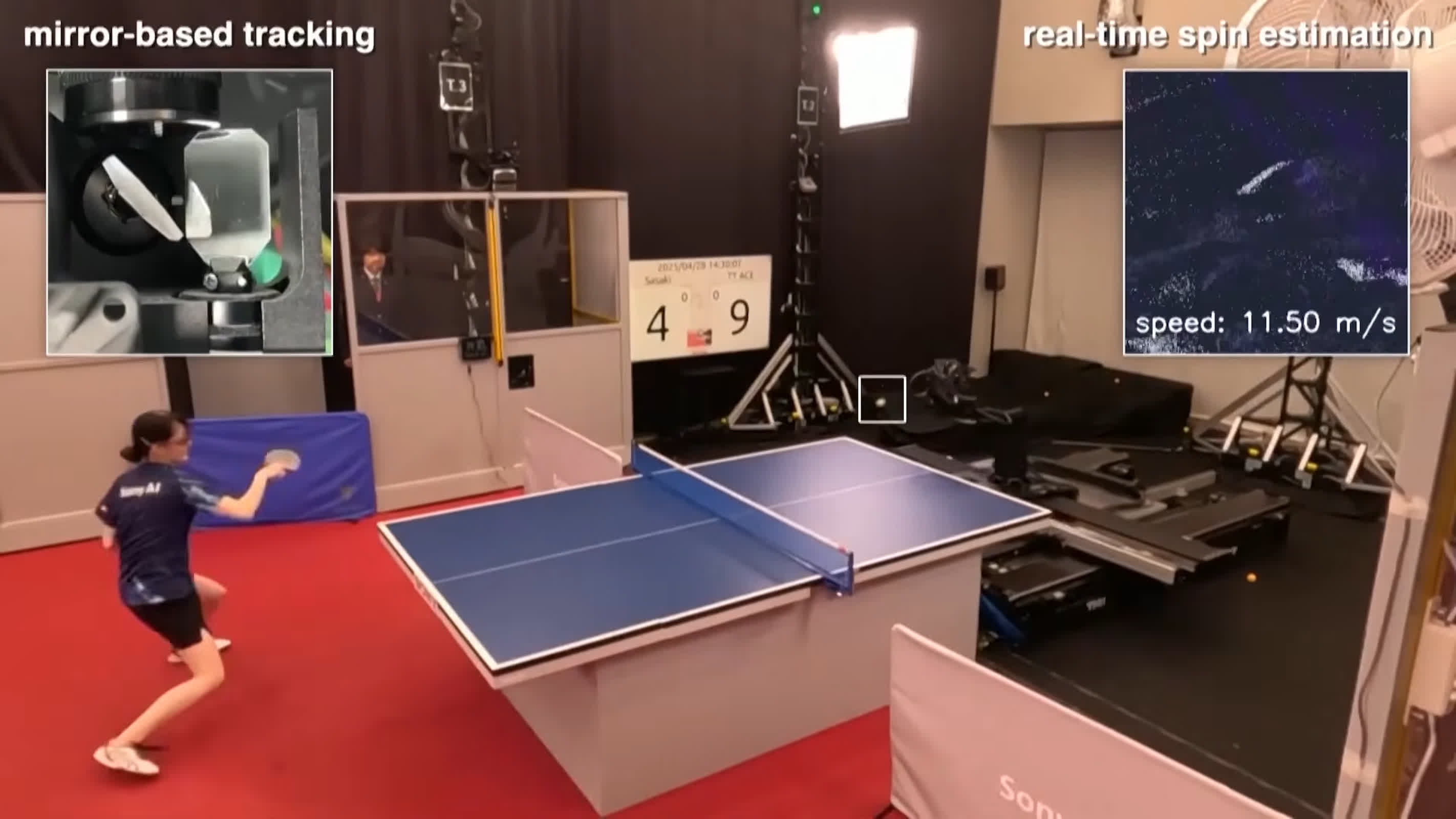
Looking ahead: Sony's latest robotics project tackles a core challenge in AI: operating reliably in fast-moving physical settings. Ace, an autonomous table tennis system, shows how close that goal is getting, with the ability to compete with – and sometimes beat – elite human players in official matches.
The Sony AI project focuses on table tennis, an activity that has resisted the kind of breakthroughs seen in digital environments. While AI has already outperformed humans in digital games, real-time physical sports remain difficult because they demand extremely fast, precise responses and continuous interaction under tight spatial and timing constraints, according to Peter Dürr, director of Sony AI Zurich and leader of the Ace project.
Ace combines perception and control systems designed for low-latency response. The system uses nine synchronized cameras and three separate vision subsystems to track the ball's position, velocity, and spin. This multi-camera setup enables update rates beyond human visual processing capabilities. "This is fast enough to capture motion that would be a blur to the human eye," Dürr said.
The perception system feeds a learning-based control algorithm trained in simulation. Instead of copying human play, Ace develops its own responses, leading to unconventional shot timing and selection. Dürr said this can create unpredictable rallies.
The robot uses eight joints: three for paddle position, two for orientation, and three for swing speed and force. This configuration allows it to reproduce a wide range of spins and trajectories, including those typically associated with advanced human play.
A study published in Nature reports that by April 2025, Ace won three of five matches against elite players and lost two against professionals. Subsequent iterations improved further, with Sony AI reporting victories over professional players in December 2025 and again in early 2026.
Matches involving Ace were conducted under International Table Tennis Federation rules and overseen by licensed umpires.
Feedback from human opponents offers a closer look at how the system performs in live competition. Professional player Mayuka Taira described the difficulty of reading the machine's intent: "Because you can't read its reactions, it's impossible to sense what kind of shots it dislikes or struggles with, and that makes it even more difficult to play against."
Rui Takenaka, an elite player who has both beaten and lost to Ace, said its returns vary by serve: complex spins are often returned with similar spin, while simpler serves produce easier balls to attack.
"Ace has a superhuman ability to read the spin of incoming balls and superhuman reaction time," Dürr said. "At the same time, professional human athletes are very good at adapting to their opponent and finding weaknesses, which is an area that we are working on."
The underlying technology has potential beyond sport. Systems that combine fast perception and precise motor control could be applied in manufacturing, service robotics, and other settings where machines operate near humans. Ace serves as a test case for those capabilities.