
First look: Microsoft is stepping up its pitch to developers who want to run AI locally, introducing a compact desktop designed for sustained, high-intensity workloads without relying on the cloud. The new Surface RTX Spark Dev Box uses Nvidia's Arm-based RTX Spark chips and is built to run at full capacity for long periods, delivering the kind of performance developers need for large, compute-heavy on-device models.
At first glance, the device is understated, with a design that loosely resembles the top of an Xbox Series X. The aluminum casing isn't just aesthetic; it also doubles as a heatsink, helping the system manage a 100-watt thermal envelope. That's slightly above the 45- to 80-watt thermal envelopes typical of RTX Spark-powered laptops. The extra headroom should help the device sustain longer, compute-heavy workloads without needing to throttle performance.
Under the hood, Microsoft is leaning heavily on memory capacity as a differentiator. The company is equipping the Dev Box with 128GB of unified memory, which it says is sufficient to run models of up to 120 billion parameters locally. Taken together, the specs make it clear Microsoft isn't pitching this as a general-purpose desktop, but as a dedicated system for developers building and testing AI locally.
The company is also trying to eliminate some of the usual setup friction. Instead of shipping a blank Windows installation, Microsoft is preloading the system with developer tools such as Visual Studio Code and GitHub Copilot. Even the operating system environment has been tuned with developers in mind.
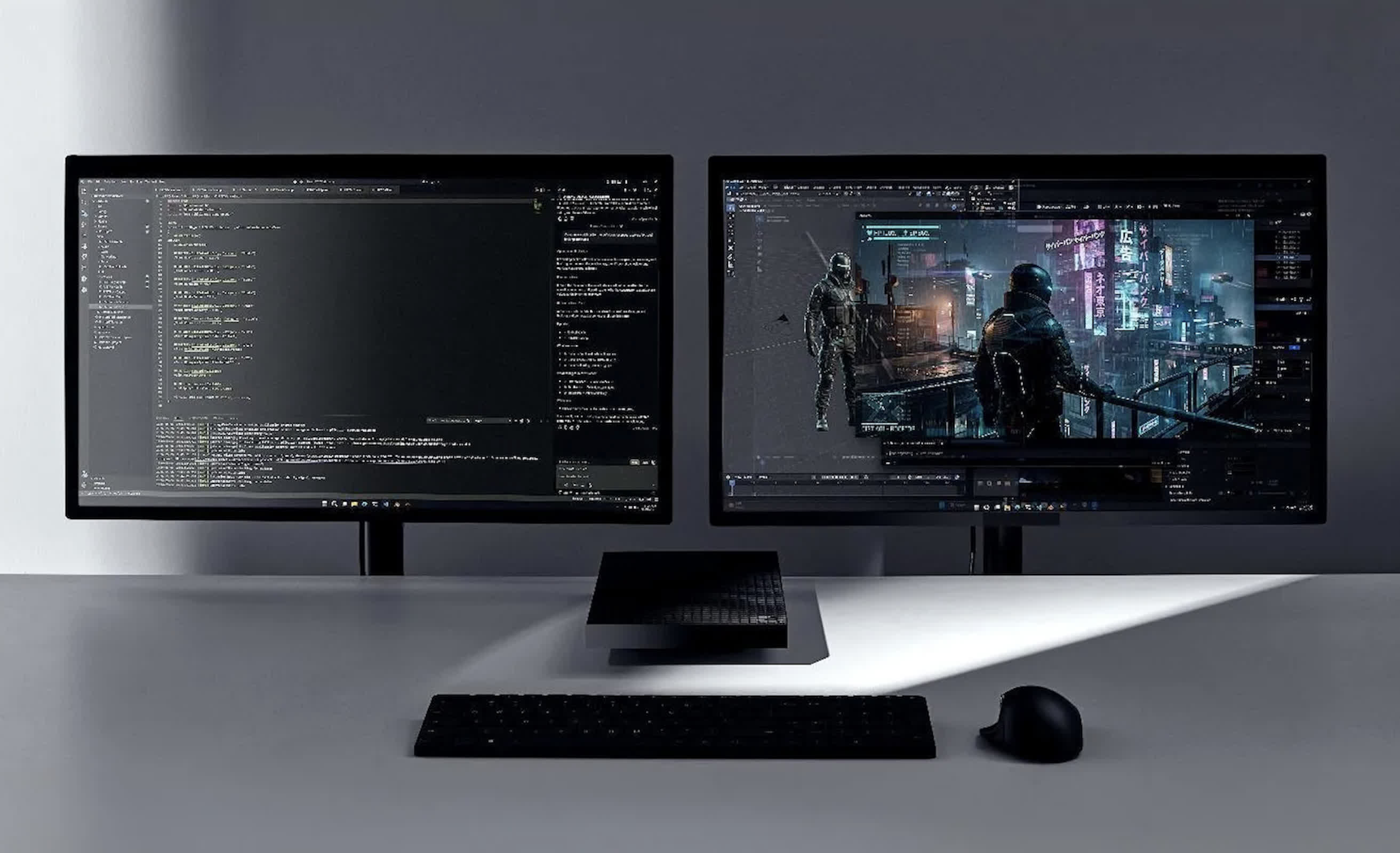
Andrew Hill, corporate vice president of Surface, said the Surface RTX Spark Dev Box comes with Windows 11 Pro pre-configured specifically for developers, with system-level settings designed to streamline workflows. Those defaults include a dark theme, a stripped-down taskbar, widgets turned off, Do Not Disturb enabled, Developer Mode enabled, and PowerShell 7 set as the default shell.
That level of pre-configuration may seem minor, but it reflects a broader shift. As AI development becomes more hardware-dependent, companies are beginning to treat the entire stack – silicon, system design, OS, and tools – as a single, integrated product. Microsoft's approach suggests it wants developers up and running immediately, without the usual hours spent configuring environments.
The timing is also notable. The Dev Box effectively steps into a space that Qualcomm had aimed to occupy with its Snapdragon Dev Kit, a Windows-on-Arm mini PC that never made it to market after running into hardware quality issues. Microsoft now appears to be aligning more closely with Nvidia's ecosystem instead, betting that its chips and software stack can better support the next phase of Windows-on-Arm development.
At the same time, the device enters a growing field of compact, AI-focused systems from various hardware partners built on Nvidia's RTX Spark platform. These machines are all exploring similar territory: how to bring serious AI compute into smaller, desk-friendly form factors without sacrificing performance.
Microsoft has yet to detail full specifications or pricing, but says the Surface RTX Spark Dev Box will go on sale later this year in the US, exclusively through its online store. For developers who want to keep large models on their own hardware rather than in the cloud, it could serve as a more focused alternative to a general-purpose desktop or laptop.