
In brief: Security cameras like those used by Flock in over 6,000 US communities have become increasingly controversial over concerns about privacy and government surveillance. Recent reports suggest that authorities are acutely aware of the mounting backlash and are obfuscating their use of the cameras in response.
A police usage policy for automatic license plate readers (ALPRs), recently obtained by 404 Media, provides an explicit example of how police departments avoid revealing when they use the AI-powered surveillance tools. Evidence suggests that authorities across the US only admit to using the cameras when absolutely necessary.
Flock cameras and other ALPRs are designed to feed license plates from passing vehicles into a searchable cloud database, which alerts officers to plates associated with serious crimes. Authorities have used them to track suspects' movements, but pushback is mounting for various reasons.
In some communities, a significant portion of ALPR reports have been false positives, leading to many unnecessary traffic stops and arrests. In one case in Ohio, an innocent man was mauled by a police dog, causing him to lose his job and home.
They have also been used to track individuals on foot, and at least 50 officers have been accused of using them for stalking. A similar number of communities have stopped using the cameras since early last year, so it is unsurprising that some departments deploy them in secret.
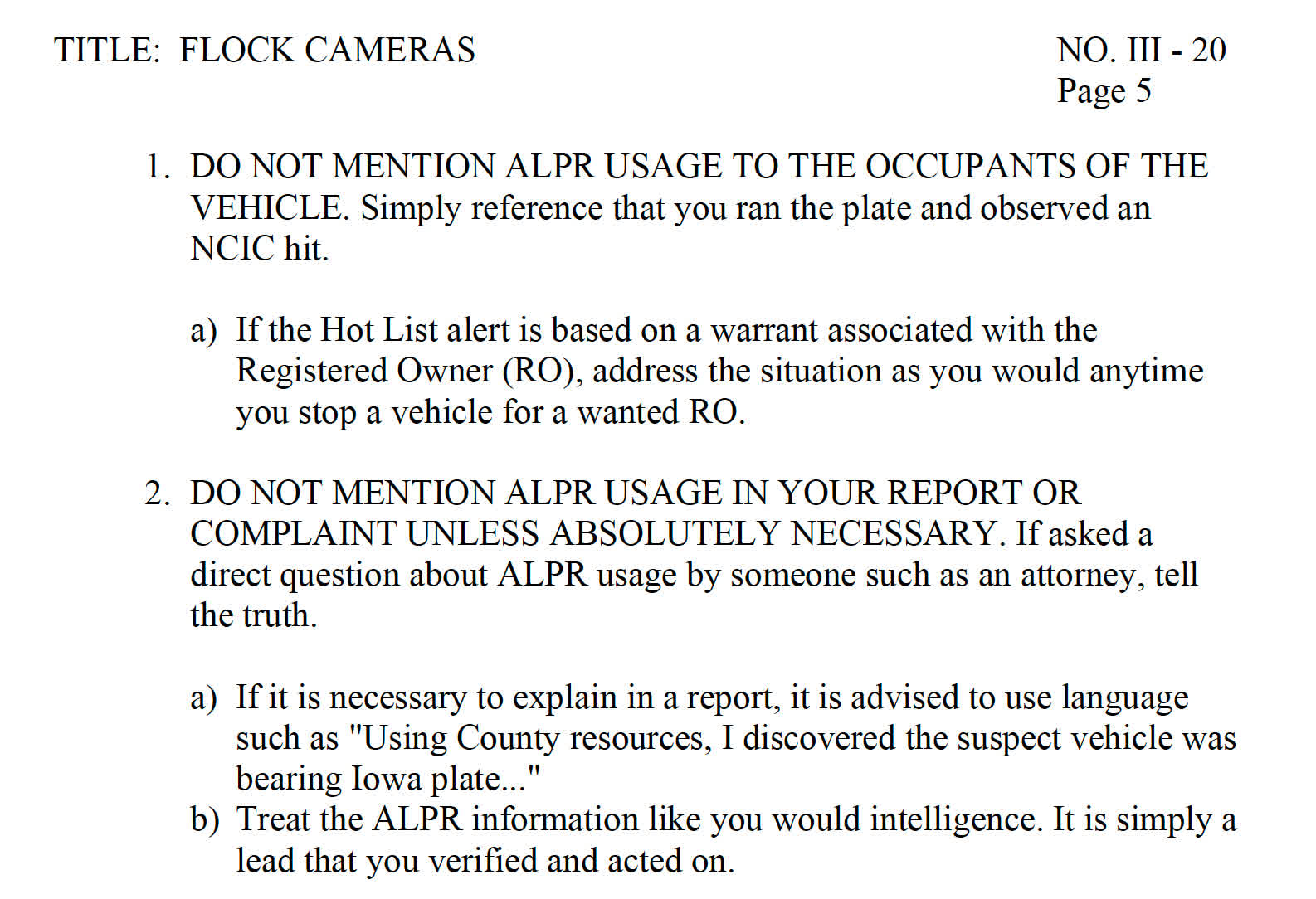
One usage policy advises police officers in Wapello County, Iowa – in all-caps text – never to mention ALPR usage when making traffic stops or writing reports. They are instructed to admit to using the cameras only when directly asked by a lawyer. Furthermore, even when required to mention the technology in reports, officers are advised to describe it vaguely as "county resources." Other departments have also advised officers to avoid explicitly mentioning ALPRs.
Such policies are reminiscent of how officers often obfuscate the use of stingrays, which track cell phone signals by spoofing cell towers. The devices have become so controversial that Android is introducing functionality to alert users to their presence.
Although some communities have adopted guidelines governing ALPR use, those guardrails have also prompted authorities to become more secretive. Officers are often advised to describe ALPR usage in vague terms in reports because they are subject to public information requests. In response to one such request, a sheriff claimed that police are attempting to prevent criminals from learning how to circumvent the cameras.
Concerned parties can check whether their local police department uses surveillance technology via the Electronic Frontier Foundation's Atlas of Surveillance.