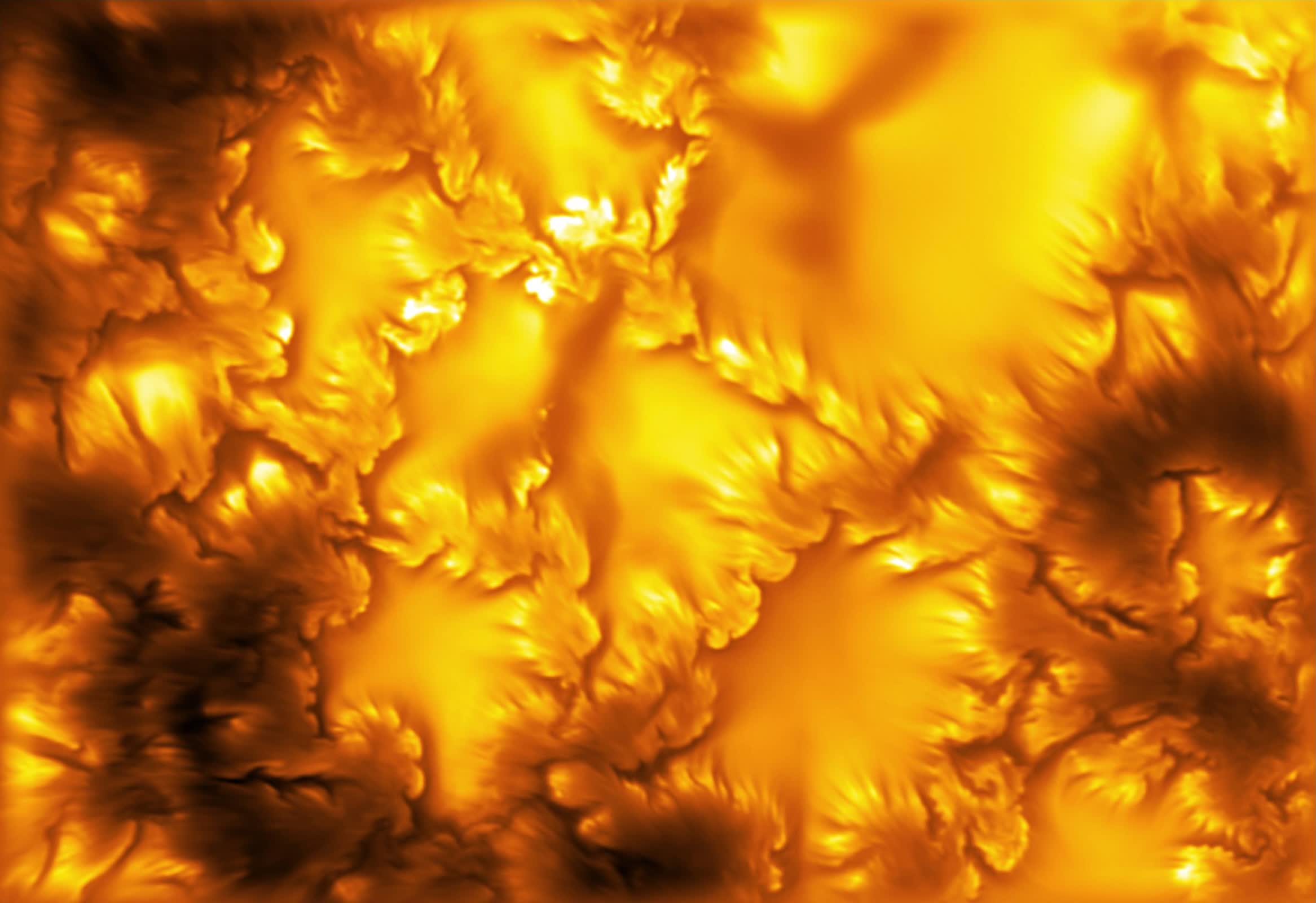
First look: Tiny whirlpools of magnetized plasma on the sun's surface have been captured in sharp detail for the first time, giving scientists a direct look at a long-predicted instability that could help explain how the sun stores and releases energy. Using the National Science Foundation's Daniel K. Inouye Solar Telescope on Maui, an international team recorded the highest-resolution images of the solar photosphere to date. In those images, they found dense fields of small, vortex-like structures along the edges of magnetic regions.
The patterns match what physicists expect from Kelvin-Helmholtz instability, a shear-driven effect seen in many fluids and plasmas but not previously resolved at such fine scales on the sun's visible surface. The results are detailed in a new paper in Nature, based on the telescope's 4-meter (13 foot) mirror and advanced optics that can resolve features only tens of kilometers wide.
The team focused on a magnetically active area near a sunspot, where convection cells, or granules, constantly rise and sink and magnetic fields are concentrated. In time-lapse sequences, they identified many tightly spaced vortices at the boundaries of these magnetic patches.
The distance between vortices – the instability wavelength – fell between 50 and 65 kilometers (31 to 40 miles) in both the telescope data and the numerical models, a close match that supports the idea that the structures are genuine plasma features, not artifacts.
Kelvin-Helmholtz instability occurs when neighboring layers of fluid or plasma move at different speeds, creating shear at the interface. Small disturbances grow into wave-like or spiral motions that can look like breaking waves on water or curved bands in clouds.
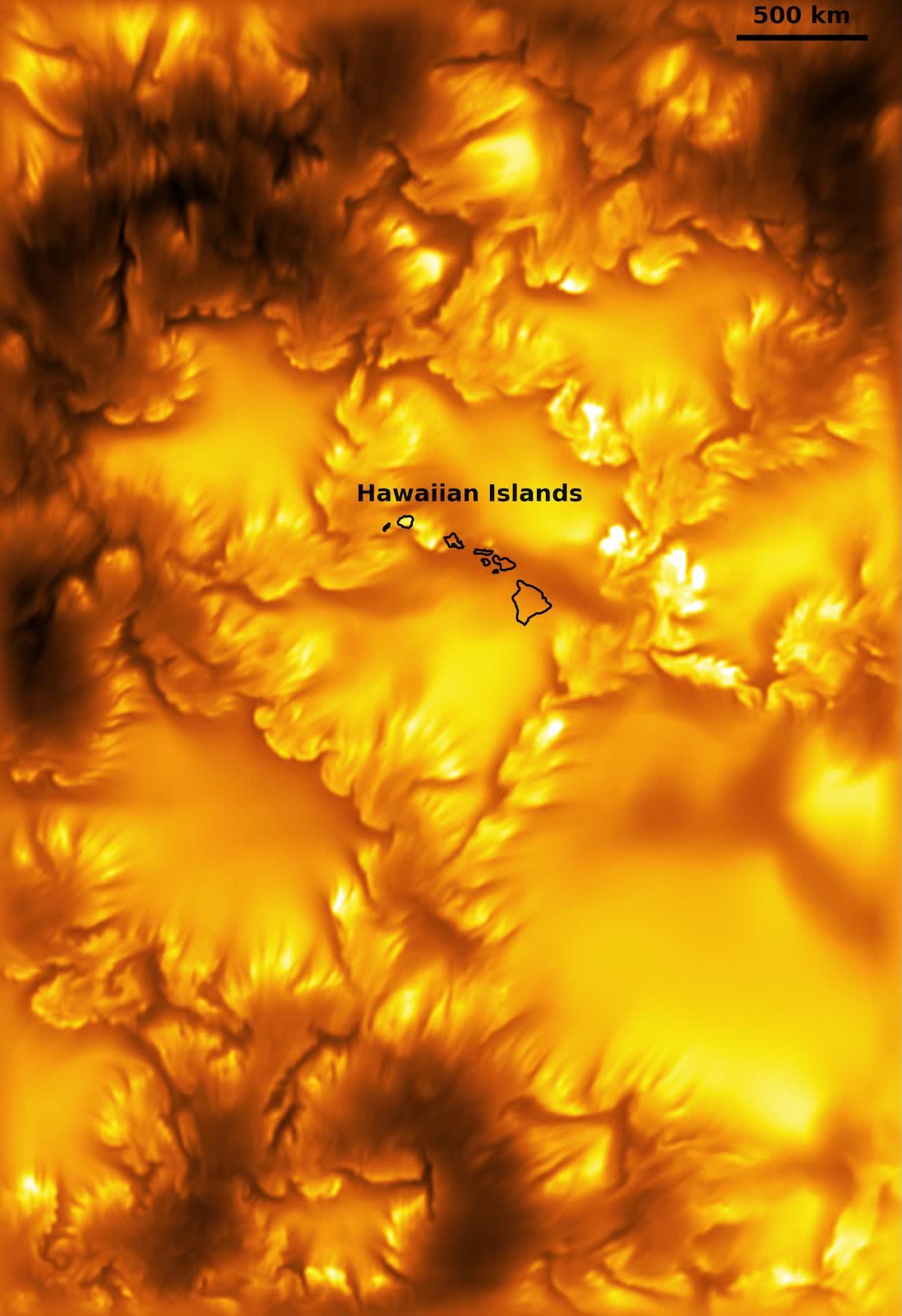
Scientists have documented the effect in Earth's atmosphere and oceans, in the atmospheres of gas giants such as Jupiter and Saturn, and in the interaction of the solar wind with planetary magnetic fields. On the sun, it had been predicted and hinted at in the outer corona, but direct confirmation in the photosphere required the resolution now available from the Inouye Solar Telescope.
"It has not been observed ever at that level on the solar surface," said study co-author Friedrich Wöger, a senior scientist at the National Solar Observatory.
To check their results, the researchers compared the telescope images with high-resolution magnetohydrodynamic simulations of the photosphere using the MURaM code. These simulations, developed by teams at the NSF NCAR High Altitude Observatory and the Max Planck Institute for Solar System Research, solve the core physics of plasma flow, radiation and magnetic fields. In both the simulated and observed data, fringe-like patterns at magnetic boundaries turned into similar swirling structures with comparable spacing and motion.
The work suggests that these small vortices may play more than a local role. Kelvin-Helmholtz structures can mix magnetized and non-magnetized plasma efficiently, speeding up the diffusion of magnetic fields through the lower solar atmosphere.
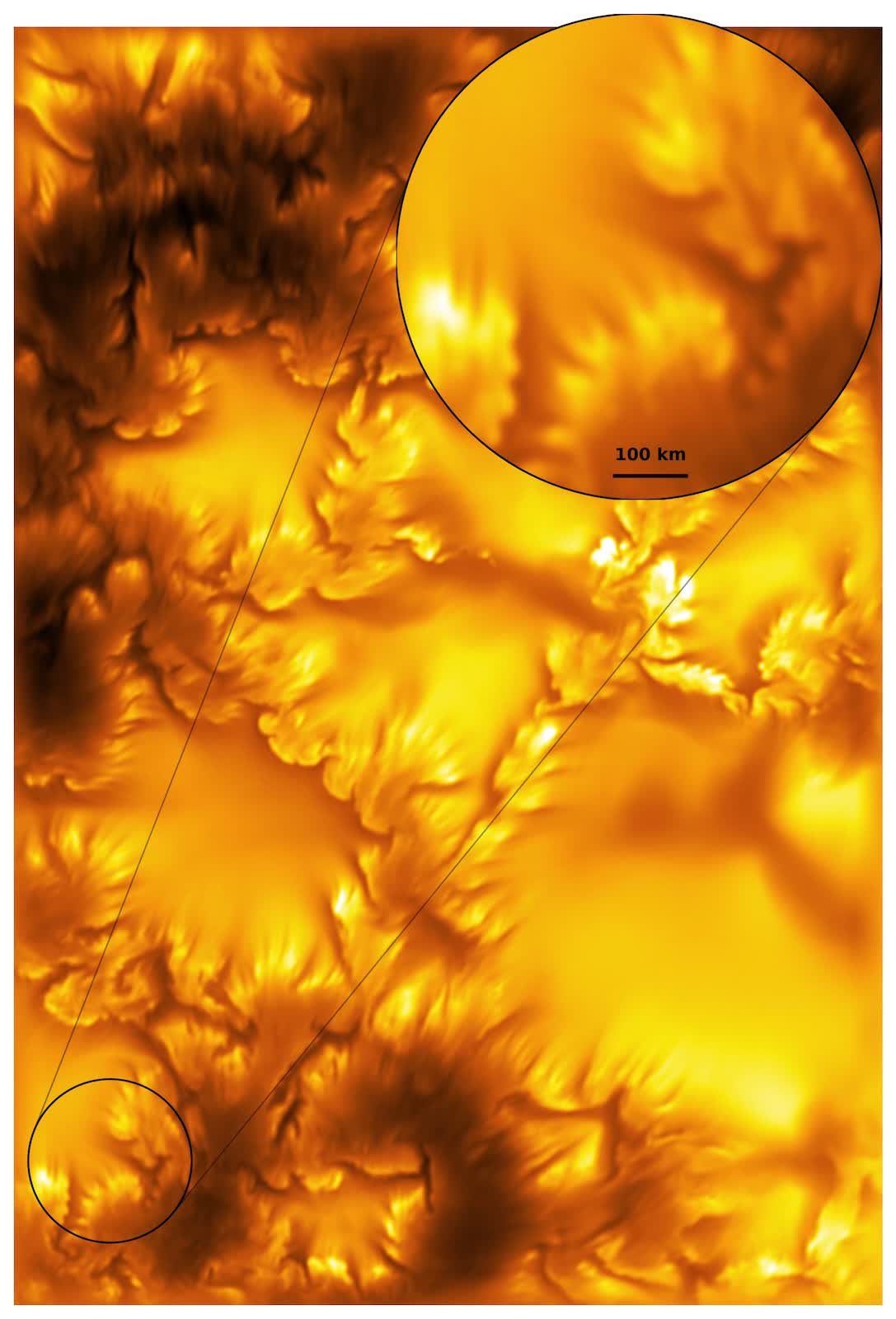
The analysis indicates that the mini-vortices help spread magnetic flux outward from granule edges, a process that could feed into models of the solar dynamo and the sun's 11-year magnetic cycle.
Dr. David Kuridze, an astronomer at the National Solar Observatory, explains that the sun's magnetic field comes from dynamo processes that convert the star's rotation into magnetic energy, but that energy has to spread out quickly to match the relatively short 11-year solar cycle. He says current models have trouble accounting for how fast this happens, and that the Kelvin-Helmholtz instability found in the photosphere could be an important source of the extra magnetic diffusion that has been missing from those explanations.
The findings also tie into questions about coronal heating and explosive events such as nanoflares, large flares and coronal mass ejections. A leading idea, called flux braiding, holds that magnetic field lines are twisted and braided by underlying motions until they reconnect and release stored energy.
What has been unclear is how that twisting is driven at small scales. Because the new vortices appear wherever strong magnetic fields meet shear flows from granulation, the team argues they may act as a steady driver, pushing twist into the magnetic field and helping move energy upward.
Next, scientists plan to use automated pattern-recognition tools to track Kelvin-Helmholtz signatures across larger data sets from the Inouye telescope. By running long-term, high-cadence observations through these algorithms, they hope to measure how much energy the instabilities carry into higher layers of the solar atmosphere and how much they affect magnetic field diffusion over time.
Those results are expected to refine space-weather models used to anticipate flares and coronal mass ejections that can disrupt power grids, satellites, GPS and communications.