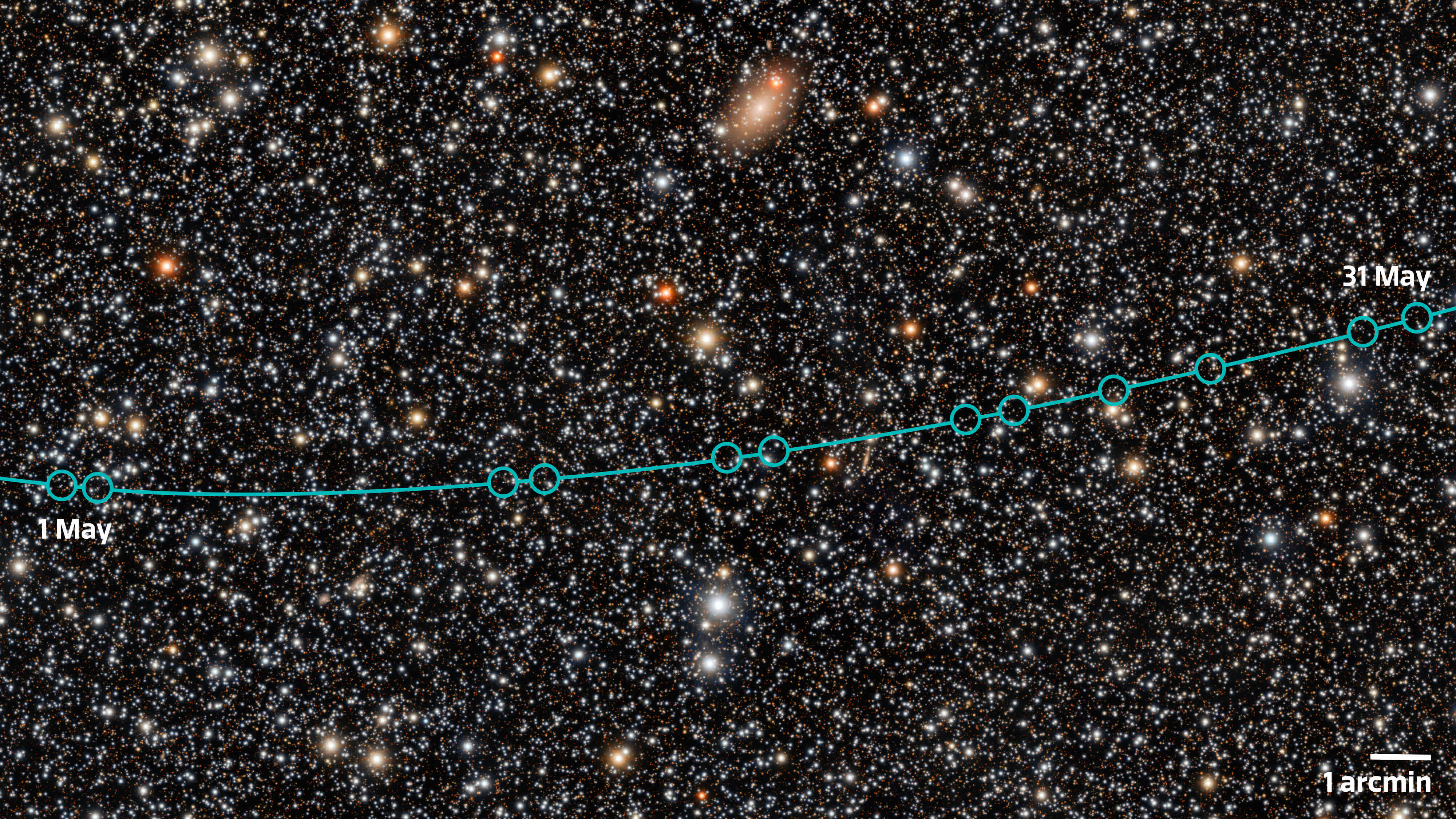
First look: The solar system's official roster of dwarf planets has held at five names since 2008. But a new observatory in Chile has spotted an icy world beyond Pluto that could become the sixth. It might also be the largest object found out past Neptune in about 20 years.
For now, the object announced by the Vera C. Rubin Observatory team earlier this week only goes by its provisional designation, 2026 ED138. It currently sits about 46 astronomical units from the Sun. Pluto, by comparison, averages around 40.
Nobody has measured its size directly yet. Instead, astronomers worked backward from how bright it looks at that distance, plus an estimate of how reflective its surface is, to arrive at somewhere between 600 and 1,500 km across. Even the middle of that range sits close to Ceres, the smallest dwarf planet on the official list. Rubin's solar system lead Mario Jurić put it at roughly 1,000 km and called it a once-in-a-generation kind of find.

It stayed hidden this long mostly because of where it sits in the sky. From Earth, ED138 lines up close to the plane of the Milky Way, where it's just one more faint dot against millions of background stars.
But Rubin photographs the whole southern sky every few nights with the largest digital camera ever built for astronomy, so the same dot keeps turning up in a slightly different spot. On October 13, Harvard & Smithsonian astrophysicist Matthew Holman ran data from earlier this year through a search code he wrote with colleague Kevin Napier.
ED138 caught his eye because it looked far too bright for something that far out. Holman admitted his first instinct was to check whether he or the code had messed up.
Jurić's search through Rubin's catalog put that doubt to rest – the object shows up in 30 images across 20 nights between March and July. Older survey images push its track all the way back to 2016, too.
None of that settles whether it's a dwarf planet, though. To earn the label, an object has to be massive enough for its own gravity to pull it round. Confirming that for ED138 will take infrared observations that can nail down its true size.
Even then, an official title could take a while. Quaoar and Gonggong are already treated as dwarf planets in plenty of research papers, yet the International Astronomical Union still hasn't added either one to its list. In the meantime, anyone curious can follow ED138's orbit in 3D on Orbitviewer.