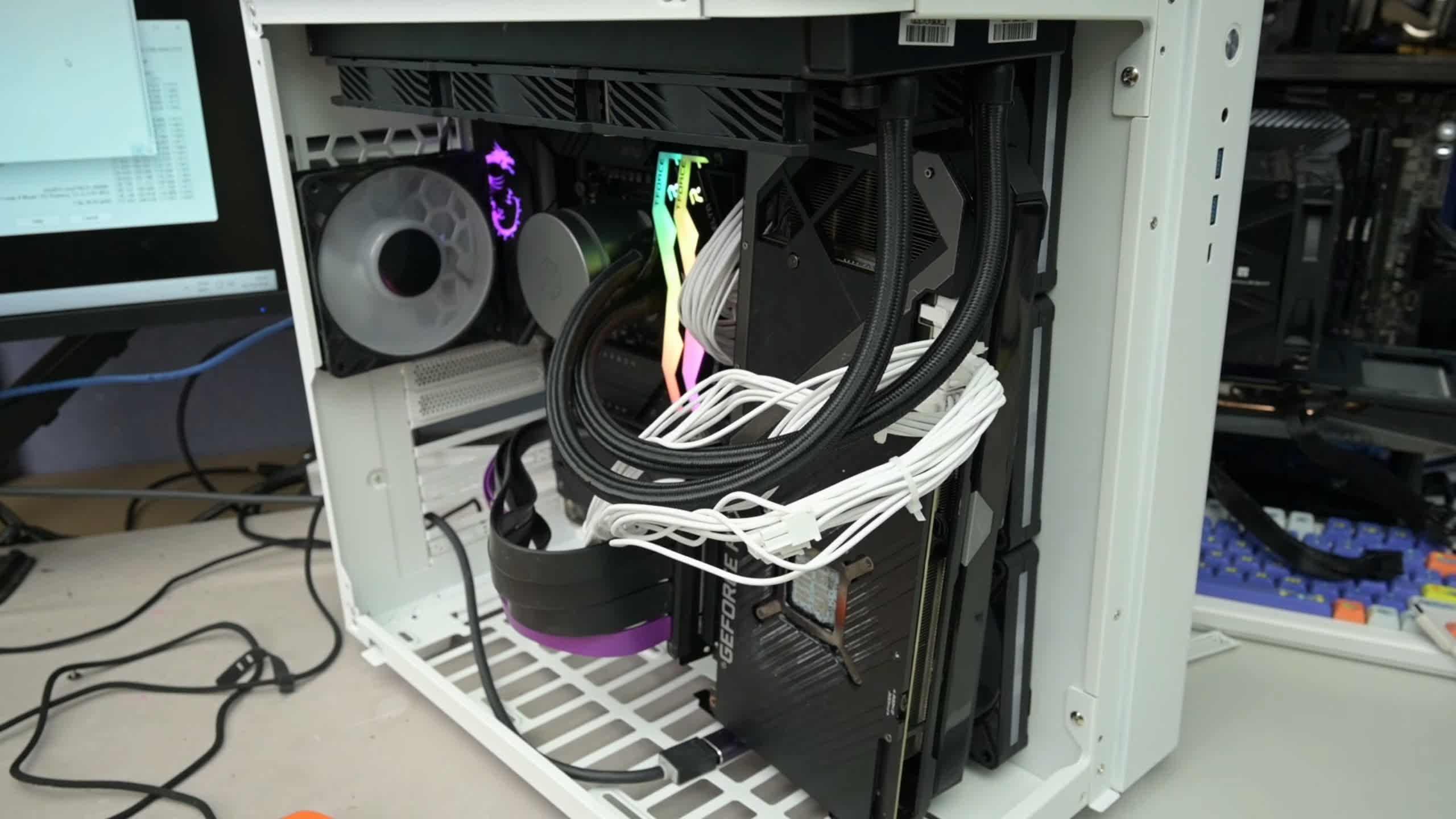
In a nutshell: PC builders have long tried to find the most optimal cooling setups for their components, moving around fans, cables, etc. to find the best configurations. A YouTube channel decided to try something a little different: moving the components themselves. This included shifting the GPU next to a case's side-intake, which resulted in a 17-degree drop in temperatures.
The experiment was carried out by TrashBench, which used an Asus ROG Strix RTX 3080 inside a dual-chamber case. The cooling came from three side-intake fans, a rear exhaust, and a top-mounted 360mm CPU AIO.
The idea was to change component placement without moving the case fans. PCIe riser cables were used so the graphics card could be moved away from its usual slot on the motherboard.
Testing involved looping 3DMark Time Spy alongside 7-Zip running on 12 CPU threads. All fans stayed at fixed RPMs, with each configuration tested for ten minutes and temperatures averaged over the final five.
The GPU's first position was on the case floor, which required the removal of the bottom mesh because it touched the card's fans. GPU temperatures barely changed, but the CPU and motherboard VRM dropped around 4°C and 7°C, respectively. Conventional vertical mounting slightly worsened GPU temperatures while modestly improving everything else.
However, placing the card directly against the side intake made all the difference. GPU core temperatures fell 16.7°C, the hotspot dropped 19.3°C, and VRAM cooled by 14°C. Motherboard VRMs also dropped around 8°C, while the CPU warmed just 1.1°C.
Moving the card behind those intake fans, into the rear chamber, improved on stock temperatures but couldn't match the previous arrangement.
Next came the CPU. Relocating its radiator would have introduced another variable, so TrashBench placed the GPU back in its usual position and reversed the radiator fans from exhaust to intake. CPU temperatures dropped about 6°C, but the graphics card suffered from the radiator's warm exhaust.
Combining the intake radiator with the GPU beside the side intake improved both components over stock. It led to a 3.3°C reduction in CPU temperature and a 14°C cooler GPU hotspot, sacrificing some GPU cooling for a better overall balance.
TrashBench acknowledges that the experiment wasn't rigorously scientific, and different cases, fans, and fan positions will likely change the results. But as the channel points out, it illustrates how the normal PC layout might not be the best one.
TrashBench carries out lots of experiments like these. Last year, it strapped dual CPU tower coolers to an RTX 2060, cutting temperatures by 31°C.