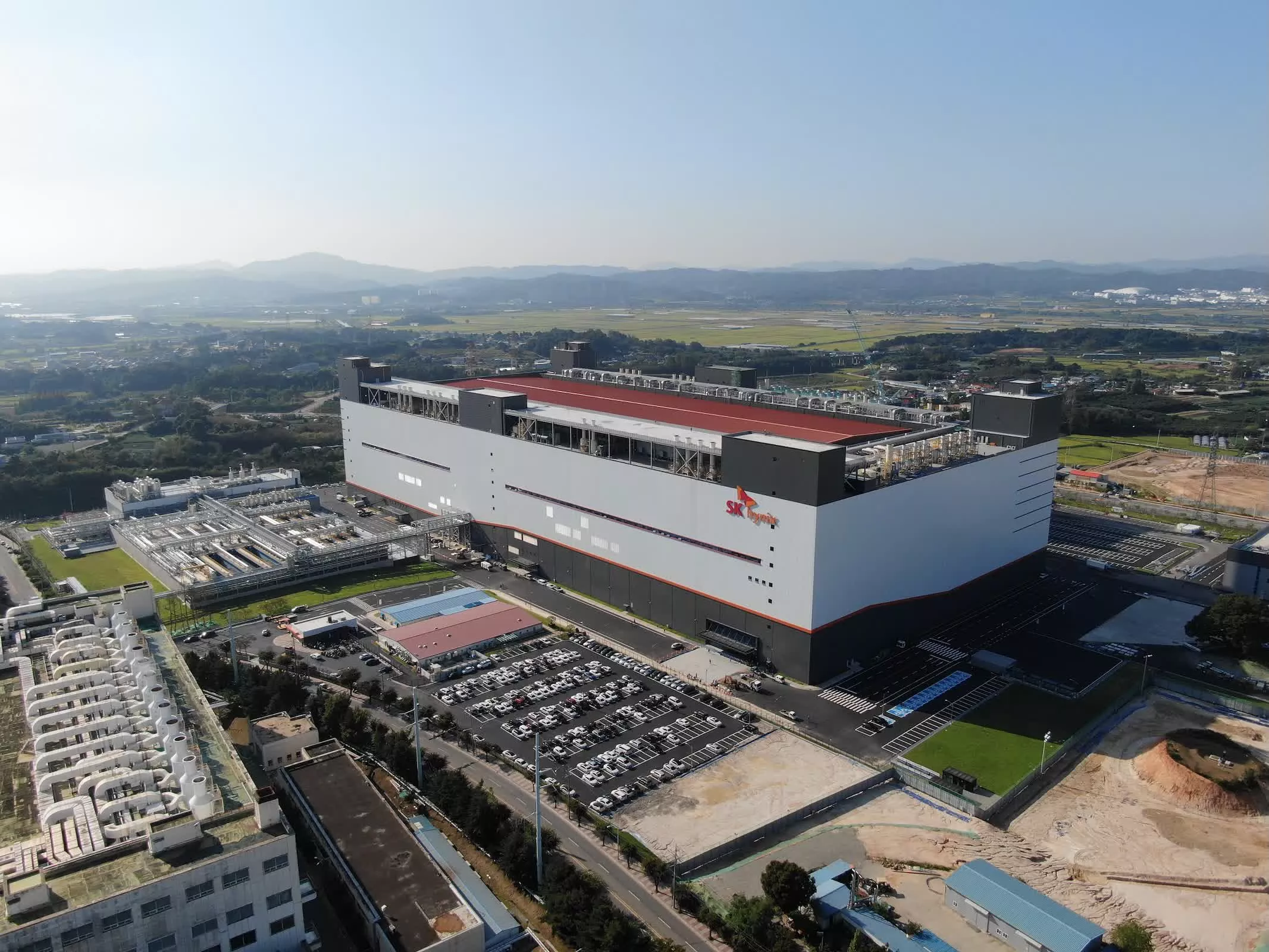
What we know so far: The US Commerce Department is holding up export licenses SK Hynix needs to ship American chipmaking equipment to its NAND memory plant in Dalian, China, according to people familiar with the matter. The delay is complicating the South Korean chipmaker's plan to build memory plants in New York. SK Hynix argues that more production in Dalian would help pay for the US project, but Commerce has said it does not plan to license equipment that would expand or upgrade chip plants in China.
Two people told Reuters that Solidigm, SK Hynix's US subsidiary, plans to spend about $45 billion on two NAND fabs in Marcy, New York. That figure could grow to about $100 billion over time. The company needs to increase output in Dalian and make more advanced NAND there to fund the US project and keep up with competitors, the people said.
The dispute turns on what counts as expansion. SK Hynix argues that putting tools into empty floor space in Dalian would not add capacity because it built the cleanroom in 2023. Commerce stated its position on upgrades and expansion in August 2025, and at a meeting last week, Under Secretary Jeffrey Kessler held to it, one person said. Still, the department has not formally denied the license to fill the empty space.
Solidigm executives have met with Commerce officials nearly 10 times since late August. At a late-August meeting, co-CEO Richard Chin and other executives met with Commerce Secretary Howard Lutnick and Kessler.
The officials seemed excited about a US NAND facility and eager to find a solution, one person said. Since then, the company has written several versions of its license applications, revising them together with the department. A separate license for 2027, covering equipment to maintain the Dalian plant, is also being negotiated.
The Treasury Department is involved, too. It would have to waive outbound investment restrictions before SK Hynix could buy tools for China. Company representatives have met with Treasury officials, who said they would wait to see what Commerce decides.
The talks test how far the Trump administration will bend national security rules meant to keep US technology from helping China's military in order to bring chip investment onshore.
"Ultimately, none of this is going to go forward without a green light from the White House," Leland Miller, a member of the US-China Economic and Security Review Commission, a bipartisan panel created by Congress, told Reuters.
New York officials are watching the calendar. "Hopefully we'll have an answer in the next couple of weeks," said Anthony Picente, county executive for Oneida County, where the plant would be built. He noted that a federal investment tax credit expires at year's end.
Solidigm has also looked at other ways to pay for the project. It explored an initial public offering to fund US production and keep up with rising memory demand. In an October 23 statement, SK Hynix said it had halted that review because of market conditions and share price trends. "Expanding Solidigm's production capacity and strengthening its competitiveness remain important priorities," the statement said.
The company, based in Rancho Cordova, California, has not committed to a site. "As a US-founded and headquartered company, Solidigm regularly evaluates strategic alternatives to best serve its customers and enhance its long-term competitiveness. The company is currently exploring options for building a NAND memory fab at potential locations around the world. No decision regarding any specific course of action has been made," Solidigm said in a statement last week. It has stood by that statement since then.
The Dalian problem goes back to 2020, when SK Hynix agreed to buy Intel's NAND factory there for $9 billion. It took control of the plant and Intel's solid-state drive business shortly before the US imposed broad export controls on American chipmaking equipment going to what it considered advanced fabs in China.
Foreign-owned plants in China were initially exempt. Last year, Commerce revoked those authorizations, calling them a "Biden-era loophole." It replaced them with annual licenses that let suppliers ship certain equipment and technology to the fabs, with quantity limits.