
For months we have been gathering and gradually testing AMD B850 motherboards, and we are finally ready to share the data for the most affordable models we have on hand. There is a lot to cover, so let's get started.
This first part of the roundup comprises 23 motherboards, while part 2 will feature an additional 20+ models that are a tad more expensive, and we will include the combined data for all B850 boards in that huge roundup.
Update: The second part of this roundup is now complete, for a total of 47 AMD B850 motherboards tested.

The Big Spec Table
Here are all the motherboards included in this roundup, in order of appearance...
| Mobo | Price | Vcore VRM | PCIe x16 | M.2 (Gen 5.0) | M.2 (Gen 4.0 / 3.0) | USB 3.x | USB 2.0 | WiFi | LAN |
|---|---|---|---|---|---|---|---|---|---|
| Asrock B850M-X | $110 | 6, 50A | 2 | 1 | 1 | 7 | 6 | - | 2.5 GbE |
| Asrock B850M-X R2.0 | $130 | 6, 50A | 2 | 1 | 1 | 7 | 6 | WiFi 6E | 2.5 GbE |
| Asrock B850 Pro-A | $140 | 14, 80A | 2 | 1 | 3 | 9 | 9 | - | 2.5 GbE |
| Asrock B850M Pro-A | $140 | 8, 50A | 1 | 1 | 2 | 9 | 8 | - | 2.5 GbE |
| Asrock B850M Pro RS | $150 | 8, 60A | 1 | 1 | 2 | 9 | 8 | WiFi 6E | 2.5 GbE |
| Asrock B850M Riptide WiFi | $170 | 12, 60A | 1 | 1 | 2 | 9 | 8 | WiFi 7 | 2.5 GbE |
| Asrock B850 Pro RS | $180 | 14, 80A | 2 | 1 | 3 | 11 | 10 | - | 2.5 GbE |
| Asrock B850M Steel Legend | $180 | 12, 60A | 1 | 1 | 2 | 9 | 8 | WiFi 7 | 2.5 GbE |
| Asrock B850 LiveMixer WiFi | $190 | 14, 80A | 1 | 1 | 2 | 11 | 12 | WiFi 7 | 2.5 GbE |
| Asrock B850I Lightning WiFi | $200 | 10, 110A | 1 | 1 | 1 | 7 | 6 | WiFi 6E | 2.5 GbE |
| Asrock B850 Riptide WiFi | $200 | 14, 80A | 2 | 1 | 3 | 12 | 8 | WiFi 7 | 2.5 GbE |
| Asus Prime B850M-K | $150 | 4-Phase doubled MOSFETs | 2 | 1 | 1 | 7 | 8 | - | 2.5 GbE |
| Asus Prime B850-Plus WiFi | $180 | 8, 60A | 4 | 1 | 2 | 9 | 8 | WiFi 6E | 2.5 GbE |
| Gigabyte B850M DS3H | $150 | 8, 60A | 2 | 1 | 1 | 7 | 8 | - | 2.5 GbE |
| Gigabyte B850M Gaming X WiFi6E | $160 | 10, 60A | 2 | 1 | 1 | 7 | 8 | WiFi 6E | 2.5 GbE |
| Gigabyte B850 Gaming WiFi6 | $160 | 6, 60A | 4 | 1 | 2 | 8 | 8 | WiFi 6E | Gigabit |
| Gigabyte B850 Eagle WiFi6E | $165 | 8, 60A | 4 | 1 | 2 | 8 | 8 | WiFi 6E | Gigabit |
| Gigabyte B850M Eagle WiFi6E | $165 | 8, 60A | 2 | 1 | 1 | 7 | 8 | WiFi 6E | 2.5 GbE |
| Gigabyte B850 Gaming X WiFi6E | $180 | 12, 60A | 3 | 1 | 2 | 8 | 7 | WiFi 6E | 2.5 GbE |
| Gigabyte B850M Aorus Elite WiFi6E Ice | $185 | 12, 60A | 2 | 1 | 1 | 10 | 8 | WiFi 6E | 2.5 GbE |
| MSI Pro B850M-P WiFi | $160 | 7-Phase MOSFETs | 4 | 1 | 2 | 9 | 8 | WiFi 7 | 5 GbE |
| MSI Pro B850M-A WiFi | $180 | 8, 60A | 2 | 1 | 1 | 11 | 4 | WiFi 7 | 5 GbE |
| MSI B850 Gaming Plus WiFi | $190 | 6-Phase doubled MOSFETs | 4 | 1 | 2 | 9 | 8 | WiFi 7 | 5 GbE |
The Motherboards
Asrock B850M-X
We will start with the Asrock B850M-X. A few weeks ago this model was still available, but at the time of preparing this content it is out of stock. We mention this because a newer R2.0 version of the board is now available, which we have on hand, and we believe Asrock is shifting production to the updated model.
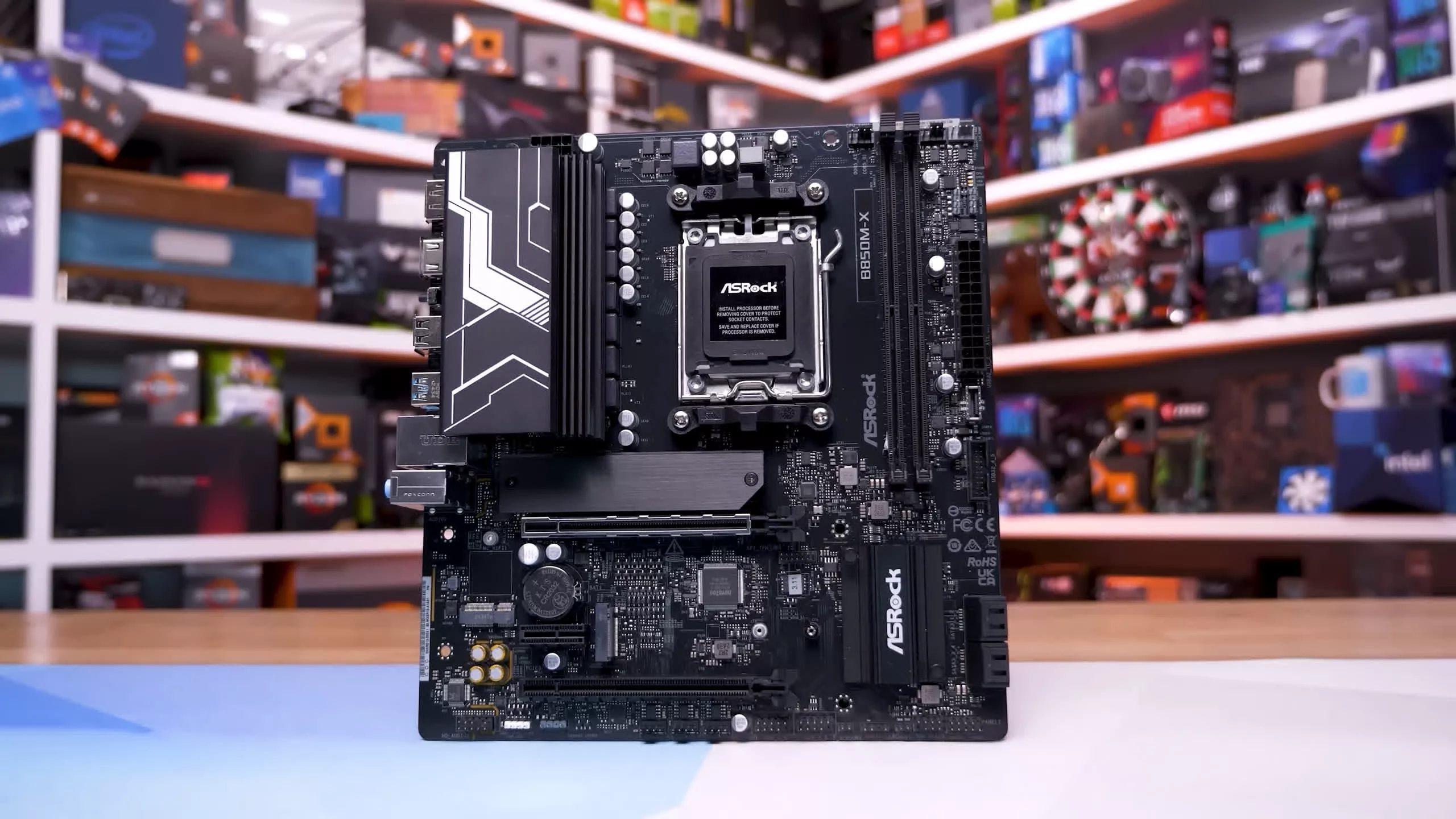
If you come across the original Asrock B850M-X, it was selling for $110, making it the most affordable B850 motherboard on the market. The board features six 50A power stages for the vcore, which is fine for Ryzen 5 and 7 processors, you might not want to min/max if you plan to push a Ryzen 9. The other limitation is that the primary PCIe x16 slot only supports PCIe 4.0, and this is where the updated revision comes into play.


Asrock B850M-X R2.0
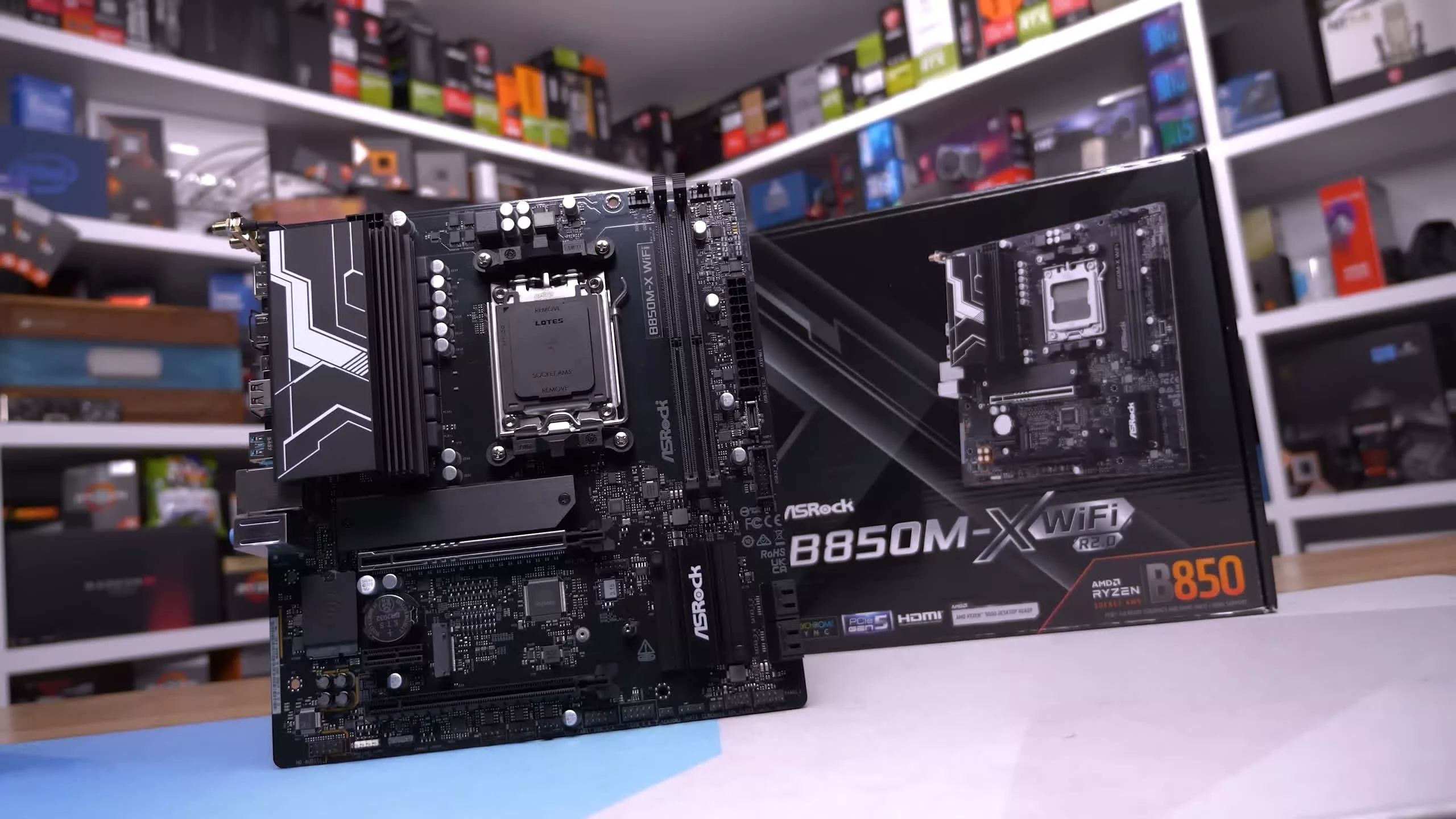
The R2.0 version updates the primary PCIe x16 slot to PCIe 5.0, but otherwise remains identical to the original version. It still uses six 50A power stages for the vcore, so VRM performance is unchanged. The most notable difference is the price, which is $130, a $20 increase for PCIe 5.0 support.
Asrock B850 Pro-A
Next are the Asrock Pro-A series boards, both priced at $140. Starting with the ATX model, the B850 Pro-A, this board features 14 80A power stages for the vcore, a significant upgrade over the B850M-X R2.0 for only $10 more.
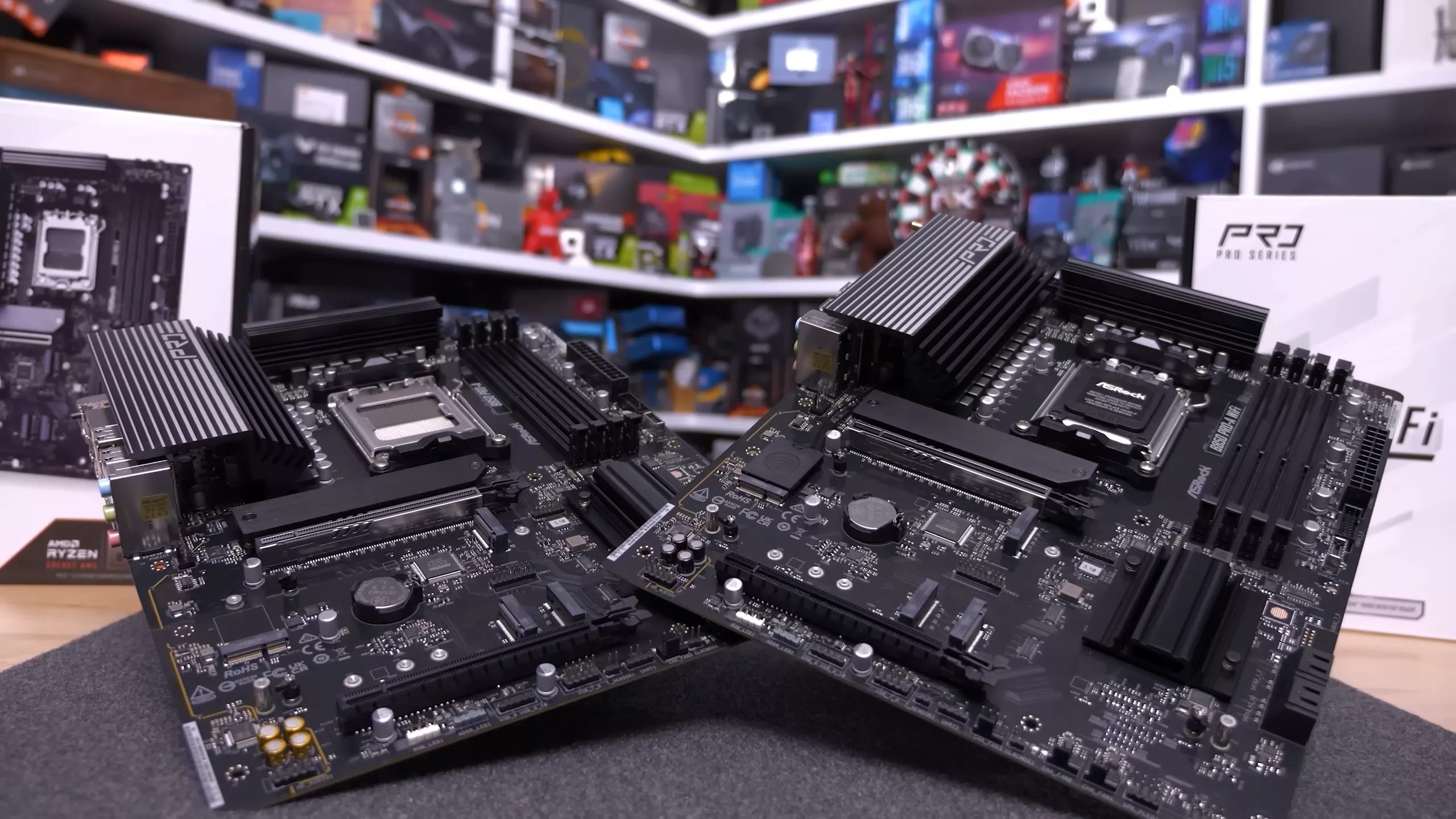
It also includes twice as many M.2 slots, two additional USB 3.2 ports for a total of nine, plus the potential for three more USB 2.0 ports, also bringing that total to nine. This makes it a much better-equipped board overall, though it is a different form factor. The only notable omission is a pre-installed I/O shield.

Asrock B850M Pro-A
The B850M Pro-A is also priced at $140, slightly more than the B850M-X R2.0, but it is far less impressive than the ATX version. The I/O panel is limited, with only four USB 3.2 ports and four USB 2.0 ports, and it too lacks a pre-installed I/O shield. There is also one fewer M.2 slot, though with three in total it is still reasonably equipped.

Power delivery consists of eight 50A power stages, making it better than the M-X but much weaker than the ATX Pro-A. It remains a solid upgrade over the B850M-X R2.0, and in our view, it is the better value of the two mATX boards.
Asrock B850M Pro RS
At $150, the B850M Pro RS is where the boards begin to look more serious. It comes with larger VRM heatsinks and a pre-installed I/O shield. However, power delivery remains the same as the B850M Pro-A with eight 50A power stages for the vcore, meaning there is no improvement in actual performance. In reality, this is simply a dressed-up version of the Pro-A.

Behind the pre-installed I/O shield is the same layout, so the $10 increase essentially gets you silver heatsinks and the shield.

Asrock B850M Riptide WiFi
The B850M Riptide WiFi is where things become more substantial, though the price climbs to $170. For that, you get 12 60A power stages for the vcore, which can comfortably handle any AM5 processor you install. It also comes with WiFi 7 as standard.

Other improvements include two M.2 heatsinks instead of one, a larger release mechanism for the primary PCIe x16 slot, and a slightly larger VRM heatsink. Overall, this is a strong board that should deliver excellent performance.

Asrock B850 Pro RS
The reason the B850 Pro-A is so well equipped is that it is based on the same design as the B850 Pro RS, though the Pro-A costs just $140. The Pro RS, on the other hand, is currently $180. At nearly 30% more, what does the Pro RS offer?

On the surface, you are getting a better-looking board. The chipset heatsink is larger, the bottom two M.2 slots share a single large heatsink with RGB lighting, and the VRM heatsink is also larger. A pre-installed I/O shield is included as well. The VRM itself remains the same with 14 80A power stages for the vcore.

There are additional USB ports available, though the I/O configuration is otherwise unchanged. You do, however, get an extra USB 3.2 Gen1 header onboard and an additional USB 2.0 port. Both the Pro RS and Pro-A also have WiFi versions, though they cost more.

Asrock B850M Steel Legend
Next is the B850M Steel Legend, Asrock's most expensive mATX motherboard in the sub-$200 price range. This board is essentially a B850M Riptide WiFi with a different aesthetic, featuring a white design rather than black. At the time of preparing this content, it costs $10 more. If you are looking for a white mATX board, this model makes sense.

To recap, it features 12 60A power stages for the vcore, WiFi 7 as standard, nine USB 3.2 ports, eight USB 2.0 ports, and 2.5 Gbit LAN, which seems to be standard across all B850 motherboards. That sums up the B850M Steel Legend.

Asrock B850 LiveMixer WiFi
At $190 we find the B850 LiveMixer WiFi. Unlike previous LiveMixer boards, it does not feature the bright colors that made the series stand out, which may disappoint some, though this more neutral look will likely appeal to a wider audience. As expected, the LiveMixer is an upgraded version of the Pro RS, priced just $10 higher.

For the additional cost you get WiFi 7 and an extra PCIe x16 slot, though one M.2 slot is removed, leaving three in total. The primary M.2 now has a tool-less design.

There are also two extra USB 2.0 ports on the I/O panel, though one fewer USB 3.2 Type-C port, with the total number of USB 3.2 ports remaining the same. For the additional $10, the LiveMixer is a solid upgrade, especially if you need WiFi.

Asrock B850I Lightning WiFi
If you want a Mini-ITX B850 motherboard for $200 or less, there is only one option: the Asrock B850I Lightning WiFi. Competing models such as the MSI B850I Edge Ti WiFi and the Gigabyte B850I Aorus Pro cost over $250, making them significantly more expensive.

The B850I Lightning WiFi includes a single PCIe 5.0 x16 slot, two DIMM slots, two M.2 slots (with the primary supporting PCIe 5.0), two SATA ports, seven USB 3.2 ports, six USB 2.0 ports, WiFi 6E, and 2.5 Gbit LAN. It has all the essentials, and at $200, it is by far the most affordable Mini-ITX B850 motherboard.


Asrock B850 Riptide WiFi
Also priced at $200 is the B850 Riptide WiFi, which is a slightly upgraded version of the B850 Pro RS, much like the LiveMixer. For $20 more than the Pro RS, the Riptide WiFi adds WiFi 7 and one additional USB 3.2 port on the I/O panel. That is the extent of the changes. It is worth choosing if you want WiFi support, otherwise the Pro RS remains the better option.

Asus Prime B850M-K
The most affordable Asus B850 motherboard we were able to purchase is the Prime B850M-K. Although Asus is mass producing this model, they did not provide a sample, claiming that Prime B850 motherboards are not being sold in Australia or the United States. We fully expect them to appear in both markets at some point.

Despite this, we were able to buy the B850M-K directly from the official Asus store on Amazon Australia for $280 AUD. It is questionable that Asus refused to provide its Prime series for evaluation and comparison against competitors. Regardless, we invested well over $1,000 in entry-level Asus B850 motherboards to complete this review.

So what does the B850M-K offer? In terms of power delivery, not much. Asus claims an 8-phase vcore, though it appears to be a 4-phase design with doubled components, using Vishay A12B and A14B discrete MOSFETs. This is essentially the bare minimum.

The board includes two PCIe x16 slots, two M.2 slots, two SATA ports, a basic USB configuration with seven USB 3.2 ports and eight USB 2.0 ports, no WiFi, and standard 2.5 Gbit LAN.

It is an incredibly basic motherboard, and based on Australian pricing relative to other models, it would likely sell for around $150 in the United States. That is the same price as the Asrock B850M Pro RS, which is far superior. Let's move on to the next Asus board we had to purchase ourselves.
Asus Prime B850-Plus WiFi
The Prime B850-Plus WiFi is another model Asus refused to supply. It would retail for around $180, though in Australia it is sold directly by the Asus store for $460 AUD. This places it in competition with the Asrock B850 Pro RS, Gigabyte B850 Gaming WiFi6, and MSI B850 Gaming Plus WiFi, which we will review shortly.

The most distinctive feature of this board is its four PCIe x16 slots. However, only the primary slot is wired for the full x16 bandwidth. Two slots are wired for x1 and one slot for x4.

The VRM is again underwhelming, relying on less efficient discrete MOSFETs. USB support is typical but not as strong as most boards at this price point. There are six USB 3.2 ports and two USB 2.0 ports on the I/O panel, along with a pre-installed I/O shield. The board also includes three M.2 slots and two SATA ports.

Overall, the feature set is decent, but the weak VRM design is a major drawback. We suspect this is the real reason Asus avoided providing samples of the Prime series.
Gigabyte B850M DS3H
Moving on to Gigabyte, we start with the B850M DS3H, priced at $150. This board features eight 60A power stages for the vcore, which should be sufficient. However, Gigabyte has limited the board to 170W. This is enough to get maximum performance from most Ryzen processors, but it slightly restricts the 9950X.

Compared with the Asrock B850M Pro-A, the DS3H has one fewer M.2 slot, offering only two, and two fewer USB 3.2 ports. A unique feature of this board is the inclusion of two DisplayPort outputs alongside HDMI, allowing simultaneous triple displays when paired with a Ryzen CPU featuring an iGPU. Overall, it is a solid entry-level motherboard, quite similar to the Asrock B850M Pro-A.

Gigabyte B850M Gaming X WiFi6E
For just $10 more, Gigabyte offers the B850M Gaming X WiFi6E. A clear advantage is WiFi6E support. You also get larger heatsinks, a pre-installed I/O shield with cover, an easier quick-release mechanism for the primary PCIe x16 slot, and some RGB lighting.

More important than the aesthetic upgrades is the improved VRM. The vcore is powered by ten 60A power stages in a 5-phase configuration. For just $10 more, the Gaming X WiFi6E is a significant upgrade over the DS3H, and unlike the DS3H, it is not power limited.

Gigabyte B850 Gaming WiFi6
The most affordable ATX B850 motherboard from Gigabyte is the B850 Gaming WiFi6, priced at $160. It is an unusual product in several ways. Most notably, it has the weakest VRM of all Gigabyte B850 motherboards, with just six 60A power stages for the vcore. This makes it even weaker than the DS3H, and as a result, it is more aggressively power limited to 150W.

The PCI Express slot layout is also unusual. In addition to the primary PCIe 5.0 x16 slot, there are three PCIe 3.0 x16 slots, but all three are wired for only x1 bandwidth and crammed together at the bottom of the board. You might consider using one for a faster network controller, since this model does not include the typical 2.5 Gbit LAN, instead relying on an outdated Gigabit connection.

The board provides three M.2 slots, four SATA ports, eight USB 3.2 ports, eight USB 2.0 ports, and WiFi 6E. Overall, the feature set feels mismatched, but the real weakness is the VRM, which makes this model difficult to recommend when better choices are available for the price.
Gigabyte B850 Eagle WiFi6E
For just $5 more, Gigabyte offers the B850 Eagle WiFi6E, which is almost identical to the B850 Gaming WiFi6 but without the VRM power limits. It features the same eight 60A power stage configuration as the DS3H, though unlike the DS3H, Gigabyte did not impose a power cap here, possibly due to the larger heatsinks.

For only $5 more, it is a significantly better choice than the B850 Gaming WiFi6, though it still relies on standard Gigabit LAN rather than 2.5 Gbit LAN.

Gigabyte B850M Eagle WiFi6E
The B850M Eagle WiFi6E is the MicroATX variant, priced at $165. Like the DS3H, it is power limited to 170W. At this price, it competes with boards such as the Asrock B850M Riptide WiFi.

Compared with the Riptide, its VRM is weaker, with only eight 60A power stages versus twelve on the Asrock. It also offers one fewer M.2 slot, just two in total, and two fewer USB 3.2 ports. Additionally, it includes WiFi 6E rather than WiFi 7. The I/O layout is otherwise similar, and both boards come with an I/O shield cover.

Gigabyte does include a tool-free M.2 heatsink and a better quick-release mechanism for the PCIe slot, which are advantages. Still, at this price point, the Asrock Riptide offers a stronger overall package.

Gigabyte B850 Gaming X WiFi6E
The B850 Gaming X WiFi6E is where Gigabyte's B850 lineup starts to make sense. This model is equipped with twelve 60A power stages for the vcore, supported by large heatsinks. It includes three M.2 slots, all cooled under a single large heatsink, and three PCIe x16 slots.

Compared with the Asrock B850 Pro RS, the I/O panel is somewhat lacking, with only eight USB ports compared to twelve, and a single Type-C port versus two on the Asrock. Both boards include six USB 3.2 ports.

The tool-free M.2 heatsink is a nice touch, although you will need to remove the graphics card to access the drives. Despite that inconvenience, the Gaming X WiFi6E is a strong offering overall.
Gigabyte B850M Aorus Elite WiFi6E Ice
At $185, the B850M Aorus Elite WiFi6E Ice is one of the best-looking MicroATX B850 motherboards. It features the same twelve 60A power stages for the vcore as the B850 Gaming X WiFi6E, again paired with large heatsinks.

It provides two M.2 slots, both with tool-free heatsinks, and a generous set of USB ports: ten USB 3.2 (eight on the I/O panel) and four USB 2.0.

This model competes directly with the Asrock B850M Steel Legend WiFi. Both are priced around $180, both use twelve 60A power stages, and both have four DIMM slots and similar USB support. Asrock holds an advantage with WiFi 7 and an additional M.2 slot, but the Aorus Elite offers a cleaner tool-free design, a stronger PCIe retention mechanism, and an attractive all-white "Ice" aesthetic.
MSI Pro B850M-P WiFi
Moving on to MSI, we have three B850 models priced at or below $200. The most affordable is the MSI Pro B850M-P WiFi at $160, competing with the Asrock B850M Riptide WiFi, Asus Prime B850M-K, and Gigabyte B850M Gaming X WiFi6E.

The Pro B850M-P WiFi stands out as the only board in this group with four PCIe x16 slots, and it includes 5 Gbit LAN. Like the Asrock B850M Riptide WiFi, it supports WiFi 7, nine USB 3.2 ports, and three M.2 slots.

Compared with Gigabyte's Gaming X WiFi6E, this MSI board is better featured, and it is clearly superior to the Asus Prime B850M-K. However, against the Asrock Riptide, it is a closer match.

The main concern is the VRM. MSI has chosen discrete MOSFETs instead of power stages, configured in a 7-phase vcore design. It will be interesting to see how well it performs under heavy loads.
MSI Pro B850M-A WiFi
For $20 more, there is the Pro B850M-A WiFi, which has been upgraded to use power stages, featuring eight 80A units for the vcore. This alone should deliver a substantial improvement. Oddly, however, the board has been downgraded to just two M.2 slots, though it retains WiFi 7 and 5 Gbit LAN support.

One welcome change is the increase in USB 3.2 ports to 11. On the I/O panel, MSI has included only USB 3.2 ports, with eight in total, two of which are Type-C.

In terms of competition, the Pro B850M-A WiFi goes head-to-head against the Asrock B850M Steel Legend WiFi and the Gigabyte B850M Aorus Elite WiFi6E Ice. All three include WiFi, though only the MSI and Asrock boards support WiFi 7. MSI is also the only brand to offer 5 Gbit LAN, and it provides the highest number of USB 3.2 ports in this price range. The drawback is that, like the Gigabyte Aorus Elite, it only supports two M.2 slots.

When compared with the B850M Steel Legend WiFi, we prefer the I/O layout of the MSI board. However, the Gigabyte Aorus Elite is stronger overall, offering twice as many power stages and a more refined design. At around $180 for a MicroATX motherboard, Gigabyte clearly has the edge.
MSI B850 Gaming Plus WiFi
Next is the MSI B850 Gaming Plus WiFi, which should not be confused with the MSI B850 Gaming Plus WiFi6E – an entirely different product. Somehow MSI has managed to give two completely different boards nearly identical names, which is unnecessarily confusing.

This model is priced at $190 and, as an ATX board, it competes directly with the Asrock B850 LiveMixer WiFi and the Asus Prime B850-Plus WiFi. In terms of features, the Asus and MSI boards are similar, but MSI takes the lead with WiFi 7 and 5 Gbit LAN. Against Asrock, MSI has the LAN advantage, but Asrock offers a much stronger VRM, more USB ports, and a superior I/O layout.

Surprisingly, at this price point MSI includes only two USB 3.2 ports on the I/O panel, a sharp downgrade from the Pro B850M-A WiFi and a clear step back from the B850 LiveMixer WiFi. Furthermore, Asrock's B850 Riptide WiFi costs just $10 more and provides a stronger feature set overall.
Benchmarks
Time for some testing. We used the Antec Flux Pro case and for recording temperatures we used a digital thermometer with K-Type thermocouples, reporting peak PCB temperature. We are not reporting Delta T over Ambient. Instead, we maintained a room temperature of 21°C, and to ensure consistency, a thermocouple was positioned next to the test system.

For the stress test we used the AMD Ryzen 9 9950X, running Cinebench 2024 in a one-hour loop. At that point we reported the maximum PCB temperature, again recorded with K-Type thermocouples.
VRM Temps
Here is a look at the recorded temperatures. We also included the average core clock frequency for each model, total system power draw (measured from the wall), and the resulting Cinebench 2024 score.
The best result came from the Asrock B850 Pro RS at just 54°C. That said, any board that stayed under 100°C without throttling the 9950X is considered a pass. The table below shows all motherboards sorted from the coolest to the hottest per our test.
| Mobo | Core Clock | System Power | Cinebench Score | Temperature (PCB backside) |
|---|---|---|---|---|
| Asrock B850 Pro RS | 5170 MHz | 309W | 2344 pts | 54°C |
| Asrock B850 LiveMixer WiFi | 5160 MHz | 311W | 2342 pts | 57°C |
| Asrock B850 Riptide WiFi | 5160 MHz | 310W | 2336 pts | 58°C |
| Asrock B850 Pro-A | 5140 MHz | 307W | 2344 pts | 58°C |
| Gigabyte B850 Gaming X WiFi6E | 5150 MHz | 313W | 2388 pts | 60°C |
| Gigabyte B850M Gaming X WiFi6E | 5070 MHz | 294W | 2346 pts | 62°C |
| Asrock B850I Lightning WiFi | 5090 MHz | 298W | 2345 pts | 65°C |
| Gigabyte B850M Aorus Elite WiFi6E Ice | 5200 MHz | 333W | 2402 pts | 68°C |
| Asrock B850M Steel Legend WiFi | 5140 MHz | 316W | 2352 pts | 71°C |
| Asrock B850M Riptide WiFi | 5150 MHz | 319W | 2355 pts | 71°C |
| Asrock B850M Pro-A | 4983 MHz | 302W | 2305 pts | 75°C |
| MSI Pro B850M-P WiFi [140W PPT] | 4400 MHz | 233W | 2079 pts | 76°C |
| MSI Pro B850M-A WiFi | 5090 MHz | 313W | 2345 pts | 77°C |
| Gigabyte B850M DS3H [170W PPT] | 4807 MHz | 258W | 2248 pts | 77°C |
| Asrock B850M Pro RS | 5180 MHz | 293W | 2204 pts | 77°C |
| MSI B850 Gaming Plus WiFi | 5060 MHz | 321W | 2338 pts | 82°C |
| Gigabyte B850 Eagle WiFi6E | 5080 MHz | 307W | 2316 pts | 83°C |
| Asrock B850M-X [160W PPT] | 4690 MHz | 266W | 2167 pts | 84°C |
| MSI Pro B850-P WiFi | 5040 MHz | 318W | 2331 pts | 85°C |
| Gigabyte B850 Gaming WiFi6 [150W PPT] | 4680 MHz | 246W | 2162 pts | 85°C |
| Asrock B850M-X R2.0 [160W PPT] | 4740 MHz | 271W | 2210 pts | 87°C |
| Gigabyte B850M Eagle WiFi6E [170W PPT] | 4880 MHz | 268W | 2284 pts | 91°C |
| Asus Prime B850-Plus WiFi | 5150 MHz | 350W | 2381 pts | 110°C |
| MSI Pro B850M-P WiFi [No Limit] | 5140 MHz | 339W | 2160 pts | 121°C |
| Asus Prime B850M-K | 5060 MHz | 336W | 2336 pts | 128°C |
The LiveMixer, Riptide, and Pro-A all performed very well, followed by the Gigabyte B850 Gaming X and B850M Gaming X. Asrock's budget Mini-ITX board, the B850I Lightning, also did well at 65°C.
Several other Gigabyte and Asrock MicroATX boards also delivered strong results, until we reached the power-limited MSI Pro B850M-P. This board ran cool at 76°C but only averaged 4,400 MHz, reducing its Cinebench score.
The good news is the 140W power limit of the Pro B850M-P is not locked. The bad news is that removing it with the 9950X results in VRM temperatures of 121°C under load, which is dangerous for sustained use. This is clearly why MSI set the 140W limit instead of allowing the 200W used in our tests.
The MSI Pro B850M-A was much better, with no power limits and full support for the 9950X. It peaked at just 77°C, matching the Asrock B850M Pro RS.
The Gigabyte B850M DS3H is another power-limited board, capped at 170W, and unlike MSI, these limits cannot be adjusted. The 170W limit is reasonable and does not heavily impact performance. However, given its $150 price point, better alternatives exist, such as the Asrock B850M Pro RS, which also ran at 77°C but sustained higher clock frequencies since it is not limited.
Next was the MSI B850 Gaming Plus, which ran 5°C hotter than the Pro B850M-A. This is because it uses less efficient discrete MOSFETs, while the Pro B850M-A uses 60A power stages. This is an odd choice by MSI, especially for a board costing close to $200. Competing boards at this price, such as the Gigabyte B850M Aorus Elite WiFi6E Ice, ran at just 68°C, or as low as 57°C for the Asrock B850 LiveMixer WiFi.
The Gigabyte B850 Eagle WiFi6E also ran hot, peaking at 83°C, though it costs $165, making it cheaper than the MSI Gaming Plus. The Gigabyte B850 Gaming WiFi6, priced similarly to the Eagle, is power-limited to 150W yet still runs at 85°C, making it a poor option. The Asrock B850M-X and its R2.0 revision are also worth avoiding for this reason.
That said, the Asrock B850M-X could be purchased for $110, making it a good value for pairing with a Ryzen 5 or even Ryzen 7 processor.
The Gigabyte B850M Eagle WiFi6E is another 170W-limited board, and as with all Gigabyte models that are power limited, these limits cannot currently be adjusted. Running at 91°C while limited is a poor result, and in this price range the Asrock B850M Riptide WiFi is the better choice.
Finally, we come to the weakest performers. For less than $200, Asus only offers poor B850 options, which explains why they declined to provide samples of their Prime series. The Asus Prime B850-Plus WiFi ran at 110°C, while the Asus Prime B850M-K nearly failed at 128°C. We were concerned about letting that test run the full hour, as the board exceeded 100°C in mere minutes.
Cinebench Test
Here is a quick look at the Cinebench results after each board stabilized following the one-hour loop. The 140W-limited MSI Pro B850M-P produced the lowest score, while the Gigabyte B850M Aorus Elite Ice was 16% faster. This gap only matters with high-end CPUs like the 9950X.

With Ryzen 5 or Ryzen 7 processors, performance will be very similar across all boards. The main takeaway is that if two models are available at the same price and with similar features, we would choose the one with superior VRM performance.
DDR5-8000 Validation
For memory testing, we used G.Skill's DDR5-6000 CL30 kit, and all boards also worked with the newer CL26 kit. For a third test, we used G.Skill's DDR5-8000 EXPO kit, which worked on all boards except four: the Asrock B850M-X, Asrock B850M-X R2.0, Asus Prime B850M-K, and Asus Prime B850-Plus WiFi, all of which failed to POST with this memory.

Boot Times
Boot times were similar across all boards, taking between 20 and 28 seconds on average across three runs. Results were not entirely consistent across all tests, but no board was alarmingly slow.

What We Learned
So there you have it, the more budget-focused AMD B850 motherboards you can buy today. Thankfully, for the most part, there are plenty of great options to choose from, as long as you do not only look at Asus products. While Asus does have some very nice B850 boards, including a few we can recommend, unfortunately none are priced at or below $200.
The B850 Prime series is quite poor overall. The feature sets are not compelling, the boards look very basic, and worst of all, the VRM performance is extremely weak.

MSI could also have done much better. It is unclear why they chose to revert back to discrete MOSFETs on boards that cost well over $150. That said, the MSI Pro B850M-A WiFi is a very good board and a solid MicroATX option. It competes closely with the Gigabyte B850M Aorus Elite WiFi6E Ice and the Asrock B850M Riptide WiFi.
It is difficult to choose between these three, as they are all excellent and very similar in both price and features. The Gigabyte model is the obvious choice for an all-white build, but otherwise they are nearly identical, so we recommend all three. The best choice will likely come down to aesthetics or whichever is priced most competitively in your region.

For best value, the Asrock Pro-A series stands out. The ATX version, the B850 Pro-A, is particularly impressive, offering strong VRM performance and plenty of features for $140. It is a little light on USB 3.2 ports and lacks WiFi, though there is a WiFi version, but that currently costs too much at $180.

If you are after a cheap board with WiFi, the Gigabyte B850M Gaming X WiFi6E is a solid option. However, for just $10 more, the Asrock B850M Riptide WiFi upgrades you to WiFi 7. Another $10 on top of that gets you the MSI Pro B850M-A WiFi.

If you prefer an ATX model, the Asrock B850 Pro-A remains a great value choice at $140. For a little more, both the Asrock B850 Pro RS and Gigabyte B850 Gaming X WiFi6E are excellent options, and either is a good pick depending on which features you prioritize.
And that wraps up this first round of B850 motherboard testing. Stay tuned for part two, which should be ready in the coming weeks.