also @ TechSpot: Gamers spend more money on iOS than dedicated handhelds

Optical Thunderbolt cables on the way, prices expected to drop

By

On January 3, 2013, 3:00 PM

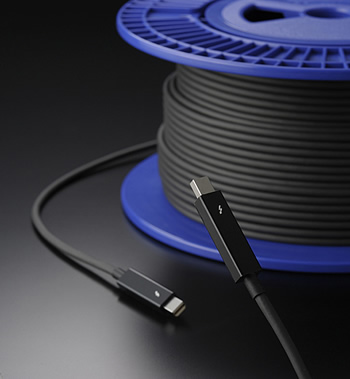
As rumored nearly a year ago, it appears optical Thunderbolt cables will be making their debut in 2013. The move to fiber-optic will bring a number of changes, but most importantly should allow for greater speeds (possibly up to 100Gbps) and far longer cables (roughly 30 meters in length). Currently, copper-based cables are capped at 10Gbps and a mere three meters. They will also maintain compatibility with existing Thunderbolt devices.

Sumitomo Electric Industries is claiming to be the first company to be certified by Intel for mass-producing optical Thunderbolt cables. Other companies will almost certainly follow, but we can expect to see these cables in 2013. 

Pricing is currently unavailable, but optical cables actually tend to be more expensive than their copper-using counterparts. Thus far, Thunderbolt cables haven't exactly been a cheap commodity, so it is reasonable to suspect they'll be even less wallet-friendly as fiber-optic incarnate. 

On the other hand, one of the primary reasons Thunderbolt cables continue to be costly is the active silicon-germanium electronics embedded into the cables -- a technology which requires expensive processes to manufacture. However, Intel's second generation cable chipset (due in 2013) promises to greatly reduce those fabrication costs. Intel expects the new design to cut cable costs from today's stiff price of 50-70 bucks to somewhere around $10. However, there's no word on whether Sumitomo's cables will feature these less expensive chips, though.

What their design will feature though is a slightly longer connector (38mm instead of 28mm) and the capacity for far greater lengths (100 feet). Otherwise, Sumitomo's cables should prove physically indistinguishable from traditional metal designs.

In spite of their improved design, the cables will debut with essentially the same specs as their copper cousins, sporting 10Gbps (bi-directional) transmission speeds, the same 4.2mm thickness and the ability to daisy chain up to six devices. Optical cables though should provide room to grow.

One drawback fiber brings with it though is its inability to effectively transmit power: this means powering your devices with pure optical cables is currently not possible. Although Sumitomo admits these cables can't power your Thunderbolt gadgets, perhaps we'll see a hybrid solution in the future though which provides both fiber-optic speeds and appreciable power transmission.

, , , , , , , , , , , , ,

Related Products from Product Finder

Apple MacBook Pro 13.3" Retina - Summer 2012

Read expert reviews, pros & cons, and product information about Apple MacBook Pro 13.3" Retina - Summer 2012. There are 47 reviews available so far.

34 Reviews

Apple MacBook Air 11.6 inch - Summer 2012

Read expert reviews, pros & cons, and product information about Apple MacBook Air 11.6 inch - Summer 2012. There are 22 reviews available so far.

16 Reviews

Apple MacBook Air 13.3 inch - Summer 2012

The MacBook Air sports a 1.8GHz dual-core Intel Ivy Bridge Core i5 processor that Turbo Boosts up to 2.8GHz, 4GB of 1600MHz DDR3L SDRAM, 128GB of flash storage and integrated Intel graphics. It is still extremely thin and lightweight at only 0.68-inches at the thickest part and 2.96 pounds. The MacBook Air carries a 13.3-inch diagonal LED backlit display, operating at 1440 x 900 with a 16:10 aspect ratio.

28 Reviews

Apple MacBook Pro 13.3 inch - Winter 2011 Version - Intel Core i5

Read expert reviews, pros & cons, and product information about Apple MacBook Pro 13.3 inch - Winter 2011 Version - Intel Core i5. There are 17 reviews available so far.

14 Reviews

User Comments: 8

Got something to say? Post a comment
  1. I want to see optical audio cables to get rid of any EMI interference buzz T_T

  2. , post: 1265993, member: 169488"]I want to see optical audio cables to get rid of any EMI interference buzz T_T

    Not a problem since 1983: http://en.wikipedia.org/wiki/TOSLINK

  3. Are these using real fiber optic glass? Because the real stuff becomes stiff when it sits unmoved for an extended period of time, then if you ever move the cable it will break. One way some ISPs who offer Internet/TV through fiber optic cables get around this is by using plastic instead of glass in the cables once the cable enters a home (outside the home is still real glass since it never needs to be moved, thus broken).

  4. One port to rule them all!

  5. Are these using real fiber optic glass? Because the real stuff becomes stiff when it sits unmoved for an extended period of time, then if you ever move the cable it will break. One way some ISPs who offer Internet/TV through fiber optic cables get around this is by using plastic instead of glass in the cables once the cable enters a home (outside the home is still real glass since it never needs to be moved, thus broken).

    I don't think the medium in which the optics are transmitted matters much.

  6. Not a problem since 1983: http://en.wikipedia.org/wiki/TOSLINK
    SPDIF optical connections confuse the hell out of a CD deck. They never seen to find the correct break between songs. As heretical as it sounds, I actually prefer an analog electrical signal transfer for that reason. It's fairly annoying for every song to begin half way through the first measure.

  7. I don't think the medium in which the optics are transmitted matters much.

    I suspect that transmission range & quality might be hampered if you used concrete?

  8. I wonder if there will be a new network cable anytime soon, the ethernet plug seems dated lol

Recently commented stories

Post a new comment

Social Login & Guest Posting TechSpot Members
Login here or sign up for free,
it takes about a minute.
Get complete access to the TechSpot community. Join thousands of technology enthusiasts that contribute and share knowledge in our forum. Get a private inbox, upload your own photo gallery and more.
TechSpot on:

Subscribe to TechSpot

Get free exclusive content, learn about new features and breaking tech news.