Crystal ball: Following predictions that the memory crisis is going to kill off sub-$500 PCs, we're now hearing that budget smartphones could face the same fate. According to Omdia, global shipments of smartphones priced below $400 will fall 22% this year, causing the overall market to decline 12% YoY.
Omdia writes that, due to the familiar issue of rising DRAM and NAND prices, mid-to-low-end smartphones are struggling with memory costs, leading to the 22% YoY decline. The problem is that phones in this segment are already built to such thin margins that there isn't much left to cut.
In the first quarter of 2026, memory accounted for nearly 60% of the total bill of materials (BOM) in sub-$400 smartphones. In devices priced below $99, that figure exceeded 64%.
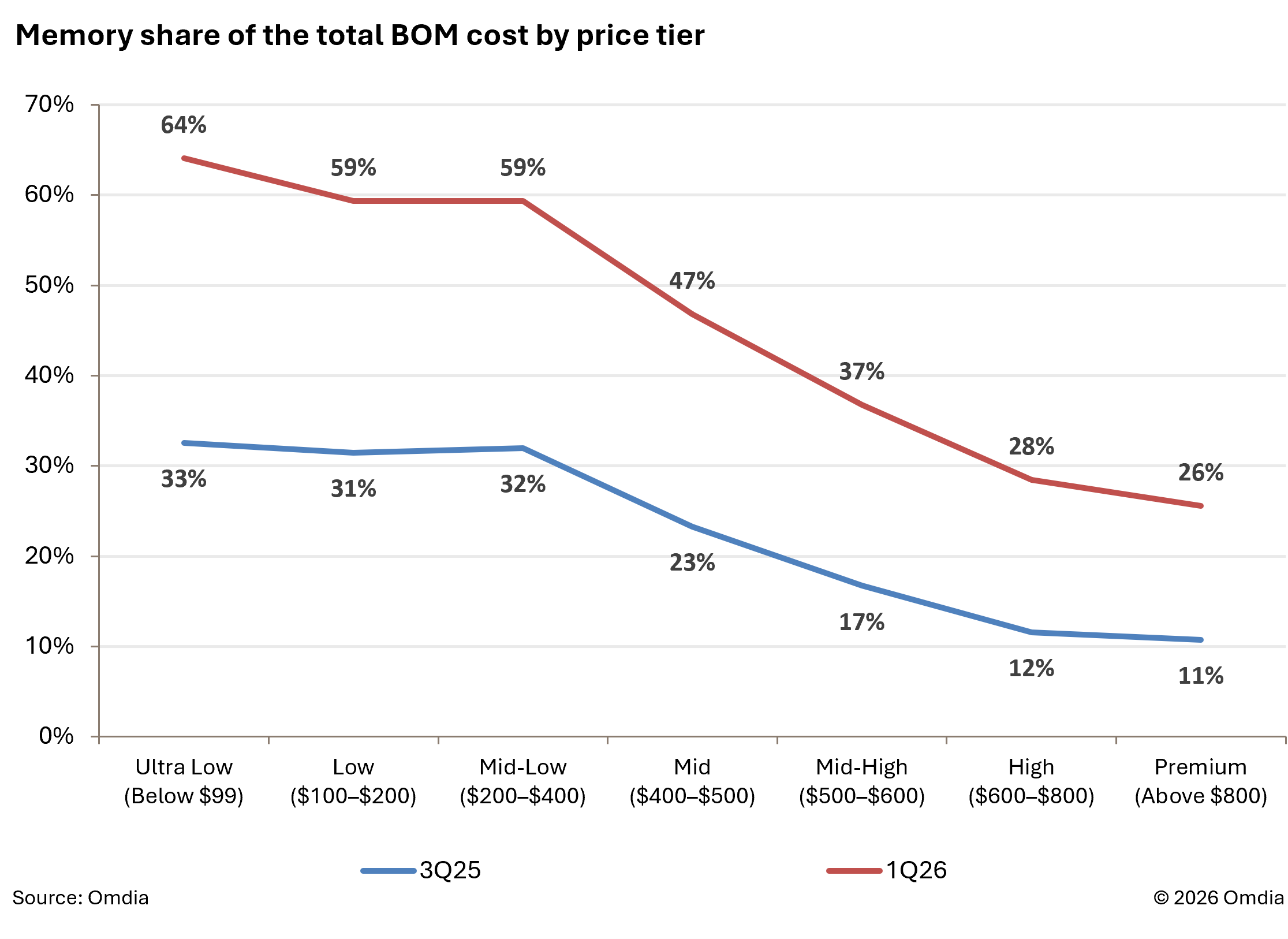
Omdia says the memory cost share in the sub-$400 segment nearly doubled between Q3 2025 and Q1 2026, while even phones above $400 saw memory's share rise by more than 100%.
Vendors have tried to absorb the hit by trimming costs elsewhere, including display panels, sensors, and RF modules, where supply is still relatively plentiful. But that only works up to a point. Low-end phones are already designed around the tightest possible cost structures, which makes it difficult to offset higher DRAM and NAND prices without either raising retail prices or making the devices worse.
Zaker Li, principal analyst in Omdia's consumer team, said the situation will worsen as memory prices keep rising over the coming quarters.
Li added that companies including Transsion, Oppo, Vivo, Honor, and Xiaomi are being forced to significantly raise retail prices just to maintain thin profit margins.
Because people buying cheap phones usually see the price as the most important factor, a $150 handset becoming a $200 handset could be enough to kill demand. Omdia says vendors are therefore gradually retreating from the low-end segment this year.
Omdia expects smartphones priced above $400 to remain resilient and grow 5.7% in 2026, helped by vendors shifting their focus to higher-mid-range and high-end products, price increases pushing more devices into higher bands, and wealthier buyers being less likely to put off a purchase. However, the overall global market is still expected to decline by 12%.
It's not just budget phones facing extinction. Gartner predicted that the AI-driven memory crisis could wipe out sub-$500 PCs by 2028. The analysis firm also estimated that combined DRAM and SSD prices will rise 130% by the end of 2026, pushing PC prices up 17% and smartphone prices up 13% compared with 2025.