Sony is deleting 551 movies and TV shows you bought on PlayStation, because you don't really own your digital purchases

DragonSlayer101

Posts: 984   +14
Staff
A hot potato: Sony is proving once again that "you will own nothing, and you will be happy." The company is purging hundreds of movie and TV show titles due to vague and unexplained licensing issues. Users who have "purchased" any of this content will soon no longer have access to it.

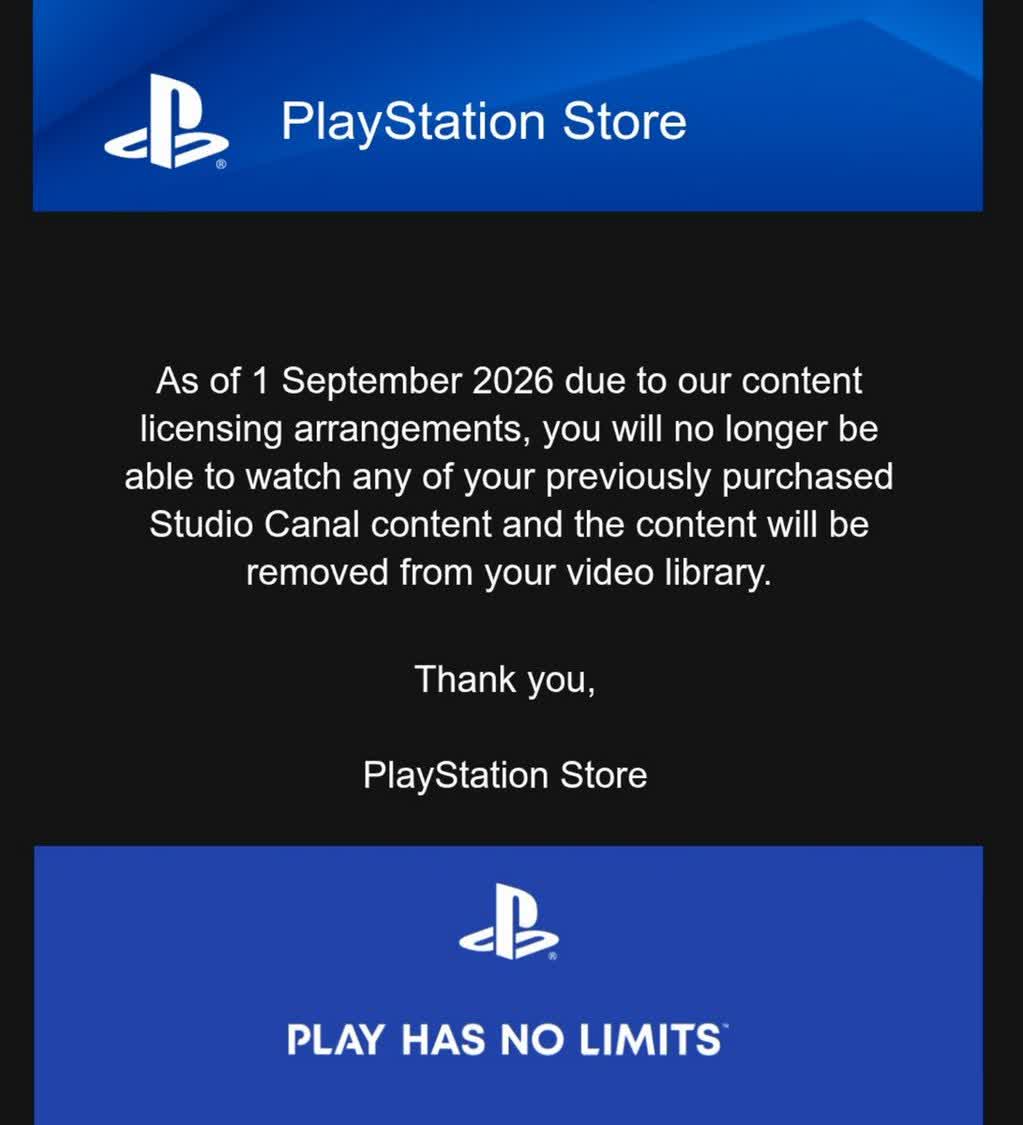
Sony has confirmed that it will remove 551 movies and TV series from the PlayStation Store in the UK on September 1, 2026. The content will also be simultaneously deleted from customers' libraries who have already purchased it. Sony did not mention anything about refunds, suggesting affected users will not be compensated financially.

In a message on the official PlayStation UK website, the Japanese electronics giant stated that all Studio Canal content will be removed after the two companies failed to renew their licensing agreement. Sony did not elaborate further, and it is unclear whether the content will remain available in other markets, including the US. Among the titles affected are cult classics, popular blockbusters, and critically acclaimed films such as Terminator 2: Judgment Day, Total Recall, Rambo, Apocalypse Now, Hot Fuzz, Moonlight, the John Wick series, Free Willy, O Brother, Where Art Thou?, Pan's Labyrinth, and Paddington.

Affected customers are understandably frustrated and are expressing their anger on social media and online message boards. This purging is not the first time Sony has summarily deleted content from users' libraries. In 2022, the company removed 314 titles in Germany and 137 in Austria.
Sony also wiped out more than 1300 seasons of Discovery TV shows in 2023, affecting thousands of gamers who had previously purchased the content on the PlayStation Store. The deleted titles included many notable shows, such as Shark Week, American Chopper, Deadliest Catch, How It's Made, Cake Boss, and MythBusters.

The announcement has also rekindled long-standing debates on what constitutes "purchase" in the digital era. While most people believe they are "buying" music, movies, and games on digital storefronts when they hit the "Buy" button, the EULA almost always describes the purchases as revocable "licenses," making such abrupt deletions legal in most jurisdictions.

The video game industry has also been plagued by planned obsolescence, with major publishers coming under fire for shutting down the servers of old games despite their continuing popularity. Frustrated with arbitrary server deactivation, gamers in Europe formed a group called Stop Killing Games to lobby lawmakers to enact legislation that would prevent publishers from rendering games unplayable by deactivating servers of paid online games.

Earlier this year, the organization served legal notices to Ubisoft after it deactivated the servers for the online-only racing game The Crew despite protests from gamers. Unfortunately for gamers, the Commission ruled in favor of Ubisoft last week, citing intellectual property rights, publisher costs, and potential cybersecurity concerns.

Permalink to story:

 
Why would you buy films on PS?


Nope, not their fault you didn’t read the terms of the agreement.
It's funny you bring that up because it's getting increasingly common that countries require the ToS to be short and easily understandable. They have been intentionally made excessively long so that consumers don't try to read it and they're written in legalese so that if they do try, they don't understand what they're agreeing to without a law degree.
 
Last edited:
These services should be advertised as a renting system.
Sony advertises the terms in their TOS, which you believe a paternalistic, patriarchal government should read for you, to spare you the bother of making responsible decisions on your own.

If this act violates the TOS, then Sony should pay a stiff penalty -- triple damages at least. But if it doesn't, blame yourself for entering into legal agreements without troubling to read them.
 
This provides another reason why some people resort to piracy. Paying for something legally only to have it removed years later reinforces the appeal of piracy, since the user effectively keeps a copy they can access indefinitely. It’s also a strong argument for physical games over digital purchases. Digital games are typically licensed and that license can be revoked, while a physical copy generally remains playable whenever you want imo.
 
It looks like Sony discontinued buying and renting movies and TV shows exactly 5 years prior to the September 1 date, which is important context to add. Whether a 5+ year license to watch the movies you "buy" is reasonable, I guess that's for the courts to decide when Sony inevitably gets sued. Instead, Sony has since created an app to buy/rent their own studio's movies with Sony Pictures Core.
 
Sony advertises the terms in their TOS, which you believe a paternalistic, patriarchal government should read for you, to spare you the bother of making responsible decisions on your own.

If this act violates the TOS, then Sony should pay a stiff penalty -- triple damages at least. But if it doesn't, blame yourself for entering into legal agreements without troubling to read them.
Their ToS says that suits have to be settled by an arbitror and that they can only be sued by the individual. So unless every country wants to invalidate their ToS(as it's written for each country they do business in), there isn't a lot of recourse. Their TOS is designed to take up years of people's time in the court system and be extremely expensive legally. Even if there is a class action lawsuit against them and they lose it, most people who used their service will walk away with probably less than $20 while law firms walk away will millions.
 
Sony advertises the terms in their TOS, which you believe a paternalistic, patriarchal government should read for you, to spare you the bother of making responsible decisions on your own.

If this act violates the TOS, then Sony should pay a stiff penalty -- triple damages at least. But if it doesn't, blame yourself for entering into legal agreements without troubling to read them.
You should not have to read through thousands of pages of legalese for every purchase you make.
 
Their ToS says that suits have to be settled by an arbitror and that they can only be sued by the individual.
Yes. So? Multiple independent studies have shown that arbitration is faster, drastically reduces legal cost overhead for *both* parties in a suit, AND yields higher payouts to plaintiffs.

"Class action" suits like this, however, yield $15 settlements to the plaintiffs and $40M paydays to the attorneys.

You should not have to read through thousands of pages of legalese for every purchase you make.
Exaggerate much? Nine pages is not 1,000. And while even that is a bit excessive, the length is due not to Sony, but to a badly abused tort system, which requires companies to spell out every little detail ad nauseam, lest they be sued incessantly for trivialities.
 
Yes. So? Multiple independent studies have shown that arbitration is faster, drastically reduces legal cost overhead for *both* parties in a suit, AND yields higher payouts to plaintiffs.

"Class action" suits like this, however, yield $15 settlements to the plaintiffs and $40M paydays to the attorneys.


Exaggerate much? Nine pages is not 1,000. And while even that is a bit excessive, the length is due not to Sony, but to a badly abused tort system, which requires companies to spell out every little detail ad nauseam, lest they be sued incessantly for trivialities.
The problem with arbitration and the reason it reduces the legal overhead is that the arbitrator is chosen by and paid by the business while also deciding who is at fault and the pay out. The arbitrator could decide that the customer who may have paid hundreds of dollars for content on the PlayStation store is entitled to a dollar. Many of these things are also sealed with NDAs so we actually don't know what is better for who. All I know is that my own attorney has advised me to never sign something with an arbitration clause.
 
At this point, my home video collection on digital and analog supports with outlive any streaming "giant" on the planet :-D

You wanna some DRM-free ISO? :-D
I know It was a joke.
But.
Make copies for security, that's Your right.
Don't offer them to strangers, that's violation of copyrigth laws in most jurisdictions.
Just saying.
 
It's funny you bring that up because it's getting increasingly common that countries require the ToS to be short and easily understandable. They have been intentionally made excessively long so that consumers don't try to read it and they're written in legalese so that if they do try, they don't understand what they're agreeing to without a law degree.

They'll also force you to accept any changes they make to TOS just so you can continue using your device.
 
Back