
See our latest update: The Best Graphics Cards
There is a war waging between Nvidia and AMD to see who can get graphics card prices back to normal levels the fastest, and right now, it appears Nvidia is winning. At least, that's what the latest GPU pricing data suggests, assessing across a wide range of regions.
We're no longer in a situation where graphics cards are completely unavailable, but six months after many releases, pricing remains a concern for some models, which we'll explore in today's guide.

This is a follow-up to the cost-per-frame GPU buying guide we published a few months ago, where we examined pricing in ten regions. We'll be doing the same today but with updated information as of September 2025.
We picked the ten countries based on where most TechSpot readers come from, choosing leading retailers in each country. From there, we calculated real-world cost-per-frame data, allowing us to evaluate how competitive Nvidia and AMD are on a global scale – and to see which countries tend to get screwed over more than others.
Cost Per Frame at MSRP – The Theoretical Baseline
First, here's a quick refresher on where GPU pricing and value should stand, based on globally announced MSRP in US dollars. The Intel Arc B580 should be the best value graphics card in this category, though there's tough competition from AMD's Radeon RX 9060 XT series.

The 9060 XT 8GB should be 12% cheaper per frame than the RTX 5060 at the same price, though neither is a good buy compared to the 9060 XT 16GB, which comes in at 17% cheaper per frame than the RTX 5060 Ti 16GB.
For mid-range shoppers, the best value choice is the Radeon RX 9070 XT at $600, which offers similar value to the RX 9070. These models are slightly better value than the RTX 5070 and come with more VRAM – 16GB versus 12GB. The 9070 XT also competes with the RTX 5070 Ti, but at MSRP, there is a $150 price gap, making the Radeon card 16% cheaper per frame. All of these options deliver superior value compared to last-generation cards, such as the RX 7700 XT and RTX 4070.
At the top of the market, the value proposition drops off significantly. Cards like the RTX 5080 command a premium for their higher performance. The RTX 5090 is clearly the worst value option overall, though it delivers top-tier gaming performance and stands in a class of its own. The RTX 5050 is also an odd case, offering weak value for an entry-level GPU.
Real-World Pricing
United States
Now let's flick over to look at real-world pricing for in-stock graphics cards at Newegg. The situation has improved significantly compared to three months ago, with many more models now available at MSRP. This includes the GeForce RTX 5070 Ti at $750, the RTX 5080 at $1,000, and the RTX 5060 Ti 16GB at $430. In fact, the only current-generation GeForce GPU priced above MSRP is the RTX 5090.
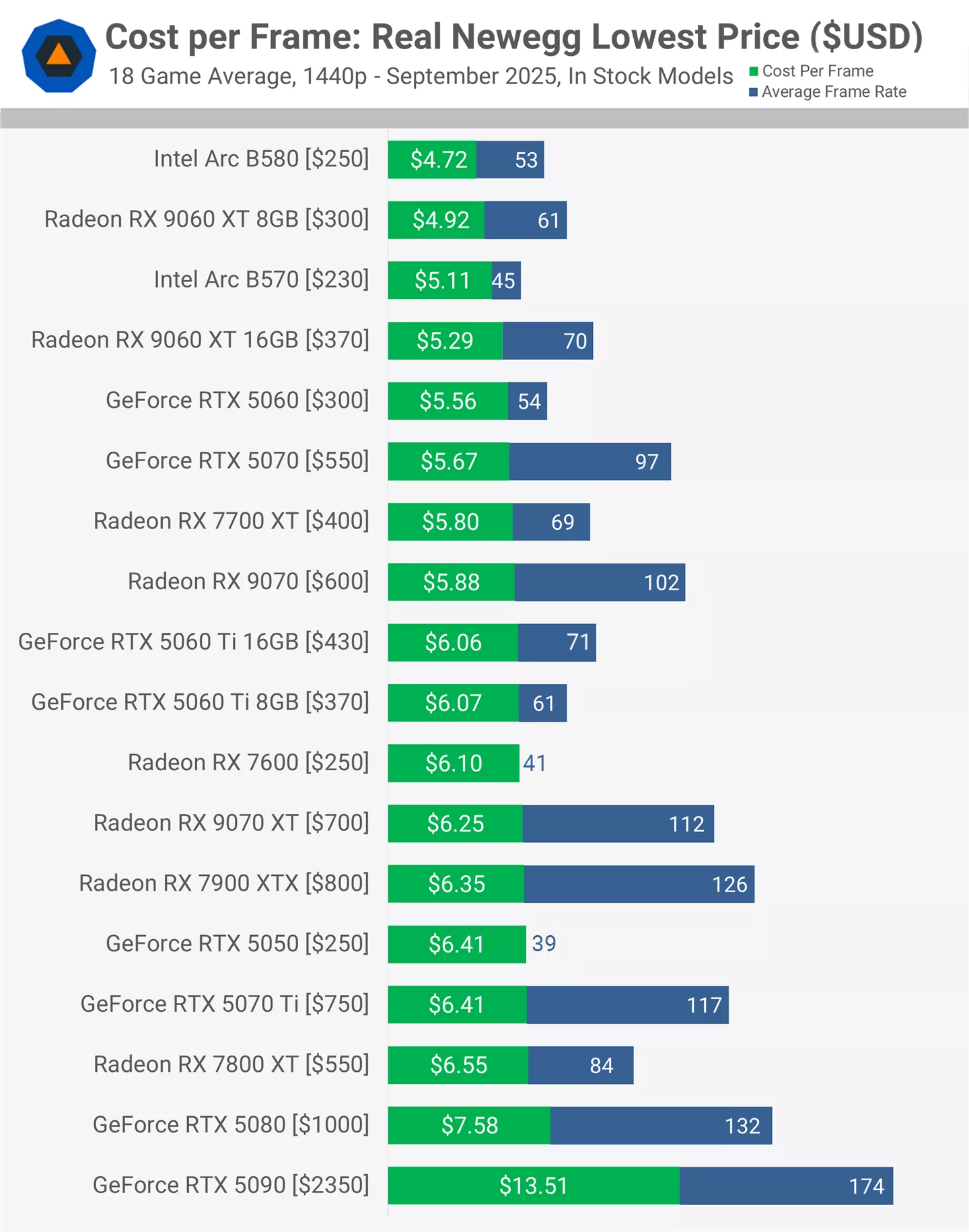
Unfortunately, the same cannot be said for Radeon cards. The extent of price inflation for AMD GPUs varies by model. The 9060 XT 8GB is readily available at $300, making it competitive with the RTX 5060. However, it's still not a great purchase overall. The 16GB model costs $20 above MSRP. While we would prefer to see no markup, the price is still reasonable – it's worth paying 8% more per frame compared to the 8GB model to get double the VRAM. It also offers slightly better value than the RTX 5060.
When compared to the RTX 5060 Ti 16GB, the cost-per-frame advantage of going with Radeon shrinks from 17% at MSRP to 13% in the real world. It's still a decent discount, though less compelling than on paper.
The Intel Arc B580 is finally in stock at $250, now providing a fair value at this price point. This makes it 11% cheaper per frame than the 9060 XT 16GB. While that's not incredible, it's in a different price tier and could make sense if you only have around $250 to spend – especially since it still comes with 12GB of VRAM. It easily outperforms the more expensive RTX 5060 in terms of value and completely outclasses the RTX 5050 at the same price. Still, it would have been far better for Intel to hit this price point months ago.
Mid-Range Market Dynamics
In the mid-range segment, AMD is struggling to compete right now because the RX 9070 and RX 9070 XT are not reaching MSRP levels. Currently, the RX 9070 XT is priced at $700, making it non-competitive with the RTX 5070 Ti. At this pricing, the two cards offer roughly the same value, meaning there's little reason not to choose the GeForce GPU instead.
The Radeon 9070 is slightly better positioned, priced at $50 above MSRP. However, this still flips the value equation. At MSRP, the Radeon should be 5% cheaper per frame than the RTX 5070, making it an attractive choice thanks to its higher VRAM. Right now, though, it's actually 4% more expensive per frame than the 5070.
As a result, for buyers shopping in the $500 – $600 range, the RX 9070 XT is effectively priced out of the market, while the RTX 5070 re-emerges as an acceptable value choice. It's not outstanding, but it's more competitive than it should be based solely on MSRP.
Micro Center Pricing
Shopping at Micro Center instead of Newegg doesn't drastically change the overall value comparisons. In the critical RTX 5070 Ti versus RX 9070 XT battle, the cards remain priced at $750 and $700, respectively. The 9060 XT 16GB is also still $370, maintaining its position at 13% cheaper per frame than the RTX 5060 Ti 16GB.

Where we do see shifts is with 8GB models. Many of these have dropped below MSRP by $20 or $30. The 9060 XT, for instance, is now $280 instead of $300. The RTX 5060 has fallen to $270. The RTX 5060 Ti 8GB has dropped to $340.
This likely reflects the very low demand for 8GB graphics cards in 2025. Since these models have decreased in price by similar amounts, their relative value positions remain consistent with MSRP levels. Among them, the 9060 XT 8GB is the best value of the 8GB cards but that doesn't mean it's a good buy overall.
We also see the RX 9070 is available for $540 at Micro Center, slightly below MSRP. This makes it competitive with the RTX 5070 once again and clearly a better value than the RX 9070 XT at this price point.
Australia
In Australia, pricing is more "normal" and value propositions are more closely aligned with MSRP-level pricing. However, this isn't always the case, as some GPUs are still overpriced compared to US' MSRP levels. For instance, the RTX 5070 Ti should be closer to $1,250 instead of $1,400 AUD when factoring in currency conversion and tax. Overall, though, the local GPU market is in decent shape.

The 9060 XT 16GB is in an excellent position, offering a 19% lower cost per frame than the 5060 Ti 16GB. This makes it the clear choice for mainstream gamers. The RTX 5050, surprisingly, is priced below MSRP at PC Case Gear, currently at $350. While this sounds good on paper, it still isn't a great deal due to its limited VRAM and weak overall performance – it simply brings its value in line with other budget cards.
The 9070 XT also delivers strong value against the RTX 5070 Ti, maintaining a 16% lower cost per frame, the same as at MSRP. Locally, both cards are priced about $100 to $150 higher than direct US conversions, but this keeps their relative value intact.
In most cases, we'd recommend the Radeon card here. However, for buyers who want to stay under $1,000 AUD, the RTX 5070 is also a solid choice and currently offers better value than the RX 9070.
Germany
At Mindfactory in Germany, the GPU market appears fairly balanced, with many models priced at or near US MSRP equivalents. In some cases, this actually makes certain cards better deals than expected, particularly for Nvidia products, since Nvidia announced very high European MSRPs.

A prime example is the RTX 5070 Ti, which has an official MSRP of €880 but is currently selling for €780 – much closer to the global equivalent of $750.
This pricing alignment helps maintain some of the value battles in check with MSRP levels. The 9060 XT 16GB is 15% cheaper per frame than the 5060 Ti 16GB, making the Radeon the better option. Similarly, the 9070 XT provides 16% better value than the 5070 Ti, just enough for a solid recommendation.
The main deviation we see is between the 9070 and 5070. At Mindfactory, the Radeon 9070 is slightly overpriced, while the RTX 5070 is slightly underpriced. This flips the value equation in favor of Nvidia. Ideally, the 9070 should be 5% cheaper per frame, but in reality, it's 4% more expensive. For buyers with around €500 to spend, Nvidia currently offers the more compelling choice.
In the UK

At Scan in the UK, the market closely mirrors what we see at Mindfactory in Germany, with only minor differences in certain models:
- The 9060 XT 16GB is 13% cheaper per frame than the 5060 Ti 16GB.
- The 9070 XT has a 14% lower cost per frame compared to the 5070 Ti.
- The 9070 is 7% more expensive per frame than the 5070 due to its higher-than-ideal pricing.
The gap between the 9070 XT and 5070 is likely too wide for these cards to compete directly on price, which hurts the Radeon's value proposition.
For the lower-cost 8GB models, pricing is mostly where it should be relative to performance. That said, we'd still argue these cards should be cheaper overall, given the limitations of having just 8GB of VRAM. The 9060 XT 8GB is the best value among these budget options, but we strongly recommend the 16GB version instead, even though it costs £75 more.
Canada
At Canada Computers, we're using an average of the lowest prices available both online and in-store. This market reflects a blend of what we typically see in the US and European regions.

The Radeon 9070 XT pricing is more favorable here than in the US, with nearly a $200 CA price difference compared to the 5070 Ti. This results in a 14% lower cost per frame for the Radeon model, closely aligning with MSRP expectations. We see the same margin when comparing the 9060 XT to the 5060 Ti, specifically for the 16GB models.
However, the vanilla RX 9070 continues to face its usual pricing issues. At $865 CA, it's positioned far too close to the 9070 XT, which currently sits at $900. Instead of providing a 5% cost-per-frame discount over the RTX 5070, it ends up being 4% more expensive and clearly worse value than the 9070 XT. As a result, the RX 9070 simply isn't worth considering in Canada.
This leaves the RTX 5070 as a competitive option. While it's not as attractive as in other regions where the 9070 XT is more aggressively priced, it remains a viable choice.
For budget PC buyers, the standout value options are the 9060 XT 8GB and the Arc B580, each with distinct trade-offs.
- 9060 XT 8GB: More powerful but limited by its lower VRAM.
- Intel Arc B580: Slightly weaker performance and less robust driver support but cheaper and equipped with more VRAM.
This kind of decision-making is becoming common across regions now that the B580 has reached a more reasonable price point.
India
The GPU market at Prime ABGB in India is volatile, with some surprising price discrepancies. The RX 9060 XT 16GB is in an excellent position, offering a 24% lower cost per frame compared to the very expensive RTX 5060 Ti 16GB. This makes it an instant buy for mainstream gamers.

However, at the higher end, the RTX 5070 Ti and RX 9070 XT are very close in value. This tips the scales in favor of the GeForce card, as its similar performance at a comparable price makes it the clear choice. It's unusual to see AMD delivering better value than usual in the mid-range but falling behind in the high-end segment.
The RX 9070 isn't priced well either. While it does offer slightly better value than the 9070 XT, it's still 11% more expensive per frame than the RTX 5070. Both cards should be evenly matched based on MSRP, but in this case, only the RTX 5070 is priced correctly. For mid-range buyers, the RTX 5070 is the obvious pick in the Indian market.
Philippines
There's good news for buyers in the Philippines: this is one of the few regions where the RX 9060 XT 16GB isn't overpriced compared to the 8GB version. In fact, the 16GB model offers better value, making it the clear choice for mainstream gamers. It delivers 15% better value per frame than the RTX 5060 Ti 16GB. Previously, this region was one of the weaker markets for 9060 XT pricing, so this marks a positive shift.

The 9070 XT is also well priced at retailer DynaQuest, currently delivering a 26% cost-per-frame discount compared to the RTX 5070 Ti. This large gap appears to stem from extraordinarily high pricing for the RTX 5070 Ti and other premium GeForce cards, including the RTX 5080 and RTX 5090. While the 9070 XT's price is slightly higher than a direct currency conversion from MSRP, it's nowhere near as inflated as Nvidia's high-end offerings.
Interestingly, this extreme price inflation seems to affect only the high-end GeForce models. The RTX 5070, for example, has relatively normal pricing. This allows it to compete closely with both the RX 9070 XT and the RX 9070. In fact, it's 5% cheaper per frame than the RX 9070. Ideally, the Radeon should provide better value in this segment, but once again, it falls short in this competitive mid-range market.
Brazil
In Brazil, AMD has a 13% cost-per-frame advantage in both the 9060 XT 16GB versus 5060 Ti 16GB comparison and the 9070 XT versus 5070 Ti matchup. Graphics cards are very expensive in Brazil, which is unfortunate, but in these two main categories neither brand is the clear winner. At best, we would lean slightly toward AMD, though the value difference falls just short of where it should be at MSRP.

Outside of these categories, the RTX 5070 stands out as one of the best value graphics cards in Brazil and offers significantly better value than the RX 9070. Surprisingly, the RX 9070 is actually more expensive than the 9070 XT, making it an unreasonable purchase.
The 9070 XT costs 10% more per frame than the RTX 5070 and sits in a completely different price tier, giving Nvidia firm control over the mid-range market.
In the lower end of the market, there are limited good options. The B580 is priced the same as the RTX 5060 and the 9060 XT 8GB, but it should be 17% cheaper to offer better value. As it stands, it does not provide the advantage it should.
Poland
At Morele in Poland, pricing aligns closely with other European markets, such as Germany. The 9060 XT is 14% cheaper per frame than the 5060 Ti when comparing 16GB models, while the 9070 XT is also 14% cheaper per frame than the 5070 Ti.

However, the RX 9070 is 5% more expensive per frame than the RTX 5070, when ideally it should be the other way around. This stems from the RX 9070 being overpriced relative to its MSRP, while the RTX 5070 is priced appropriately.
Intel Arc GPUs continue to be decent entry-level options in Poland. Most of these lower-cost cards are priced reasonably, though comparisons such as the RX 9060 XT 8GB versus the RTX 5060 remain unremarkable. The limited VRAM on these cards makes them difficult to recommend. The RTX 5050 also offers very poor value here, as it does in most other regions.
Netherlands
At Megekko in the Netherlands, the 9060 XT 16GB is 14% cheaper per frame than the 5060 Ti 16GB, continuing a pattern seen across many regions. However, unlike Poland, the 9070 XT is not as strong a value against the 5070 Ti. It provides only an 8% cost-per-frame discount, which is not enough to recommend the Radeon card. This is primarily due to inflated pricing on the 9070 XT in this region, as AMD has been unable to bring it down to its $600 US MSRP.

The RX 9070 is 7% more expensive per frame than the RTX 5070 at Megekko, mirroring trends in many other regions. As a result, the RTX 5070 remains a good choice for mid-range gamers, while the RX 9070 is stuck in an unattractive middle ground.
Intel's B580 also fails to deliver strong value here, priced at 280 euros, which is too close to the 9060 XT 8GB at 300 euros.
What We Learned
When examining graphics card pricing and cost per frame this month, we see a more stable and consistent global market compared to three months ago. GPU pricing has largely settled, more models are available at MSRP, and there are fewer regional outliers.
In the mainstream segment, there has been little change. Competition remains healthy between the RTX 5060 Ti 16GB and RX 9060 XT 16GB. At MSRP, the Radeon card should be 17% cheaper per frame, and across ten regions it averaged 15% cheaper. Most regions were very consistent, with only slight variations due to minor overpricing of the 9060 XT 16GB.

At the lower end of the market, many 8GB cards are now available, competing with Intel's Arc Battlemage series. The good news is that the B580 is now readily available at its $250 MSRP across multiple regions, making it far more viable than in past months when it exceeded $300. Alongside the RX 9060 XT 8GB, it often ranks among the best cost-per-frame options.
Each card has trade-offs though: the Intel B580 offers more VRAM but has weaker performance and less reliable drivers, while the RX 9060 XT 8GB does offer stronger performance and more stable drivers, but limited VRAM capacity. Unfortunately, neither the RTX 5060 nor especially the RTX 5050 offer strong value in this segment.

Across most regions and in every segment below the GeForce RTX 5090, Nvidia and its partners have done a better job than AMD at ensuring cards are available at MSRP.
This includes Europe, where GeForce GPUs are often found below the local MSRP, aligning more closely with official pricing. Even now, buyers can find the RTX 5070 for $550, the RTX 5070 Ti for $750, and the RTX 5080 for $1,000, which is a major improvement over a few months ago.

AMD, on the other hand, has struggled to keep up. As of today, the RX 9070 XT still sells for $700.
On a more global scale, the Radeon 9070 XT vs GeForce 5070 Ti battle is a bit inconsistent, with price inflation varying depending where we look. In about half of the regions we assessed, the 9070 XT offers a 15% lower cost per frame than the 5070 Ti, matching its advertised advantage and making it a solid choice.

In the other half, the margin shrinks, and the GeForce GPU becomes the better buy. This usually occurs when the 9070 XT is priced too high.
Given that AMD has been selling these cards since the beginning of the year, it is surprising that they are still unable to consistently offer them at MSRP levels.
The most decisive win for Nvidia is in the mid-range segment. The GeForce RTX 5070 is widely available at MSRP, while the RX 9070 often is not. Ideally, if both cards were at MSRP, we would recommend spending 10% more for the RX 9070 XT, but that is rarely a realistic choice.

Instead, the RTX 5070 competes directly with the RX 9070. However, because AMD has not been able to consistently price the RX 9070 at MSRP, and the RTX 5070 is sometimes found below MSRP, the value equation has flipped decisively in Nvidia's favor. The RX 9070 should be 5% cheaper per frame, but on average it ends up 9% more expensive, making it much harder to recommend.

It has taken a long time, but it is good to see Nvidia largely resolve supply issues heading into the holiday season accompanied by several major game releases. At this point, there's not a whole lot Nvidia needs to do here, outside of maybe dropping their crappy 8GB models well below MSRP, and then focusing on the upcoming Super refresh.
AMD, by contrast, needs to focus on one clear goal: getting Radeon GPUs down to MSRP across all regions. They cannot compete effectively if the Radeon RX 9070 XT is only $50 cheaper than the GeForce RTX 5070 Ti. AMD should focus on meeting their advertised pricing, expanding FSR 4 game support, and building on that momentum.