
A little over a year ago, we compared the Radeon RX 9070 XT and GeForce RTX 5070 Ti in a 55 game benchmark and found the Radeon GPU trailing by roughly 5% at both 1440p and 4K. That comparison, however, focused primarily on rasterization performance, which is something we're changing for this updated benchmark review.
This time around, we've a few interesting changes to the testing methodology. Most importantly, every game has been tested using two quality presets, with some configurations enabling ray tracing and others disabling it. The result is a much broader look at how these GPUs behave across modern rendering workloads, and there's a lot of interesting data to unpack.

In total, we've benchmarked 52 games, including a healthy mix of newer releases. Most of the testing was conducted in-game using external performance monitoring software, though in cases where a built-in benchmark was used, we've labeled that on the graphs.
With that out of the way, let's dive into the data…
Test System Specs
| CPU | AMD Ryzen 7 9800X3D |
| Motherboard | Gigabyte X670E Master [BIOS F42b] Resizable BAR Enabled |
| Memory | G.Skill Trident Z5 RGB DDR5-6000 CL30 [CL30-38-38-96] |
| ATX Case | MSI Prospect 700R |
| Power Supply | Kolink Regulator Gold ATX 3.0 1200W |
| Storage | TeamGroup T-Force Cardea A440 M.2 PCIe Gen4 NVMe SSD 4TB |
| Operating System | Windows 11 25H2 |
| Display Driver | Nvidia GeForce Game Ready Driver 596.49 WHQL AMD Radeon Adrenalin 26.5.2 WHQL |
Gaming Benchmarks
Pragmata
Pragmata is a strong showing for the RX 9070 XT. The Radeon card outperforms the RTX 5070 Ti across all tested metrics. It holds a solid 5-9% lead with the quality settings maxed out and extends that to an impressive 12-13% advantage when ray tracing is enabled.

Arc Raiders
In Arc Raiders, the RX 9070 XT generally outpaces the 5070 Ti. While average frame rates are tied using the RT Epic preset, the Radeon GPU delivers significantly stronger 1% lows across all settings, resulting in a noticeably smoother experience. This is especially true at 1440p RT Static, where it leads by 9% on average.

Assassin's Creed Shadows
In Assassin's Creed Shadows, the Radeon GPU consistently outperforms the RTX 5070 Ti by 8% to 12% across all tested settings. Both GPUs deliver smooth native frame rates at High settings up to 4K, though the Ultra High preset with heavy ray tracing enabled requires upscaling for optimal playability.

Battlefield 6
Battlefield 6 delivers mixed but overall competitive results. The RX 9070 XT takes a slight lead using the High preset, peaking at a 7% advantage at 4K. However, when switching to the more demanding Overkill preset, the RTX 5070 Ti pulls ahead by roughly 5% at both 1440p and 4K.

Marvel Rivals
Marvel Rivals presents an incredibly tight race between the two cards. The RX 9070 XT holds a negligible lead at 1440p Medium, while the RTX 5070 Ti edges ahead slightly at 4K. Using the Ultra Quality preset with Lumen enabled, the GPUs are effectively deadlocked, delivering identical average frame rates and 1% lows.

Crimson Desert
Crimson Desert heavily favors Nvidia. The RTX 5070 Ti consistently beats the RX 9070 XT across all tests, leading by roughly 10% at Medium settings and extending that margin to 13-14% at Cinematic quality. Notably, only the 5070 Ti manages to hit 60 fps at native 4K Cinematic settings.

F1 25
F1 25 shows a clear split between rasterization and ray tracing performance. The RX 9070 XT wins using the standard High rasterization preset, leading by around 7% at 1440p. However, enabling Ultra High ray tracing completely flips the results, giving the RTX 5070 Ti a massive 20-24% lead and highlighting Nvidia's superior ray tracing performance in this title.

Cyberpunk 2077: Phantom Liberty
In Cyberpunk 2077, the RX 9070 XT slightly edges out the 5070 Ti in pure rasterization using the Ultra preset. However, enabling ray tracing heavily favors Nvidia, with the 5070 Ti taking a 15% lead at 1440p. Even then, both cards struggle without the aid of upscaling.

Call of Duty: Black Ops 7
Call of Duty heavily favors AMD. The RX 9070 XT dominates the 5070 Ti, delivering a staggering 62% lead using the 4K Basic preset. Even with ray tracing and Quality upscaling enabled, Radeon maintains a commanding 19-28% advantage, solidifying its dominance in this particular title.

Clair Obscur: Expedition 33
In Clair Obscur: Expedition 33, the RTX 5070 Ti leads at Medium quality, outperforming the RX 9070 XT by as much as 20% at 4K. However, at Epic quality, the 9070 XT slightly pulls ahead at 1440p, while both GPUs are tied at native 4K with a less-than-ideal 35 fps.

Borderlands 4
The Radeon RX 9070 XT consistently outperforms the RTX 5070 Ti in Borderlands 4. It holds a minor edge at High settings but stretches that lead to 10% at 1440p using the Badass preset. Native 4K Badass settings push both GPUs below 30 fps, making upscaling necessary for a playable experience.

Doom: The Dark Ages
In Doom, the RX 9070 XT wins in pure rasterization, beating the 5070 Ti by 10-12% at Ultra Nightmare settings. However, enabling path tracing completely cripples the Radeon card, allowing the RTX 5070 Ti to nearly double its performance.

Even so, neither GPU reaches what we would consider playable frame rates, and even with upscaling enabled, 1440p still feels like a stretch for the RTX 5070 Ti.
Dying Light: The Beast
The RTX 5070 Ti commands a strong lead in Dying Light: The Beast. It outperforms the RX 9070 XT by 17-19% at High settings. Enabling Ultra ray tracing allows Nvidia to maintain a 14-16% advantage, though native 4K RT remains unplayable on both cards without upscaling.

Forza Horizon 5
In Forza Horizon 5, the RX 9070 XT holds a consistent but slight edge over the RTX 5070 Ti. At Ultra quality, the Radeon card leads by roughly 7% at both resolutions. At Maximum quality, the gap shrinks to under 5%, with both GPUs delivering excellent high-refresh 4K performance.

Forza Horizon 6
In Forza Horizon 6, the RX 9070 XT slightly outperforms the RTX 5070 Ti. It leads by up to 6% at 1440p using the Extreme preset, though margins tighten to just a few frames at 4K. Even with Extreme+RT enabled, both cards are effectively tied, requiring upscaling for smooth 4K gameplay.

Final Fantasy XVI
In Final Fantasy XVI, the RX 9070 XT dominates the RTX 5070 Ti across all presets. It leads by a massive 21% at 1440p using both the Medium and Ultra presets. While the gap narrows slightly at 4K, the Radeon GPU still maintains a comfortable 10-16% advantage, though both cards struggle to hit 60 fps at 4K Ultra.

Ghost of Tsushima
Ghost of Tsushima strongly favors AMD. The RX 9070 XT commands a solid lead across all resolutions and presets, peaking at a 14% advantage at 1440p Very High. Even at native 4K using the Very High preset, the Radeon GPU remains well above 60 fps, beating the 5070 Ti by nearly 10%.

God of War Ragnarök
In God of War Ragnarök, the RX 9070 XT holds a minor 3-4% advantage over the RTX 5070 Ti in almost all scenarios. However, pushing the game to 4K Ultra completely eliminates that gap, resulting in a virtual tie where both GPUs deliver an excellent 85-86 fps experience.

Hell is Us
In Hell is Us, the Radeon RX 9070 XT holds a consistent but modest lead over the RTX 5070 Ti at 1440p, outperforming it by up to 8% at Very High settings. That gap narrows as resolution increases, resulting in a tie during 4K Ultra testing.

Delta Force
Delta Force shows a near tie at Very High quality, with the RX 9070 XT holding a practically invisible lead. At Ultimate quality, the RTX 5070 Ti takes over, matching Radeon at 1440p but pulling ahead by a noticeable 12% at 4K.

Apex Legends
Apex Legends has been included because it's both highly requested and extremely popular, though in truth it's not particularly well suited for benchmarking due to the game's hard 300 fps cap. As a result, both GPUs easily hit the 300 fps engine limit at 1440p across both tested presets.

At 4K, the RTX 5070 Ti takes a decisive 10% lead over the RX 9070 XT using both Medium/Low and Maximum settings, though both still deliver highly competitive esports-level frame rates.
PUBG: Battlegrounds
PUBG presents a fascinating split. The RTX 5070 Ti consistently delivers higher average frame rates, beating the RX 9070 XT by 10-15% at 4K. However, the Radeon GPU delivers significantly stronger 1% lows across every test, meaning it will likely provide a noticeably smoother and more consistent gaming experience.

Counter-Strike 2
Counter-Strike 2 exhibits unusual scaling behavior. The RX 9070 XT dominates at Medium settings, beating the 5070 Ti by 14% at 1440p and 24% at 4K. However, switching to the Very High preset completely flips the results, allowing the 5070 Ti to pull ahead with a 24% lead at 4K.

Rust
In Rust, the RTX 5070 Ti decisively dominates the RX 9070 XT. While Nvidia leads by a modest 7% at 1440p High, the gap widens dramatically at 4K and higher quality settings. At 4K Max Quality, the 5070 Ti crushes the Radeon card with a staggering 44% performance advantage.

Tom Clancy's Rainbow Six Siege
The RTX 5070 Ti takes a clear victory in Rainbow Six Siege. It outperforms the RX 9070 XT across all tested resolutions and presets, extending its lead from 6% at 1440p Medium to roughly 11% at 4K Ultra+. Both GPUs easily deliver frame rates well beyond competitive esports requirements when using competitive-style settings.

Warframe
The RTX 5070 Ti dominates in Warframe, consistently outperforming the RX 9070 XT by 10-15% across all tested settings and resolutions. Both graphics cards provide flawless ultra-high-refresh gameplay, with the 5070 Ti averaging more than 200 fps even at native 4K High quality.

World of Warships
World of Warships delivers mixed results. The RX 9070 XT narrowly wins at 1440p High, but the RTX 5070 Ti dominates everywhere else, taking a 10% lead at 4K High and extending that to a significant 20% advantage at 4K Maximum Quality. Even so, both GPUs deliver extremely high-refresh-rate performance.

Overwatch
In Overwatch, both GPUs deliver extremely high frame rates at 1440p Medium settings. However, stepping up to the Epic preset gives the RTX 5070 Ti a commanding advantage. Nvidia outpaces the RX 9070 XT by 16% at 1440p and 23% at 4K, while also delivering notably stronger 1% lows.

Hunt: Showdown 1896
Hunt: Showdown 1896 reveals extremely tight competition between the two GPUs. They are effectively tied at 1440p Medium, both pushing beyond 240 fps. The RTX 5070 Ti gains a slight edge at 4K and Ultra settings, though the performance difference remains under 5% across all tested configurations.

Helldivers 2
Helldivers 2 performance swings back and forth depending on the settings used. The GPUs are tied at 1440p Medium, while Nvidia takes a 6% lead at 4K Medium. However, shifting to Ultra settings heavily favors AMD, with the RX 9070 XT beating the 5070 Ti by 7% at 1440p and 3% at 4K.

Naraka: Bladepoint
Naraka: Bladepoint shows a near tie at 1440p using the highest quality preset. However, the RTX 5070 Ti scales much better at 4K, taking a 7% lead. Enabling ray tracing severely impacts the Radeon card, allowing Nvidia to extend its advantage to 14% at 1440p and a massive 25% at native 4K.

Grand Theft Auto V Enhanced
GTA V Enhanced sees both cards hitting the roughly 160 fps engine cap at 1440p Very High settings. At 4K, the RTX 5070 Ti pulls ahead by 14%. Enabling Maximum ray tracing extends Nvidia's lead further, allowing the 5070 Ti to outperform the 9070 XT by 25% at both tested resolutions.

War Thunder
In War Thunder, the competition is incredibly tight. The RX 9070 XT takes a minor 4% lead at 1440p Movie Quality, while the RTX 5070 Ti edges ahead slightly at 4K. With Ultra ray tracing enabled, both GPUs are effectively tied across both resolutions, delivering nearly identical frame rates.

Baldur's Gate 3
Baldur's Gate 3 scaling is highly dependent on the preset used. The RTX 5070 Ti holds a solid 7-8% lead at Medium quality. Surprisingly, at Ultra quality the RX 9070 XT flips the results, beating the GeForce card by 18% at 1440p and 8% at 4K.

Windrose
Windrose scaling also changes depending on the preset. At Medium quality, the RTX 5070 Ti comes out ahead, leading by 12% at 1440p and 4% at 4K. However, switching to Epic quality favors AMD, allowing the RX 9070 XT to pull ahead by roughly 5-8% across both resolutions.

Ark: Survival Ascended
The RTX 5070 Ti delivers a clean sweep in Ark: Survival Ascended, outperforming the RX 9070 XT across all tested resolutions and presets. Nvidia's lead ranges from 5% at 1440p up to 12% at 4K using the Very High preset, while both GPUs still provide playable native 4K Epic performance.

Red Dead Redemption 2
The RTX 5070 Ti flexes its muscles in Red Dead Redemption 2, comfortably beating the RX 9070 XT. Nvidia takes a modest 7% lead at 1440p High, but that gap widens significantly at higher settings. At 4K Ultra, for example, the 5070 Ti crushes the Radeon card by a massive 24% margin.

Fortnite
In Fortnite, the GPUs are neck and neck at 1440p using Performance mode, with both clearing 720 fps, which is likely a CPU bottleneck. However, at 4K Performance, the RTX 5070 Ti surges ahead by 20%. With Epic quality and ray tracing enabled, the Nvidia GPU maintains a smaller lead, outperforming Radeon by 11% at 4K.

Valorant
In Valorant, both GPUs deliver extremely high frame rates well above 500 fps, even with the game maxed out at 4K. The RTX 5070 Ti generally leads by around 9-10% across 1440p and 4K Medium, as well as 1440p High, though we have to imagine those margins are ultimately meaningless in practice.

Resident Evil Requiem
In Resident Evil Requiem, the RX 9070 XT maintains a consistent but slight edge over the RTX 5070 Ti. It leads by roughly 9% at 1440p Max Quality, even with ray tracing enabled. However, at 4K the performance gap practically disappears, leaving both GPUs effectively tied across all settings.

Mafia: The Old Country
Performance in Mafia: The Old Country is practically identical between the two cards. The RX 9070 XT manages a barely measurable 2-3% lead at 1440p across both the Medium and Epic presets. At 4K, the GPUs are completely deadlocked, tying at 47 fps using Medium settings and a sluggish 33 fps using Epic.

Halo Infinite
Halo Infinite delivers mixed results. The RX 9070 XT takes a 6-8% lead in pure rasterization using Medium settings. However, enabling ray-traced shadows at Ultra quality shifts the balance, allowing the RTX 5070 Ti to close the gap completely and take a negligible 1-2% lead over AMD.

Monster Hunter Wilds
Monster Hunter Wilds favors the RX 9070 XT at 1440p, where it holds a 10% lead at Medium settings and a 5% lead with Ultra ray tracing enabled. However, increasing the resolution to 4K completely neutralizes that advantage, resulting in both GPUs tying at 49 fps using Ultra RT settings.

Cities: Skylines II
The RX 9070 XT is the clear winner in Cities: Skylines II. It beats the 5070 Ti by a massive 17-22% margin at 1440p across both the Medium and High presets. The gap narrows slightly at 4K, but the Radeon card still maintains a clear performance advantage.

Kingdom Come: Deliverance II
The RTX 5070 Ti establishes a clear and consistent lead in Kingdom Come: Deliverance II. It outperforms the RX 9070 XT across the board, stretching its advantage to 13% at 1440p Ultra. Importantly, only the Nvidia GPU comfortably clears the 60 fps threshold at native 4K Ultra.

The Witcher 3: Wild Hunt
In The Witcher 3, the RX 9070 XT holds a slight edge in pure rasterization, beating the RTX 5070 Ti by 3% at 1440p Ultra, though the two GPUs are tied at 4K. Enabling ray tracing shifts the advantage to Nvidia, with the 5070 Ti leading by 9% at 1440p and 6% at 4K.

Space Marine 2
The RTX 5070 Ti is the clear winner in Space Marine 2. While the GPUs are effectively tied at 1440p Medium due to a CPU bottleneck, Nvidia scales much better at higher settings, pulling ahead by 11% at 4K Medium and roughly 12-15% across both 1440p and 4K using the Ultra Quality preset.

Starfield
Starfield leans toward AMD. The RX 9070 XT beats the 5070 Ti by 10-12% at Medium quality across both resolutions. However, pushing the game to Ultra Quality significantly narrows the gap, with Radeon holding a 5% lead at 1440p while tying the Nvidia GPU at 4K.

Star Wars Outlaws
Star Wars Outlaws is incredibly demanding, and the game uses ray tracing by default with no option to disable it. The RTX 5070 Ti maintains a slight 5% edge at Medium settings. Enabling Ultra Direct Lighting ray tracing cripples both cards, though Nvidia still manages a 28% advantage at 1440p. At 4K, both GPUs produce single-digit 1% lows, making upscaling mandatory.

Spider-Man 2
In Spider-Man 2, the Radeon RX 9070 XT holds a minor 3-4% rasterization lead over the RTX 5070 Ti across both resolutions. However, enabling Ultimate ray tracing levels the playing field at 1440p while giving Nvidia a slight 8% advantage at 4K, though both GPUs drop below 40 fps.

Stalker 2: Heart of Chornobyl
Stalker 2 heavily favors Nvidia's architecture. The RTX 5070 Ti consistently outperforms the RX 9070 XT across the board, maintaining a 9-12% lead across all tested resolutions and presets. At native 4K Epic settings, both GPUs struggle and require upscaling to achieve playable frame rates.

Indiana Jones and the Great Circle
In Indiana Jones and the Great Circle, the GPUs are closely matched at Supreme quality, with Radeon narrowly winning at 1440p while Nvidia takes the lead at 4K. However, once high ray tracing is enabled, the results heavily favor the RTX 5070 Ti, which crushes the 9070 XT by a massive 56% at 1440p.

Performance Summary
After looking through dozens of individual benchmarks with wild performance swings favoring one brand or the other, this 52-game average graph provides the ultimate bird's-eye view of how these two GPUs stack up across a wide variety of engines, APIs, and graphical settings.
As expected, once all the data is aggregated, the GeForce RTX 5070 Ti and Radeon RX 9070 XT deliver practically identical overall performance. At 1440p, the two GPUs effectively trade blows within the margin of error.
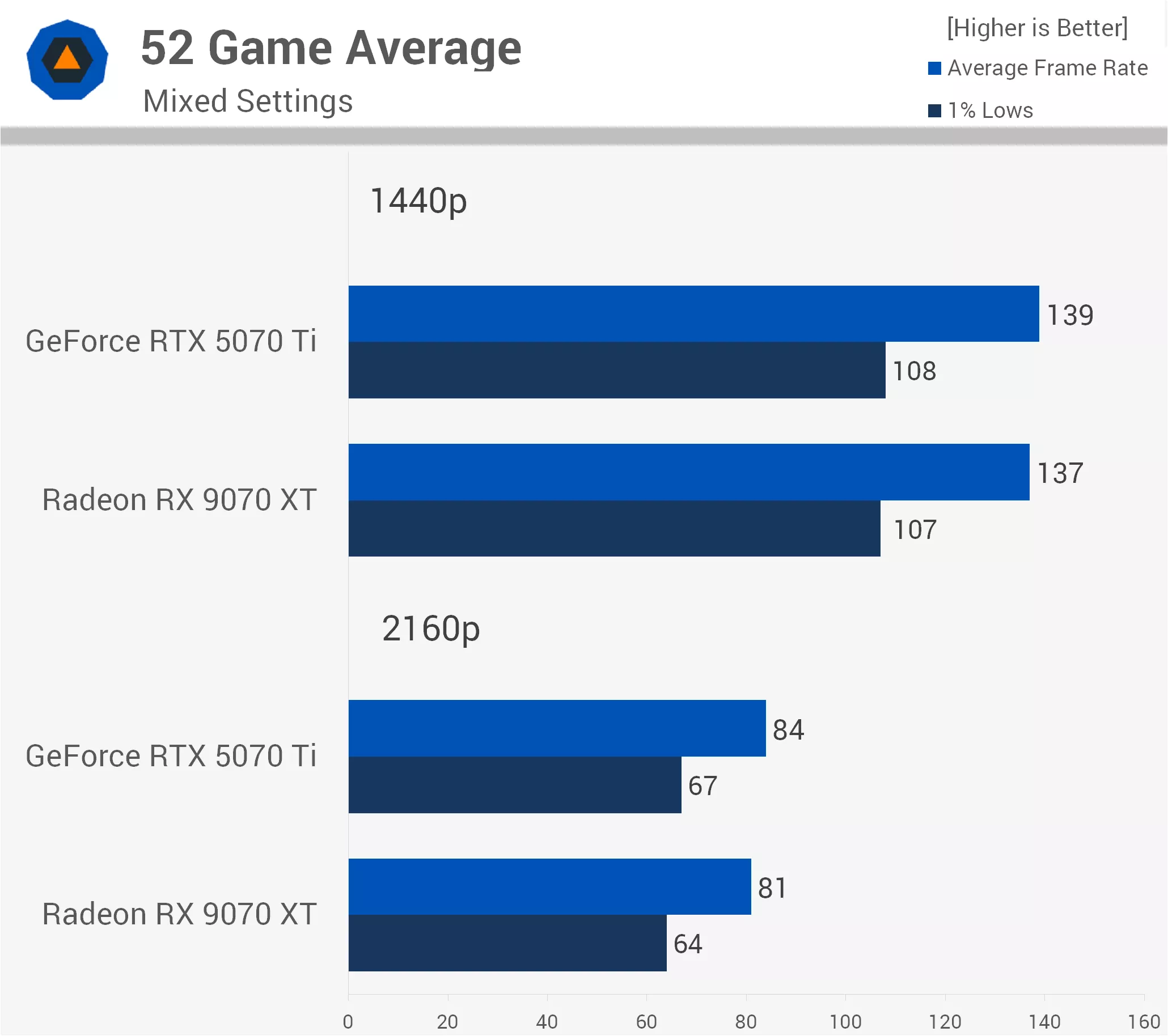
The RTX 5070 Ti edges out the RX 9070 XT by a microscopic margin of 2 frames per second, a difference of roughly 1.4%. It's the same story for the 1% lows, where the RTX 5070 Ti averages 108 fps compared to 107 fps for the 9070 XT. Both cards deliver incredibly smooth, stutter-free performance across the vast majority of titles at this resolution.
Pushing the resolution to native 4K gives the Nvidia GPU a slight advantage as memory bandwidth and architectural strengths are pushed harder, though it is still far from a blowout.
The RTX 5070 Ti averaged 84 fps compared to 81 fps for the RX 9070 XT, giving the GeForce GPU roughly a 4% lead.
Power Consumption
Whenever we publish these large performance updates, some readers will inevitably ask about power consumption. We normally don't spend much time revisiting power data because it doesn't meaningfully change from the day-one reviews.


But as a quick refresher, the RX 9070 XT typically consumes ~20% more power than the RTX 5070 Ti, making the GeForce GPU the more efficient option.
Nvidia Wins Features, AMD Wins Value
After testing a massive range of games across multiple settings, it's clear that Nvidia remains the king of heavy ray tracing and especially path tracing workloads. For example, in Doom at 1440p with path tracing enabled, the RTX 5070 Ti dropped to an unplayable 31 fps, yet that still made it 63% faster than the RX 9070 XT.
With upscaling enabled, it's possible to achieve a half decent experience, though personally the frame rates would still be too low for us to enjoy a fast-paced shooter like Doom. However, the point we're trying to make is that this example highlights the architectural limitations of AMD's current RT cores when subjected to full path-traced global illumination.

Whether or not you believe the RTX 5070 Ti is powerful enough to truly take advantage of path tracing depends on a few factors, though it's fair to say future titles will likely become increasingly difficult to run using these settings.
Another thing we noticed during testing was that the Blackwell architecture typically scales better at 4K, often pulling ahead in titles where it previously trailed at 1440p. This is likely due to the 5070 Ti enjoying 40% more memory bandwidth than the RX 9070 XT thanks to its use of GDDR7 memory.
Finally, if you're big on competitive shooters such as PUBG, Valorant, Fortnite, and Rainbow Six Siege, the RTX 5070 Ti could prove to be the better option. Not only does it generally deliver stronger performance in these titles, but Nvidia's regular driver updates also help ensure a smoother experience overall. As an example, we find Radeon performance in Fortnite can occasionally become a bit inconsistent.

The Radeon RX 9070 XT, on the other hand, proved to be a rasterization powerhouse. With ray tracing disabled, the 9070 XT consistently beats the 5070 Ti at 1440p. It also delivered strong performance in PlayStation ports such as Ghost of Tsushima and God of War, as well as games optimized for Radeon hardware such as Spider-Man 2 and Helldivers 2.
In Pragmata, Resident Evil Requiem, and Monster Hunter Wilds, the RX 9070 XT didn't just win in standard rasterization, it also tied or outright beat the RTX 5070 Ti with ray tracing enabled. So there are certainly examples where the 9070 XT performs very well with RT effects active.
At the end of the day, these GPUs are very evenly matched overall, something clearly reflected in the 52-game average data. For most buyers, the decision will ultimately come down to features and pricing, though given current market conditions, pricing is likely to be the deciding factor.

Right now, AMD Radeon RX 9070 XT graphics cards can easily be found for around $700, while the RTX 5070 Ti typically costs about $1,000, making the GeForce GPU nearly 40% more expensive. In our opinion, it simply doesn't do enough to justify that premium. A 20% premium could perhaps be defended, but nearly 40% is a much, much harder sell.
Different regions will see different situations (check out our latest GPU pricing update), but to cite one example, in Australia it's similar to the US, with the RTX 5070 Ti costing ~46% more at $1,340 AUD versus $930 AUD for the Radeon GPU.
Given the current pricing, we would choose the Radeon every time. In fact, now may be one of the best times to buy one if you haven't already, as we continue to hear murmurs that GPU pricing could rise again soon... as crazy as that sounds.