A Coldcard firmware flaw let hackers drain $70 million in Bitcoin in 41 minutes, with losses now topping $88 million

Skye Jacobs

Posts: 2,182   +62
Staff
Why it matters: A hardware wallet is supposed to solve one problem: keep your Bitcoin keys somewhere no attacker can reach them. This week showed what happens when the flaw sits inside the wallet itself. A firmware bug that's been shipping in Coldcard devices since 2021 let an attacker guess supposedly random seed phrases from the outside, no physical access, no phishing, no malware required, and drain funds from thousands of addresses. The running total is already past $88 million, and it's still climbing.

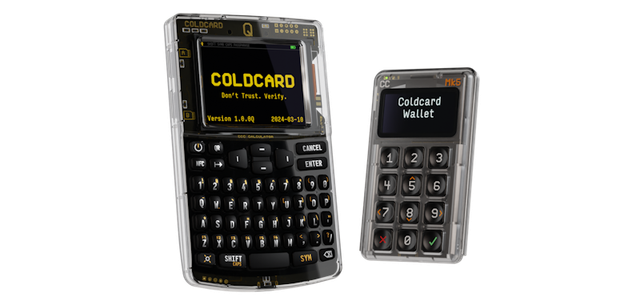
A flaw in Coldcard's firmware has put the spotlight on a basic part of wallet security: how the device generates its seed in the first place. The issue came into focus after an attacker drained 1,196 Bitcoin addresses on July 30 in a 41-minute stretch, taking 1,082.65 BTC worth about $70.2 million at the time.

Galaxy Research tied the sweep to Coldcard, the Bitcoin-only hardware wallet line made by Coinkite, and said the pattern matched a firmware problem rather than a random event. Two more waves have surfaced since, and Galaxy's running total now stands at 1,367.05 BTC, worth about $88.6 million, across 4,585 addresses. The firm describes that as a preliminary observed figure that could still climb as it traces more on-chain activity.

The problem goes back to a March 2021 firmware integration error. Instead of using the STM32 hardware random number generator, affected devices fell back to a deterministic software pseudorandom number generator when creating seeds. That matters because seed generation is supposed to produce output that cannot be guessed or reconstructed.

In plain terms: a wallet's seed is the master code, usually a string of 12 or 24 words, that can recreate every address and private key tied to it. That code has to come from a process nobody could predict or reverse-engineer, which is why devices lean on a dedicated randomness chip instead of ordinary software. When that swap happens quietly in reverse, the numbers still look random on screen, but they aren't, and that gap is what an attacker can exploit.

Block said an attacker who can pin down the device UID, timer state, and earlier random-number calls can reproduce candidate output streams without touching the wallet itself. Those candidate seeds can then be tested by deriving addresses and comparing them with public blockchain data. In other words, the weakness isn't in the blockchain, but in how the wallet device formed the starting point for key generation.

Put simply, the attacker never had to steal or even see the physical wallet. If you can work out roughly how a device's internal clock and serial number behaved the moment it powered on, you can recreate the same "random" number it generated on an ordinary computer, then just check whether that guess unlocks a real, funded address.

The bug traces back to a config mismatch in Coldcard's production code. The firmware defined a hardware RNG setting, but the library that handled it checked whether the setting existed rather than whether it was actually enabled. That sent the build into MicroPython's Yasmarang fallback, which starts from fixed device data and doesn't gather fresh entropy after initialization.

In practice, this was a coding oversight rather than a deliberate shortcut. The software was supposed to check whether the hardware randomness generator was switched on, but it only checked whether that setting existed in the code at all, which was true either way. So every device quietly fell back to the weaker method, a backup meant only for rare edge cases, without anyone noticing it had become the default.

Coinkite says the effective entropy is about 40 bits on the Mk3 and about 72 bits on the Mk4, Mk5, and Q. That's well below the 128 bits expected from a standard 12-word BIP-39 seed.

To translate the bit counts: think of entropy as the size of a combination lock. A 40-bit lock has around a trillion possible combinations, small enough for ordinary hardware to work through in hours. 72 bits is a much bigger lock, out of reach for a hobbyist but not for a well-funded attacker. A proper 128-bit lock, by contrast, would take far longer than the universe has existed to crack by brute force, even at billions of guesses a second.
Coinkite released emergency firmware on July 31 for all affected models and release tracks. That update, however, doesn't fix seeds that were already created. The company is telling users with exposed seeds to generate a new one on patched firmware and move their coins. Restoring an old seed on a new device or updated firmware doesn't remove the weakness.

Which devices are exposed depends on the firmware running when the seed was created. Block places Mk2 and Mk3 versions 4.0.0 through 4.1.9 on the vulnerable path, while Coinkite lists Mk3 versions 4.0.1 through 4.1.9 and says the issue was fixed in 4.2.0. For newer models, Mk4 and Mk5 are affected before 5.6.0, the Q before 1.5.0Q, and Edge builds before the later edge-specific fixes.

Coinkite says seeds built with at least 50 fair, independent, private dice rolls aren't exposed to this bug alone. Users who aren't sure how their seed was made should migrate anyway, the company says. A strong BIP-39 passphrase creates a separate wallet, but Coinkite still recommends replacing the seed. Multisig only helps if the quorum isn't made up entirely of affected devices. Tapsigner, Opendime, and Satscard use different codebases and aren't affected.

No one has named the attacker. Galaxy said it found no other Bitcoin transactions in the previous 30 days with the same 30 sat/vB, no-change pattern, but it also warned that the signature identifies the operator, not necessarily the theft. A sweep, the firm said, can look the same as a legitimate move by the owner.

A second wave on July 31 drained another 76.16 BTC from 1,478 addresses, and a third, identified August 1, took 207.73 BTC from 1,912 more – bringing the three-wave total to the current 1,367.05 BTC. Galaxy said the first two waves shared the same transaction fingerprint, but the third used a different output pattern, which the firm said could mean the original attacker changed tools, or that a second party is now exploiting the same flaw.

The failure has landed hardest on exactly the users who took the most care to avoid it. Jonathan Goodman, who says he lost roughly $1.6 million in the exploit, described keeping his Coldcard in a safety deposit box that had never touched the internet, textbook practice for cold storage. "I did everything right," he wrote in a post that circulated widely on X.

Coldcard's user base has traditionally skewed toward people who went out of their way to learn self-custody rather than casual holders, which has fed a broader sense among affected users that no publicized best practice fully protects against a flaw built into the hardware itself.

This situation has fed a wider debate on Bitcoin forums over what self-custody can realistically promise. If a five-year-old firmware bug could sit undetected in a well-regarded device, some holders are asking what basis there is for treating other hardware wallets as safe simply because they haven't been caught yet.

Others have pointed to Coinkite's own acknowledgment that AI tools may have helped surface the flaw as a sign the gap between a bug shipping and someone finding it is likely to keep shrinking.

The incident comes soon after Coinspect's "Ill Bloom" research in early July, which described a separate weak-PRNG flaw in older software wallets and linked it to more than $5 million in losses across several blockchains since May. The two disclosures point to the same lesson: when randomness is weak, the rest of the cryptography can be perfectly sound and still fail.

Permalink to story:

 
Sheesh what a long article, instead of using the purpose build hardware the software fallback was used for random number generation - which lead to much easier to reproduce outcomes.

Sounds like some developer accidently let some temporary code become permanent code. Well, that's an expensive whoopsy. I guess they'll be using build flags next time.
 
The reason cryptocurrency will fail in the long run is that people are too lazy to use everything that makes it digital cash. Host a wallet on a secured PC and this **** will never happen.
 
The reason cryptocurrency will fail in the long run is that people are too lazy to use everything that makes it digital cash. Host a wallet on a secured PC and this **** will never happen.
This happened to a HARDWARE wallet. The wallets were completely offline, even more "secured" that what you suggested. The money was stolen anyways. You can buy it here and it looks like a calculator: https://coldcard.com/

In the article on the EU developing their own digital currency just a month ago, I pointed out that this could happen:
What happens if an "offline" transaction is able to be recorded on one device without involvement from another? This would mean a private key was stolen or there's a flaw in the cryptography somewhere. The device that made up the fake transaction (receiving money) would need to create this "zero-knowledge proof" that a second device didn't authorize.
In response, I was told that the blockchain systems are "what made bitcoin impossible to steal directly" lol:
Why would that happen in a blockchain system? Normally you have to keep beating every other system calculating the blockchains validity and continue to do so to keep the money. That's a ton of power depending on the algorithm for the hashing. It's also what made bitcoin impossible to steal directly.
In reality, there are ALWAYS software flaws. In fact, now more than ever we are more vulnerable because AI is capable of finding more intricate security vulnerabilities than humans ever could. And after 15 years, when Bitcoin is supposed to be incredibly secured, we are still getting news of a mass, digital heist.

People who deny that Bitcoin can be stolen are just like the people who claim communism can work if done right. My response? Sure it can, under the perfect conditions. But you won't find that happening here on Earth.
 
Last edited:
This happened to a HARDWARE wallet. The wallets were completely offline, even more "secured" that what you suggested. The money was stolen anyways. You can buy it here and it looks like a calculator: https://coldcard.com/

In the article on the EU developing their own digital currency just a month ago, I pointed out that this could happen:

In response, I was told that the blockchain algorithms are "what made bitcoin impossible to steal directly" lol:

In reality, there are ALWAYS software flaws. In fact, now more than ever we are more vulnerable because AI is capable of finding more intricate security vulnerabilities than humans ever could. And after 15 years, when Bitcoin is supposed to be incredibly secured, we are still getting news of a mass, digital heist.

People who deny that Bitcoin can be stolen are just like the people who claim communism can work if done right. My response? Sure it can, under the perfect conditions. But you won't find that happening here on Earth.
So a bunch of people had their crypto stolen that was stored in an offline hardware wallet?
 
So a bunch of people had their crypto stolen that was stored in an offline hardware wallet?
This happened to a HARDWARE wallet. The wallets were completely offline, even more "secured" that what you suggested. The money was stolen anyways. You can buy it here and it looks like a calculator: https://coldcard.com/

In the article on the EU developing their own digital currency just a month ago, I pointed out that this could happen:

In response, I was told that the blockchain systems are "what made bitcoin impossible to steal directly" lol:

In reality, there are ALWAYS software flaws. In fact, now more than ever we are more vulnerable because AI is capable of finding more intricate security vulnerabilities than humans ever could. And after 15 years, when Bitcoin is supposed to be incredibly secured, we are still getting news of a mass, digital heist.

People who deny that Bitcoin can be stolen are just like the people who claim communism can work if done right. My response? Sure it can, under the perfect conditions. But you won't find that happening here on Earth.
I don't exacly know the entire story of either one of you sides. I think plutoisaplanet is trying to say if the transactions are recorded by another device as they are being made, the other device is making a duplcate wallet with all of the credentials to get to it. Is this correct, it would be just about the only way to steal bitcoins from a so called offline wallet if what I am thinking is true. What makes any kind of wallet a hardware wallet? Are you saying computer hardware is a wallet? Computer hardware would mean the data stored on it is the wallet. Could ya'll expound, maybe I'm just not savvy enough yet about bitcoins. I don't mess with bitcoins myself just for these kind of reasons. I prefer something of value that is physical that I can hold onto. A Dvd player still works without the hassel of getting tangled up on the world wide web . Could it be some of the very pirates are instigated by the very producers of whatever themselves.
 
Last edited:
This happened to a HARDWARE wallet. The wallets were completely offline, even more "secured" that what you suggested. The money was stolen anyways. You can buy it here and it looks like a calculator: https://coldcard.com/

In the article on the EU developing their own digital currency just a month ago, I pointed out that this could happen:

In response, I was told that the blockchain systems are "what made bitcoin impossible to steal directly" lol:

In reality, there are ALWAYS software flaws. In fact, now more than ever we are more vulnerable because AI is capable of finding more intricate security vulnerabilities than humans ever could. And after 15 years, when Bitcoin is supposed to be incredibly secured, we are still getting news of a mass, digital heist.

People who deny that Bitcoin can be stolen are just like the people who claim communism can work if done right. My response? Sure it can, under the perfect conditions. But you won't find that happening here on Earth.
You are very much right about bitcoin, but I do have to point out that what the EU is doing with the digital currency is better protected from fraud. The money is 100% backed and guaranteed by the European Central Bank (ECB) which means it's not affected by traditional bank failures.

It may not be perfect, but that's kinda the point of using these services. (and if I'm not mistaken the digital wallets have a hard limit on how much you can deposit of several thousand euros, I saw 3000 somewhere)
 
So a bunch of people had their crypto stolen that was stored in an offline hardware wallet?
Yes. Because those coins exist in a ledger, and if you feed bad data into that ledger, those "coins" are yours. That is what was done here, the hackers were able to clone the hardware IDs of the wallets, expose a flaw in the fallback software that generated encryption codes, and posed as the owners telling the blockchain to transfer ownership of the tokens to another wallet.

Because you see, Crypto is not a "currency". It is a collection of tokens on a blockchain. You cannot physically "own" them nor "control" them. Arguably, the same applies to any digital currency, those only exist and are secure because of government regulations around banking and currency. Crypto, OTOH, is a digital security, it has none of the aspects of a real currency that would be necessary for its use. It's a stock, but not one with the protections of being part of the stock market. And it is rife with security flaws and design failures that make it extremely vulnerable to things like this.
I don't exacly know the entire story of either one of you sides. I think plutoisaplanet is trying to say if the transactions are recorded by another device as they are being made, the other device is making a duplcate wallet with all of the credentials to get to it. Is this correct, it would be just about the only way to steal bitcoins from a so called offline wallet if what I am thinking is true. What makes any kind of wallet a hardware wallet? Are you saying computer hardware is a wallet? Computer hardware would mean the data stored on it is the wallet. Could ya'll expound, maybe I'm just not savvy enough yet about bitcoins. I don't mess with bitcoins myself just for these kind of reasons. I prefer something of value that is physical that I can hold onto. A Dvd player still works without the hassel of getting tangled up on the world wide web . Could it be some of the very pirates are instigated by the very producers of whatever themselves.
It's not a duplicate wallet, it is the blockchain itself. The blockchain contains a public, decentralized, auditable record of every holder's wallet ID and the amount of "currency" in said wallet. You can just look at the record of wallet #123 and see it has $500 in bitcoin in it. Now, whom wallet #123 actually belongs to is the pseudo anonymous part of crypto. But the wallets contents, related to that chain, are all known.

If you can emulate the crypto hash used to secure the wallet's identity, it would be trivial to feed the chain bad data and say you are the owner of that wallet, and the funds should be transferred to wallet #456. The chain does not care who inputs the hash, only that the hash is correct. It's like banking, if you could just submit a transfer if you knew the routing number and didnt have to log onto the bank website and prove you owned the account first, and every account and all their balances were public knowledge you could just google.
 
Last edited:
So a bunch of people had their crypto stolen that was stored in an offline hardware wallet?
As mentioned by Theinsanegamer, data is not stored on wallets but the blockchain. Your private keys are stored on a wallet, and using the private key to do the right cryptography math (a proof, or signature) is what’s needed to use the money. For hardware keys, all the math is done on the wallet after a passphrase is entered. Only the results of the math are shared externally after the user approves on the device.

Someone was able to recreate those keys because the RNG was software designed and there wasn’t enough “entropy”. That entropy is collected from software instead of the physical world, sometimes relying on the current date. There were two possible exceptions to that. Users were able to use a passphrase (the key to decrypt their wallet) and the key generation relied on that to generate keys to some degree. Coinkite also said that if users used enough dice rolls to create entropy (literally inputting the results of physically rolling dice 50+ or 100+ times), they are not affected.
 
No sympathy

The only people that suffered were people who thought they were smarter than everyone else and wanted something for producing nothing of intrinsic value to anyone but themselves.

..f**k 'em.
 
Because you see, Crypto is not a "currency". It is a collection of tokens on a blockchain. You cannot physically "own" them nor "control" them.
Err, you don't seem to realize that 90% of the US dollars in circulation are digital in form, not physical. Are they or are they not currency?

Arguably, the same applies to any digital currency, those only exist and are secure because of government regulations around banking and currency.
And yet even with those regulations, a quarter of a trillion dollars each year is stolen in just the US alone.

Crypto [is] a stock, but not one with the protections of being part of the stock market.
Crypto is not a stock, which equates to partial ownership of a physical corporation. One thing crypto shares in common with stocks, though, is a permanent ledger transaction recording every transfer of ownership, which makes every theft trackable -- a protection that physical currency lacks.
 
Last edited:
Err, you don't seem to realize that 90% of the US dollars in circulation are digital in form, not physical. Are they or are they not currency?


And yet even with those regulations, a quarter of a trillion dollars each year is stolen in just the US alone.


Crypto is not a stock, which equates to partial ownership of a physical corporation. One thing crypto shares in common with stocks, though, is a permanent ledger transaction recording every transfer of ownership, which makes every theft trackable -- a protection that physical currency lacks.
"Are they or are they not currency?" - it's obviously currency regardless of the form. you can easily turn it into cash at an ATM if you want.

Bitcoin on the other hand is not currency. In simple terms, it's a digital asset/product that you can sell or buy on the market (a market that's not that different to how stocks work). And as with many digital things, you can use it for trade.
 
"Are they or are they not currency?" - it's obviously currency regardless of the form. you can easily turn it into cash at an ATM if you want.

Bitcoin on the other hand is not currency. In simple terms, it's a digital asset/product that you can sell or buy on the market (a market that's not that different to how stocks work). And as with many digital things, you can use it for trade.
Does the value of bitcoins rise and fall if it is not that different to how stocks work? I have never tried stocks or bitcoin.
 
"Are they or are they not currency?" - it's obviously currency regardless of the form. you can easily turn it into cash at an ATM if you want.

Bitcoin on the other hand is not currency. In simple terms, it's a digital asset/product that you can sell or buy on the market (a market that's not that different to how stocks work)
Oops! At my current account balances, converting them into cash at an ATM would take several years, given the per-day withdrawal restrictions. Even inside the local branch office itself, they require 7 business days notice to convert more than $100K into cash. And I can't even imagine the difficulty a firm like Apple would face attempting to convert their $60B in digital currency into physical cash.

Bitcoin is a currency: a medium of exchange that -- like fiat paper currency -- has no intrinsic value in itself. It may not be a particularly useful currency in my opinion, but it's still a currenct. And it is nothing like the stock market: if you own a single share in a corporation that has just one share outstanding: you own the entire company outright: along with any and all land, structures, or other hard assets it owns.
 
Last edited:
Um, I don't know if anyone noticed that Digital Currency was everywhere before bitcoin, really we have too many digital currencies before digital coins, once you add those in we are wasting massive money just trying to keep all these systems alive. I wouldn't put it past the admins of the systems to be able to pull money from the collective to pay for operating costs that are not passed to the digital currency holders. No one would adopt the coins if they were paying the operating costs in the form of fees. So these costs are eaten by the developers and sustaining investors but they are never ending costs. So eventually they will become a serious issue. Cash has costs too but far less.
 
Oops! At my current account balances, converting them into cash at an ATM would take several years, given the per-day withdrawal restrictions. Even inside the local branch office itself, they require 7 business days notice to convert more than $100K into cash. And I can't even imagine the difficulty a firm like Apple would face attempting to convert their $60B in digital currency into physical cash.

Bitcoin is a currency: a medium of exchange that -- like fiat paper currency -- has no intrinsic value in itself. It may not be a particularly useful currency in my opinion, but it's still a currenct. And it is nothing like the stock market: if you own a single share in a corporation that has just one share outstanding: you own the entire company outright: along with any and all land, structures, or other hard assets it owns.
"At my current account balances, converting them into cash at an ATM would take several years" - ok dude, you need to stop trolling. making troll comments for the sake of troll comments is just childish. there are other ways of getting your money, but hey, that's too much for you to think of.

"Bitcoin is a currency" - it's not, it's just a digital asset that you can buy and trade. it's a product that people like to pretend is money, like the "fake currency" in games that you buy with actual money. the value comes from what people are willing to pay for it.

exactly like with pedo trump's and his wife's memecoins. it had "value" until the rug pull scam happened. was that "currency" too? under your definition, it was.
 
"At my current account balances, converting them into cash at an ATM would take several years" - ok dude, you need to stop trolling.
I realize that account balances in Romania are measured in beetroots and hog bellies, but here in the US, bank ATMs have daily withdrawal limits, usually in the $500 range. Withdrawing any sizeable balance in that manner does indeed take years.

... there are other ways of getting your money, but hey, that's too much for you to think of.
You really struggle with English, don't you? I specifically named the ONLY other way to convert an account balance to cash, and even that takes several days.

"Bitcoin is a currency" - it's not, it's just a digital asset
Learn what words mean. "Assets" have underlying value, even if they're digital. A medium of exchange, however, does not.

exactly like with pedo trump's and his wife's memecoins.
As long as you're still living it up in the child exploitation capitol of the Northern Hemisphere, you probably shouldn't throw stones at others.
 
I realize that account balances in Romania are measured in beetroots and hog bellies, but here in the US, bank ATMs have daily withdrawal limits, usually in the $500 range. Withdrawing any sizeable balance in that manner does indeed take years.


You really struggle with English, don't you? I specifically named the ONLY other way to convert an account balance to cash, and even that takes several days.


Learn what words mean. "Assets" have underlying value, even if they're digital. A medium of exchange, however, does not.


As long as you're still living it up in the child exploitation capitol of the Northern Hemisphere, you probably shouldn't throw stones at others.
Ah I get, it, you do approve of trump scamming people with his memecoins and you think that it's normal for him to do that. No wonder you think of crypto as "currency". Thanks for clarifying that. Defending pedo trump this fervently is just sad.

"I specifically named the ONLY other way to convert an account balance to cash" - not the point of the argument.
And you seem to be stuck on the word "ATM", which is just childish. It was an example of how you can get cash, not how to get all the money at once. Are pretending not to understand or are you too focused on those silly "Romanian" insults?

"Learn what words mean." - everybody here knows what those words mean better than you. Information from Science Direct and European Central Bank: "Bitcoin is legally and economically classified as a digital asset or crypto-asset, functioning primarily as a speculative investment and store of value rather than a widespread medium of exchange"; "Essentially, it is a digital token that can be exchanged electronically"; "virtual, yes, but currency, no"; "Bitcoin is a speculative asset.".

FYI I like it when you use these insults about Romania. It just makes you look worse and worse here because you know you can't give proper arguments back, just lies and disinformation that I've completely destroyed every time. Typical maga :)
 
Last edited:
Information from Science Direct and European Central Bank: "Bitcoin is legally and economically classified as a digital asset
From the US Federal Reserve:

"Bitcoin is a digital currency ... Bitcoin is not a physical coin that you keep in your purse or wallet. Rather, it is a virtual currency...."


"I specifically named the ONLY other way to convert an account balance to cash" - not the point of the argument.
And you seem to be stuck on the word "ATM"
You forget you were the one who brought up ATMs. The point stands: digital currency in a bank account balance is often no easier nor quicker to convert into physical cash than is Bitcoin or any other crypto currency.

FYI I like it when you use these insults about Romania.
Romania does an excellent job of insulting itself.
 
Back