Forward-looking: A Japanese startup, Sensia Technology, is challenging long-held assumptions about how speakers are built. The company has introduced what it describes as the first portable speaker made entirely of sound-emitting fabric, an approach that replaces rigid cones and enclosures with flexible electronic components, allowing the woven material itself to function as an audio transducer across its entire surface.
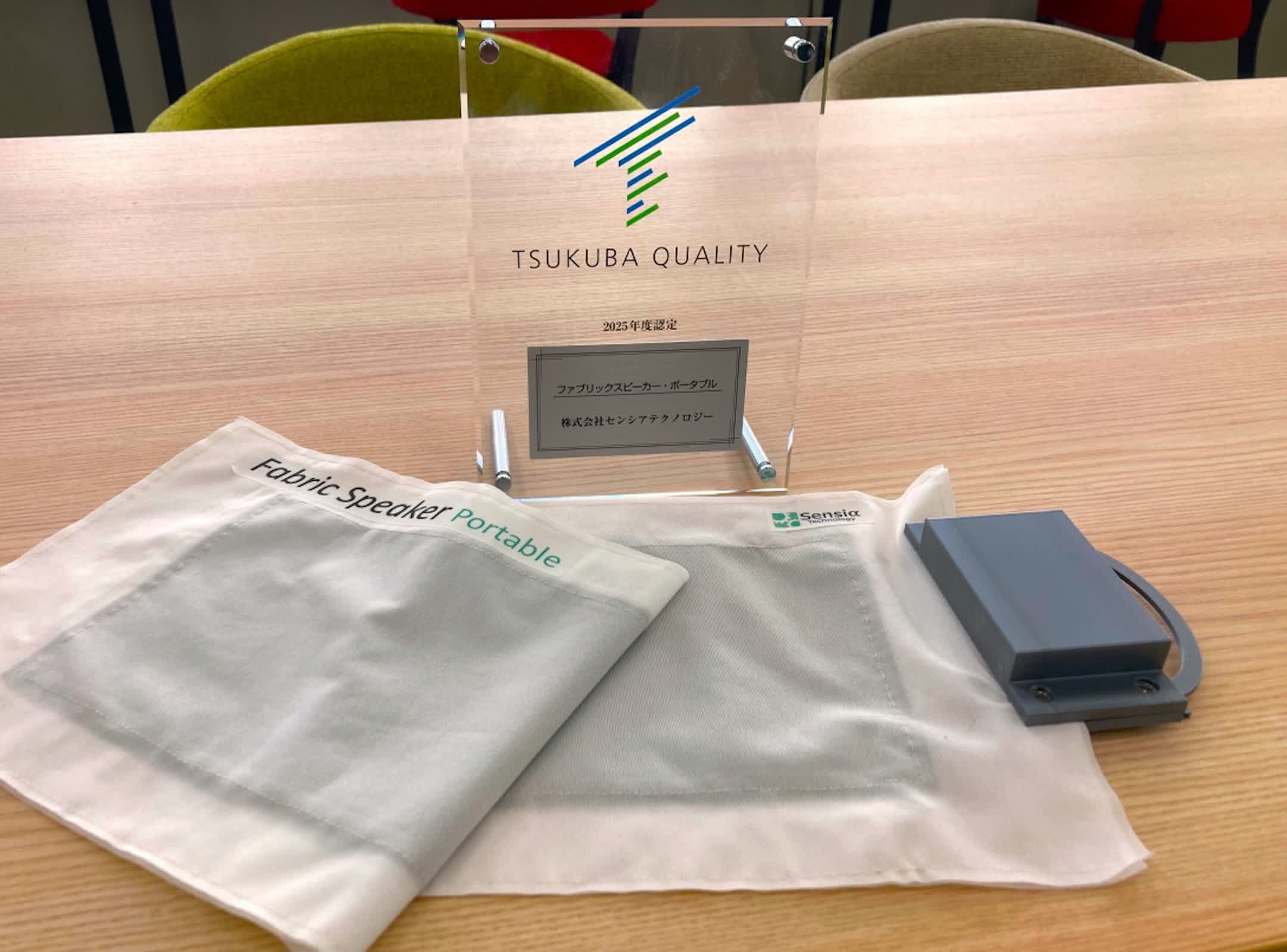
The technology originated at Japan's National Institute of Advanced Industrial Science and Technology (AIST) in 2018, where researchers demonstrated a thin, lightweight, bendable electronic textile. Sensia's new product represents the first commercial application of that research, adapting the concept into a consumer-ready format that requires no traditional speaker cones or enclosures.
The design is based on electrostatic speaker architecture, a method that uses electrical attraction and repulsion to generate sound. Sensia's fabric integrates conductive fibers into a capacitor-like structure: two flexible conductive layers separated by a thin dielectric film.
When an audio signal is applied, it modulates the electric field between these layers, causing the fabric to vibrate and subtly displace air. The result is audible sound distributed evenly across the entire textile surface, without the need for localized driver components.
The use of flexible electronics distinguishes the Fabric Speaker Portable from earlier textile audio products – such as cushions or pillow speakers – that conceal rigid audio drivers within fabric coverings. Those traditional designs often create lumpy enclosures and uneven sound fields.

The technology originated at Japan's National Institute of Advanced Industrial Science and Technology
Sensia's version, by contrast, operates uniformly, producing sound from every part of its surface. This eliminates dead zones and allows for a thinner, more natural feel.
A small plastic module attached to one edge houses the device's power supply, wireless connectivity circuitry, and drive electronics. According to the company's technical documentation, the speaker can reach sound pressure levels around 68 decibels when used singly and approximately 71 decibels when paired, roughly comparable to the hum of a household vacuum cleaner at close range.
While Sensia has not disclosed data on frequency range or distortion levels, the company positions the device as suitable for ambient and personal listening, whether hung on a wall like a sound tapestry or placed beneath fabric surfaces such as bedsheets or cushions.
For now, Sensia's fabric speaker remains a niche demonstration of how flexible microelectronics can redefine traditional hardware categories. If the technology scales, it could inform the next generation of embedded or wearable audio systems, integrating sound into everyday materials rather than enclosing it in rigid devices.
A Japanese startup built a speaker that's basically a sheet of fabric


