Big quote: GitHub Copilot is taking on more of the work that happens around writing code, not just the code itself. Its agent can now set up environments, make changes in a repository, run tests, and open a pull request for a developer to review. David Fowler, a Microsoft Distinguished Engineer who leads work on Aspire, put it bluntly in a post on X: "Typing code is absolutely over."

Fowler was not suggesting that software engineers are becoming unnecessary. But as AI handles more routine coding work, developers may spend less time writing individual lines and more time on system design, requirements, dependencies, and the review needed to make sure software is secure and works as intended.
Copilot's coding agent is part of that change. GitHub has added Windows development environments for the agent, allowing it to build and test Windows-targeted projects, run linters, and check whether builds succeed. The agent can then return its work to a human developer for review through a pull request.
GitHub has also brought agent sessions to the Windows Subsystem for Linux, which is useful for teams that build software across Windows and Linux toolchains, especially when applications are developed on Windows but tested or deployed in Linux-based environments.
– David Fowler (@davidfowl) September 3, 2026
Microsoft is making similar changes in Aspire, its code-first toolchain for building distributed applications. Aspire lets developers describe application components such as services, containers, and databases in one application model, giving an AI agent more context than it would get from a single source file or a chat prompt.
Aspire 13.1 introduced deeper support for AI coding assistants. Aspire 13.2 added an agent-friendly command-line interface and support for the Model Context Protocol, which can give AI tools controlled access to development resources and context.
Microsoft's Aspire team said in April that AI agents can be good at generating code, but that producing code is different from delivering a working application. Aspire is meant to close some of that gap by allowing an agent to start services, inspect logs and telemetry, identify errors, restart components, and test again. In theory, that gives an agent a way to investigate an application failure directly instead of relying on a developer to copy error output into a chat window.
Microsoft is using AI on the security side as well. Its MDASH system is an agentic vulnerability scanner used by engineering teams working on Windows, Azure, and identity systems. Microsoft's Windows security team said MDASH "enabled our security team to perform vulnerability hunting at the scale of Windows with a much higher depth of analysis than was previously possible."
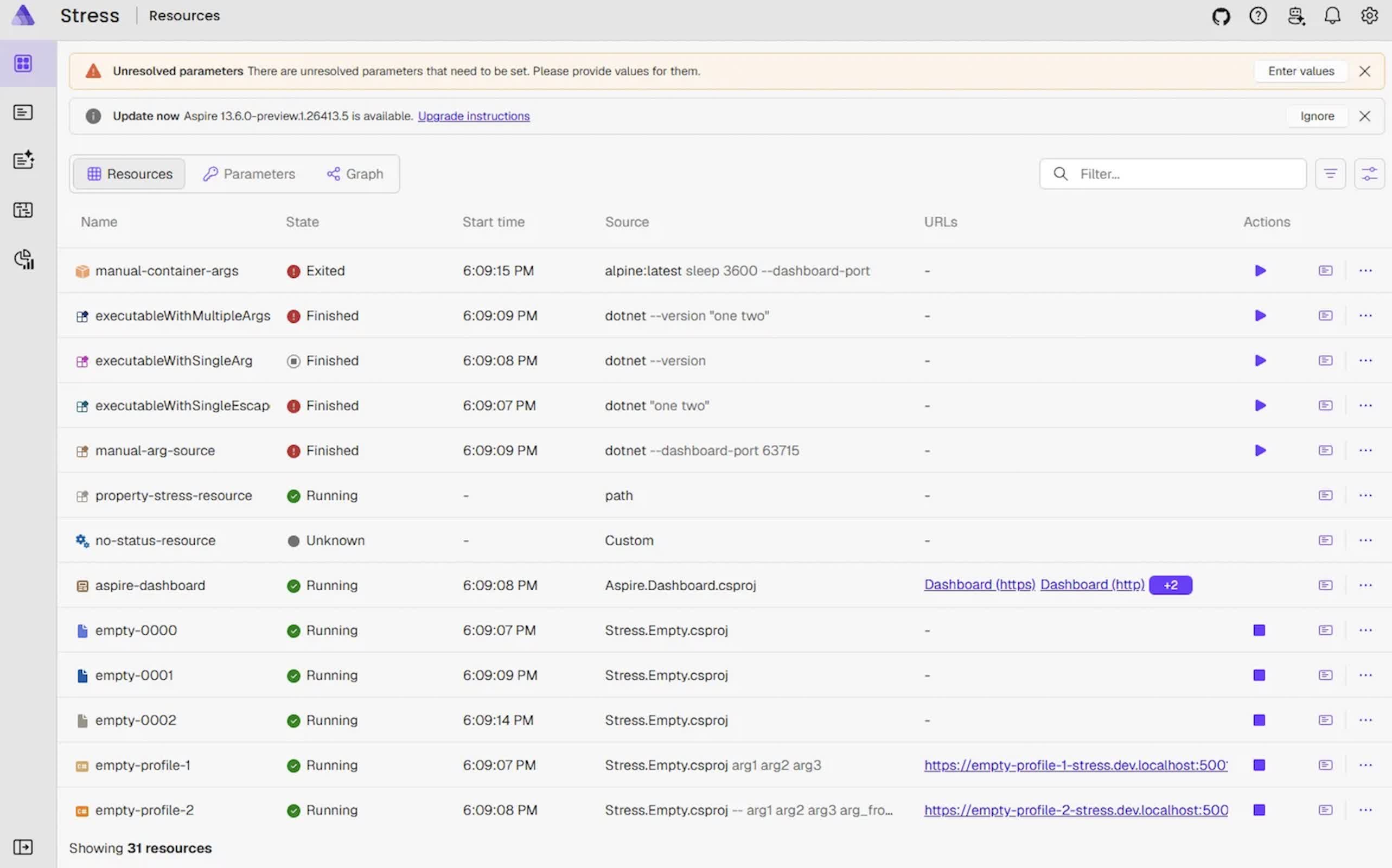
An Aspire dashboard.
The company said the work includes components such as the Windows kernel, Hyper-V, and the networking stack. Those are large and security-sensitive codebases, where automated analysis can help researchers examine more code and investigate issues more quickly.
Microsoft's native Windows development tools are also part of the picture. The company recommends WinUI 3 for new native Windows applications, and the framework is now open source. More accessible source code and documentation can make it easier for AI tools to understand common project structures and supported APIs.
Microsoft has also published a guide for using Copilot to build WinUI applications. It covers code completion, file context, and project-specific instructions, showing that the company expects AI assistance to become part of regular Windows development work.
Project Zenith, announced September 4, adds a hardware angle. Microsoft described it as a stripped-down Windows 11 setup for developers, with a baseline requirement of 64GB of unified memory and 250GB/s of memory bandwidth. The initial focus is on AMD Ryzen AI Halo chips.
The hardware is intended to support local AI models with more than 30 billion parameters. Running models locally could reduce cloud inference costs and give developers more control over how proprietary code and data are handled.
All of which explains why Fowler's remark is less sweeping than it first appears. He was not predicting that developers will disappear; instead, his post reflected how their work is changing. AI may take over more boilerplate coding and routine fixes, but developers will still decide what gets built, review what the tools produce, and make sure the software is secure, reliable, and ready to run in the real world.
A Microsoft engineer says "typing code is absolutely over," here's what he means


