Apple and Samsung are dominating smartphone sales so thoroughly that only one other company makes the top 10

Shawn Knight

Posts: 15,828   +202
Staff member
In a nutshell: Apple and Samsung dominated the global smartphone market in the first quarter of 2026, claiming nine of the top 10 best-selling devices worldwide. Counterpoint Research data shows Xiaomi was the sole outsider to break through, securing the tenth spot – every other position belonged to either an iPhone or a Galaxy.
The iPhone 17 was the best-selling smartphone in the first quarter, accounting for six percent of global sales. Apple's iPhone 17 Pro Max ranked second, followed by the standard iPhone 17 Pro. Samsung grabbed fourth and fifth place with the Galaxy A07 G4 and Galaxy A17 5G, respectively.

Apple launched the iPhone 17 series in September 2025. The handset was more of an incremental update than a generational change, but that has not slowed sales. For the fiscal second quarter that ended March 28, the iPhone category generated $56.99 billion – slightly lower than estimates, but far from bad.

CEO Tim Cook said demand was not the issue, instead pointing to the supply chain. "The demand was off the charts. And there's just a little less flexibility in the supply chain at the moment for getting more parts," he recently told Reuters.
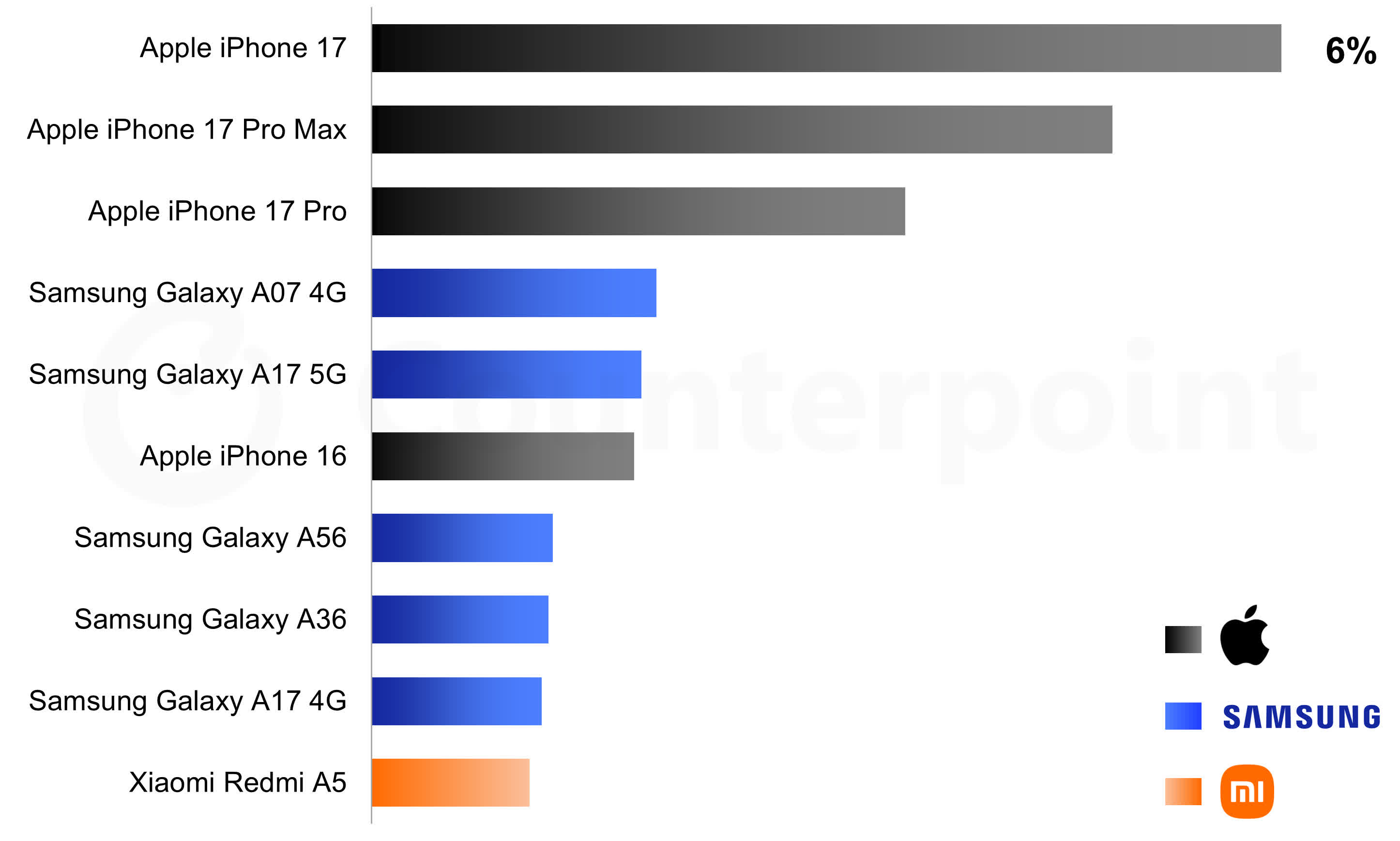
Xiaomi was the only company not named Apple or Samsung to make it into the top 10, capturing the last spot with its Redmi A5 smartphone. It was the most affordable offering on the list, Counterpoint noted.

Speaking on Apple's performance, Counterpoint Senior Analyst Harshit Rastogi said the iPhone 17 continues to outperform its predecessor, owing to key upgrades like camera resolution, higher base storage, and an improved display refresh rate that brings the base model closer to the Pro variants and providing better overall value.

As for Samsung, the Galaxy A series was the company's clear frontrunner. The Galaxy A07 4G was not only Samsung's best-selling phone of the quarter, but also the top Android phone worldwide. The entry-level handset features a 6.7-inch display, a 50-megapixel rear-facing camera, and a 5,000mAh battery – all for less than $100.

Looking ahead to the rest of the year, Counterpoint expects high-end smartphones to continue to gain share despite an overall market decline.

Permalink to story:

 
For comparison, this has been true the last two years as well (in Q1 2024 there actually wasn't any phone on the list besides from Apple or Samsung): https://counterpointresearch.com/en/insights/top-10-bestselling-smartphones-q1-2025


Also, clearly when Counterpoint says it "expects high-end smartphones to continue to gain share", it must be referring to the best selling phones from Apple and Samsung. In prior years, it considered these to be phones selling at $600 and up. Separately, the iPhone "Pro Max" models have been in decline from first place in 2024.
 
A mid-range phone will do anything you could want now - why spend more for marginal upgrades? Also, Samsung and Apple deliver a better user experience overall. Its a shame that Samsung's devices aren't made as well as most other brands, but marketing, value and UX nearly always win.
 
A mid-range phone will do anything you could want now - why spend more for marginal upgrades? Also, Samsung and Apple deliver a better user experience overall. Its a shame that Samsung's devices aren't made as well as most other brands, but marketing, value and UX nearly always win.

Couple reasons (using the USA model). Most smartphone customers are not "tech smart". Most smartphone users are still use to buying a phone from a CARRIER. It's been that way since cell phones
came along. Walk into a carrier store and you could mistake that you walked into an Apple or Samsung
store because that's what you see and that is what the sales people will push. They will push the higher end versions. Then once you are hooked in, typically they will "give" you a "free" upgrade next year to lock you into another contract.
People are like sheep a lot of the times...plus if they buy the high end version, they will still be "in their click" with their so called friends.
 
iPhone resale value is way higher than any other brand - so buying one and then selling it a few years later to get a new one makes it a better value than buying a Galaxy…

This is fact, resell value is night vs day compared to Android.

If you buy an Android flagship on release and sell it 2 years later, you lost almost everything and these are often priced just as high as Apple during launch. Samsung is the worst here. They lower price like crazy after just a few weeks/months and after 6 months you are looking at 50% lower price or so. 1 year later they repeat the cycle (and they almost give last years model away in the remaining weeks of a cycle, to clear inventory)

Apple resale value is alot higher due to Apple not lowering prices much if at all, and the fact that there is massive demand in the second hand market for Apple and with 7-8 years of iOS upgrades, many won't care if an iPhone is 2-3-4 years old.

I had like 5 Android phones in my closet collecting dust till I gave them away. They were close to unsellable. I had 5 iPhones total, they all sold for hundreds of dollars after 2-3 years. 300-400 dollars often is easy for a Pro model or 256GB regular model after a few years.

Its like with Nvidia GPUs for the most part - You pay more initially but you regain that amount when selling. Demand is huge, as 90% wants Nvidia GPU.

Supply vs demand... Samsung phones should never cost the same as Apple phones, or even close, the TCO is crazy on Samsung if you buy on release. Always wait a few months, then buy Samsung. Boom, you saved 25% or more.
 
Last edited:
Good to see no Pixel Phones in the list I guess people are getting sick of Google killing their phones after a couple of years.
 
Well, now that Android is on a collision course to be AndroidOS, where it's basically "iOS, made by Google", there's even less incentive to own an Android device at all.

If Google is determined to turn every Android device into an iPhone, by seriously paring back sideloading and potentially unifying the whole experience with Android 16, "because Apple does it", then I might as well just...get an iPhone.
 

Samsung is cheap if you trade in your old phone.
I would probably try other phones if Samsung did not offer
such attractive trade-in deals.
I presume that deals and good reliability are the main reasons
they are one of the top cellphone companies, at least in the USA.


Well, now that Android is on a collision course to be AndroidOS, where it's basically "iOS, made by Google", there's even less incentive to own an Android device at all.

If Google is determined to turn every Android device into an iPhone, by seriously paring back sideloading and potentially unifying the whole experience with Android 16, "because Apple does it", then I might as well just...get an iPhone.
Totally agree, but the price is the last incentive. How I wish there were a truly open source affordable alternative.
 
Totally agree, but the price is the last incentive. How I wish there were a truly open source affordable alternative.
I'm sorry to be bearer of bad news, but the price is actually the least important part of the package. That might seem like an absolutely bizzare statement to make, but it's also a fact. Most people do not buy smartphones based on the price alone, they buy into an ecosystem. We know this is true, because the iPhone 16 was the best selling smartphone of last year and it costs $700 at the time of writing on Apple's website for the 128GB model. On Android, you can buy the Moto G 2025 edition with the same amount of storage for $200 MSRP on Amazon, unlocked.

You buy iPhone for its uniformity and for iMessage (this is less relevant than it was 10 years ago, now that RCS support is standard, but it still matters), plus it continues to be a status symbol. Conversely, you buy Android for its customization, ability to install apps from basically anywhere (in theory, at least) and the fact that its open nature readily facilitates custom bootloaders. In other words, you buy Android to not be an iSheep or to be different, while still enjoying the benefits of a large app economy.

Linux does not have an answer to this problem. Multiple companies have tried (and mostly failed) to deliver something resembling "Linux, but on mobile". The problem is that Linux is primarily, first and foremost, a desktop OS; it does not work well on smartphones. Every attempt to retrofit some distro into mobile basically amounts to converting existing desktop apps into mobile ones, rather than custom-built apps specifically for mobile Linux. The second, and far more complicated problem to overcome, is that Linux does not have a mobile ecosystem. While Android .apks can be made to run on Linux smartphones, doing so is basically an admission that Linux does not have enough market share to warrant vendor support.

The open source community can rant on and on, all it wants, about how "closed source" apps do not matter and/or how deleterious they are for the platform, but if you want to have "Linux on mobile" rather than just using LineageOS as a custom bootloader on a hacked Android device for the nth time, then you have to bite the bullet and allow commercial programs, including (probably) a secure environment, for them to run in. You can run progressive web apps on mobile Linux, for example, but you cannot run a dedicated bank app, because you cannot guarantee a bank-approved sandbox is present, with which to create a secure tunnel. Everything is out in the open―this is a feature, not a bug―and there is a price to pay for this kind of "freedom".
 
As an Amazon Associate we earn from qualifying purchases.
I'm sorry to be bearer of bad news, but the price is actually the least important part of the package. That might seem like an absolutely bizzare statement to make, but it's also a fact. Most people do not buy smartphones based on the price alone, they buy into an ecosystem. We know this is true, because the iPhone 16 was the best selling smartphone of last year and it costs $700 at the time of writing on Apple's website for the 128GB model. On Android, you can buy the Moto G 2025 edition with the same amount of storage for $200 MSRP on Amazon, unlocked.

You buy iPhone for its uniformity and for iMessage (this is less relevant than it was 10 years ago, now that RCS support is standard, but it still matters), plus it continues to be a status symbol. Conversely, you buy Android for its customization, ability to install apps from basically anywhere (in theory, at least) and the fact that its open nature readily facilitates custom bootloaders. In other words, you buy Android to not be an iSheep or to be different, while still enjoying the benefits of a large app economy.

Linux does not have an answer to this problem. Multiple companies have tried (and mostly failed) to deliver something resembling "Linux, but on mobile". The problem is that Linux is primarily, first and foremost, a desktop OS; it does not work well on smartphones. Every attempt to retrofit some distro into mobile basically amounts to converting existing desktop apps into mobile ones, rather than custom-built apps specifically for mobile Linux. The second, and far more complicated problem to overcome, is that Linux does not have a mobile ecosystem. While Android .apks can be made to run on Linux smartphones, doing so is basically an admission that Linux does not have enough market share to warrant vendor support.

The open source community can rant on and on, all it wants, about how "closed source" apps do not matter and/or how deleterious they are for the platform, but if you want to have "Linux on mobile" rather than just using LineageOS as a custom bootloader on a hacked Android device for the nth time, then you have to bite the bullet and allow commercial programs, including (probably) a secure environment, for them to run in. You can run progressive web apps on mobile Linux, for example, but you cannot run a dedicated bank app, because you cannot guarantee a bank-approved sandbox is present, with which to create a secure tunnel. Everything is out in the open―this is a feature, not a bug―and there is a price to pay for this kind of "freedom".
The moto g is in no way comparable. Less then half the support life for updates, a dramatically slower processor and storage, a serious screen downgrade, and cheap motors are loaded with bloatware.
 
As an Amazon Associate we earn from qualifying purchases.
I'm sorry to be bearer of bad news, but the price is actually the least important part of the package. That might seem like an absolutely bizzare statement to make, but it's also a fact. Most people do not buy smartphones based on the price alone, they buy into an ecosystem. We know this is true, because the iPhone 16 was the best selling smartphone of last year and it costs $700 at the time of writing on Apple's website for the 128GB model. On Android, you can buy the Moto G 2025 edition with the same amount of storage for $200 MSRP on Amazon, unlocked.

You buy iPhone for its uniformity and for iMessage (this is less relevant than it was 10 years ago, now that RCS support is standard, but it still matters), plus it continues to be a status symbol. Conversely, you buy Android for its customization, ability to install apps from basically anywhere (in theory, at least) and the fact that its open nature readily facilitates custom bootloaders. In other words, you buy Android to not be an iSheep or to be different, while still enjoying the benefits of a large app economy.

Linux does not have an answer to this problem. Multiple companies have tried (and mostly failed) to deliver something resembling "Linux, but on mobile". The problem is that Linux is primarily, first and foremost, a desktop OS; it does not work well on smartphones. Every attempt to retrofit some distro into mobile basically amounts to converting existing desktop apps into mobile ones, rather than custom-built apps specifically for mobile Linux. The second, and far more complicated problem to overcome, is that Linux does not have a mobile ecosystem. While Android .apks can be made to run on Linux smartphones, doing so is basically an admission that Linux does not have enough market share to warrant vendor support.

The open source community can rant on and on, all it wants, about how "closed source" apps do not matter and/or how deleterious they are for the platform, but if you want to have "Linux on mobile" rather than just using LineageOS as a custom bootloader on a hacked Android device for the nth time, then you have to bite the bullet and allow commercial programs, including (probably) a secure environment, for them to run in. You can run progressive web apps on mobile Linux, for example, but you cannot run a dedicated bank app, because you cannot guarantee a bank-approved sandbox is present, with which to create a secure tunnel. Everything is out in the open―this is a feature, not a bug―and there is a price to pay for this kind of "freedom".
No... while there is definitely a "status" thingy for SOME iPhone purchasers, there is also the well documented performance advantage (every benchmark comes up Apple), resale value and ease of use... not to mention a bunch of other stuff I'm probably missing...

Comparable phones to iPhone are the Samsung Galaxy series - which cost about the same amount... yet Apple outsells them easily...
 
As an Amazon Associate we earn from qualifying purchases.
The moto g is in no way comparable. Less then half the support life for updates, a dramatically slower processor and storage, a serious screen downgrade, and cheap motors are loaded with bloatware.
I wasn't going for "apples to apple", I was going for "price valuation". As in, "roughly how much phone do you get for your money, if you focus purely on the cost of the specs, trying to get the most out of your money, and forgo 'experience' as a consideration?"

In my example, the Moto G wins out in terms of "maximizing dollars spent", but loses out on basically everything else. The iPhone is a better overall package, but the "cheapest" current model is the iPhone 17e for $600―not exactly an impulse purchase. Neither is $200, for that matter, but it's much cheaper.

A mediocre something is sometimes better than a premium nothing.
 
Last edited:
I wasn't going for "apples to apple", I was going for "price valuation". As in, "roughly how much phone do you get for your money, if you focus purely on the cost of the specs, trying to get the most out of your money, and forgo 'experience' as a consideration?"

In my example, the Moto G wins out in terms of "maximizing dollars spent", but loses out on basically everything else. The iPhone is a better overall package, but the "cheapest" current model is the iPhone 17e for $600―not exactly an impulse purchase. Neither is $200, for that matter, but it's much cheaper.

A mediocre something is sometimes better than a premium nothing.
That’s your opinion - and clearly not shared by the millions of smartphone buyers out there.
 
Good to see no Pixel Phones in the list I guess people are getting sick of Google killing their phones after a couple of years.
What do you mean by "killing"? My last two phones have been Pixels and I'm very happy with them. I get seven years of OS upgrades and I don't have to contend with Samsung's interface shells.
 
What do you mean by "killing"? My last two phones have been Pixels and I'm very happy with them. I get seven years of OS upgrades and I don't have to contend with Samsung's interface shells.

The commentor is just another Google hater. I switch back and forth between iPhone and Pixel, and the top-line Pixels are wonderful. I've also owned OnePlus phones which are very slick, but sadly, the future of the company is in doubt.
 
The commentor is just another Google hater. I switch back and forth between iPhone and Pixel, and the top-line Pixels are wonderful. I've also owned OnePlus phones which are very slick, but sadly, the future of the company is in doubt.
They killed the 1 by breaking the GPS. The 4 and 6 with a software update that made the battery simply no longer charge (they even offered money back as they knew how bad it was). Now the 9 and 10 are having similar issues. Other than that it's a bed of roses.
 
The commentor is just another Google hater. I switch back and forth between iPhone and Pixel, and the top-line Pixels are wonderful. I've also owned OnePlus phones which are very slick, but sadly, the future of the company is in doubt.
I think I read somewhere that google's phone division is to be sold to Samsung. I hope not. But you have to wonder. If google pixels are not even in the top 10 sales, are they turning a profit?
 
They killed the 1 by breaking the GPS. The 4 and 6 with a software update that made the battery simply no longer charge (they even offered money back as they knew how bad it was). Now the 9 and 10 are having similar issues. Other than that it's a bed of roses.
Y'know, it's kind of funny in a sad way: from the sounds of it, Google is vibe-coding a lot of their bug fixes. Updates now frequently break their devices. So, you'd think iPhone users (the sycophantic ones squarely in the "Apple can do wrong" camp) would be rejoicing. After all, this means iOS is better because Android is worse...

...except that's not true, either. Android is in a rough spot, but iOS is not in a better one. iOS 26 has been an unmitigated disaster. As bad as iOS 18 was (I speak from personal experience when I say, it's been an ordeal), iOS 26 somehow managed be worse, with a 45% market share compared to 76% on 18. People are simply not updating their devices. Flat Design is boring and dull, but at least it's a "known quantity". Liquid Glass is ugly, low contrast, hard to read, drains the battery quickly and performs poorly even on hardware built specifically for it because of all the transparent finishes and dynamically-shifting interface flourishes...just an overall bad experience, top to bottom.

I guess that means Apple is also vibe-coding their system now. So, nobody wins.
 
Well, now that Android is on a collision course to be AndroidOS, where it's basically "iOS, made by Google", there's even less incentive to own an Android device at all.

If Google is determined to turn every Android device into an iPhone, by seriously paring back sideloading and potentially unifying the whole experience with Android 16, "because Apple does it", then I might as well just...get an iPhone.
They know what they are doing. It's not about earning Android market shares, it's about closing the market. Control and surveillance. They could care less of it was 100 percent apple, the same goal would be achieved. That won't happen though, the Wests MO is monopoly through duopoly, red vs blue. As you can see, Android dominates the lower budget market.

And having two options instead of one always appeals to the people, for some reason.

Plus we've effectively banned all the competition, like the Chinese brands who offer many more features, less cost, higher quality and innovation.
 
Back