Bottom line: Apple's standing in the global laptop market is changing for reasons beyond simple demand. Its edge comes from how Cupertino builds its hardware, controls its supply chain, and prices devices in a volatile component market.

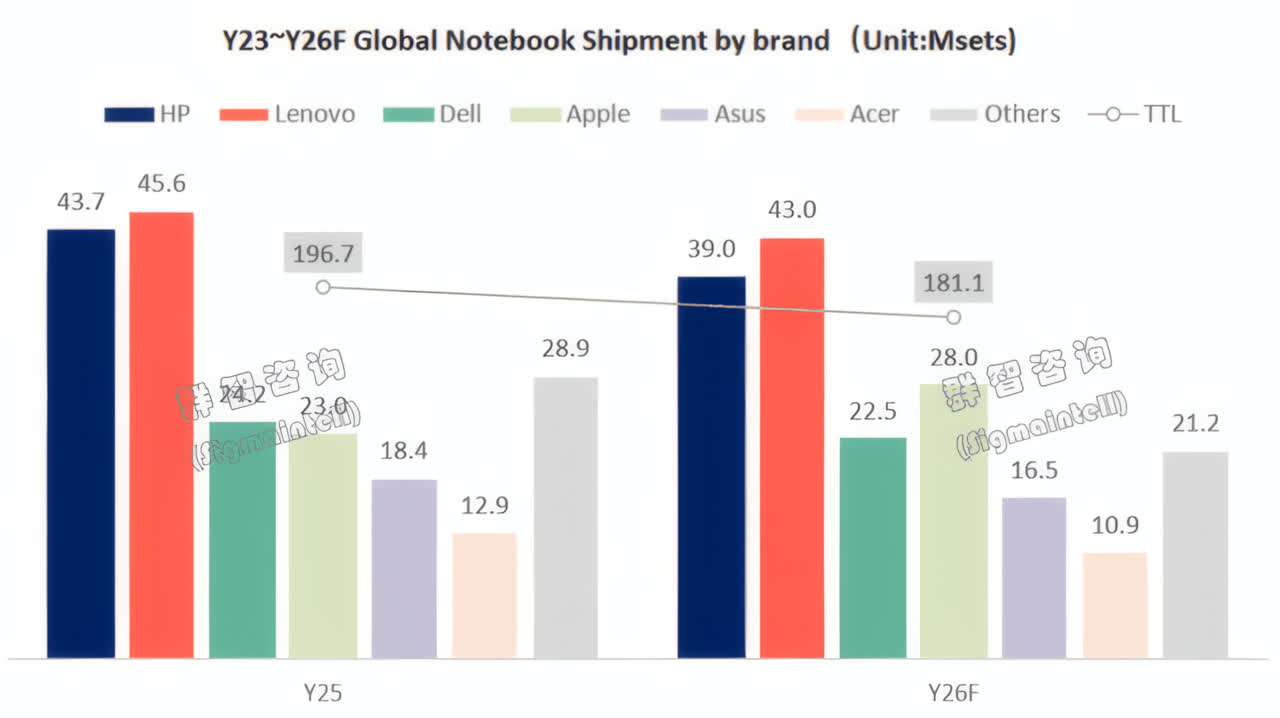
Market research firm Sigmaintell projects Apple will ship about 28 million MacBooks in 2026, up from roughly 23 million units in 2025. That would push the company past Dell into third place by unit volume, behind Lenovo and HP, with estimated unit volumes of 43 million and 39 million, respectively.
Total global notebook shipments are forecast to fall to 181.1 million units in 2026, an 8% year-over-year decline. Rising DRAM prices are a central factor, constraining supply and dampening demand across most OEMs. In that context, Apple is the only major manufacturer expected to grow shipments.
Apple's hardware architecture is a major driver of this momentum, alongside its pricing and supply decisions. Its unified memory architecture allows the CPU, GPU, and neural processing components to access a single shared pool of high-bandwidth memory. That design cuts unnecessary data copies, trims latency, and boosts efficiency.
It also simplifies memory sourcing, giving Apple more leverage with suppliers than rivals that depend on discrete memory configurations and third-party chips. Apple pairs this architecture with software optimizations. macOS uses memory compression to cut background RAM use, so systems can run well with less physical memory. On lower-cost models such as the MacBook Neo, the system can spill over to SSD as virtual memory, adding flexibility without significantly raising hardware costs.
Those efficiency gains matter more in a year of rising memory costs. While competitors raise prices to protect margins, Apple has largely held its prices steady. Reports suggest the company has locked in memory supply on better terms, softening the impact of those cost spikes on its lineup.
The result is a widening pricing gap in key segments. For example, lower-spec Surface models that once sat in the midrange now cost more, and top-end versions are priced above comparable MacBook builds. Apple's MacBook Air and MacBook Pro systems, by contrast, remain priced more competitively relative to their specifications.
Apple's expanding product range also plays a role. The new low-cost MacBook Neo, which could account for about 10 million units in 2026, pushes Apple deeper into the entry-level market while it continues to invest at the high end. The remaining volume is projected to come from the MacBook Air and MacBook Pro lines, which continue to serve mainstream and professional users.
Apple set to overtake Dell as MacBook shipments rise against market decline


