In brief: A few months after acquiring Arduino, Qualcomm is introducing its first product designed to combine its processor technology with the "maker" ethos of the Italian company. Unsurprisingly, the device is primarily focused on AI, generative AI, and large language models.
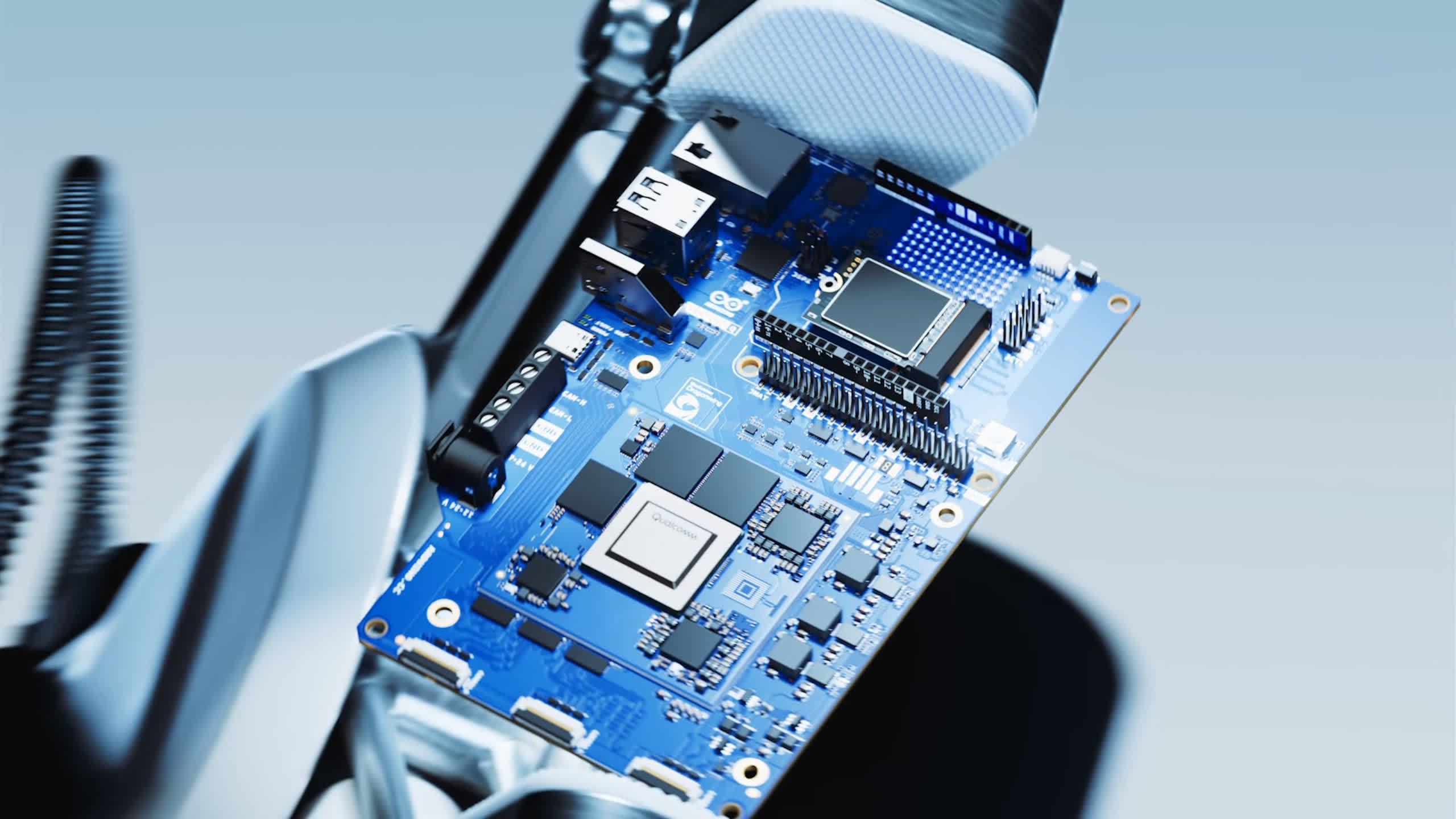
Named after the Italian word for "21," Ventuno Q is Qualcomm's first attempt to soothe the wary Arduino community. The UK chip designer acquired the Italian microcontroller maker in October, quickly drawing mistrust from users after changing the platform's terms of service. While Arduino is now a more corporate-friendly product line, the freedom to experiment and create has not entirely vanished.
Ventuno Q represents a significant improvement over the "dual-brain" architecture used in the Arduino Uno Q platform. The microcontroller is built on the Dragonwing IQ8 Series, Qualcomm's AI-focused SoC line, described as a high-performance computing processor designed for robotics, industrial automation, machine vision, and other offline AI workloads.
The SoC delivers up to 40 TOPS of NPU performance, an octa-core Kryo Gen 6 CPU, and an Adreno 623 GPU. Ventuno Q also includes a dedicated STM32H5 microcontroller for low-latency actuation and motor control. The device comes with 16GB of RAM, 64GB of eMMC storage, and extensive connectivity and expansion options, including Wi-Fi, Ethernet, Bluetooth, and USB.
According to Arduino Vice President Fabio Violante, Ventuno Q is designed to bring AI from the cloud to the "physical" world at the edge of computing. Machines and devices built with the new microcontroller can perceive their environment, make decisions, and act based on programmed tasks and AI models.
To support AI development, Arduino is providing the App Lab environment, which unifies the development experience. The software suite includes numerous pre-trained models for tasks such as speech recognition, gesture recognition, object tracking, and more. Ventuno Q is also hardware-compatible with other platforms, including Arduino Uno shields, Qwiic sensors, and Raspberry Pi HATs.
Thanks to its ability to process real-world inputs and run popular AI software, Ventuno Q can power fully offline AI systems, robotics and motion-control devices, and AI-based sensing systems. Qualcomm also highlighted its potential as an educational tool, ideal for teaching computing concepts or rapidly prototyping classroom projects.
While Ventuno Q promises to be a powerful successor to the Arduino Uno Q, advanced performance comes at a cost. The new single-board computer is expected to launch in Q2 2026 with a price around $300, compared to $59 for the current 4GB Arduino Uno Q model.
Arduino Ventuno Q marks Qualcomm's entry into offline AI and robotics


