Astronomers identify a galaxy made almost entirely of dark matter

Alfonso Maruccia

Posts: 2,600   +978
Staff
In context: While it is still considered a hypothetical theory, dark matter is being actively studied by scientists looking for novel cosmological clues. It does not interact with light or other types of electromagnetic radiation and can only be detected through its gravitational pull on nearby structures or the universe as a whole.
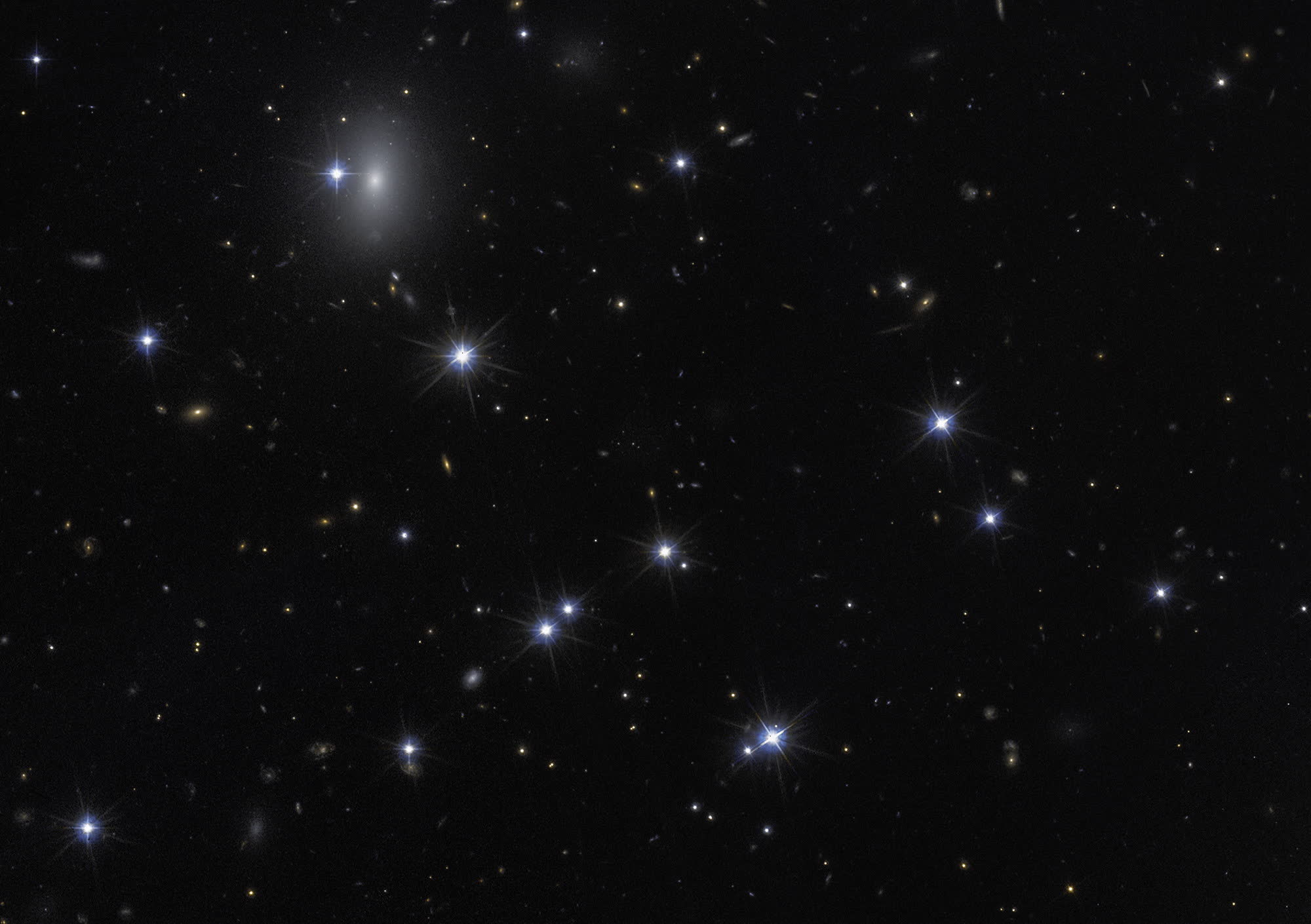
A team of astronomers led by David Li has recently confirmed the discovery of ten potential "dark galaxies," where starlight is so faint that it's extremely difficult to detect anything with traditional observatories. The new list also includes Candidate Dark Galaxy-2 (CDG-2), a celestial structure that might be composed of 99% dark matter and just 1% of normal matter.

CDG-2 was discovered by combining observations made through the Hubble Space Telescope, the Euclid space observatory, and the Hawaii-based Subaru Telescope. Li and his team at the University of Toronto were able to gain insight into the dark galaxy by looking for globular clusters, which are compact, spheroidal star formations that are closely bound together by gravity.

Thanks to Hubble's high-resolution cameras, the team was able to detect four different globular clusters in the Perseus galaxy cluster, 300 million light-years away from Earth. By combining further Euclid and Subaru observations, the researchers revealed a faint glow surrounding the clusters. This sparse light was coming from a nearby galaxy with extremely faint signs of starlight.
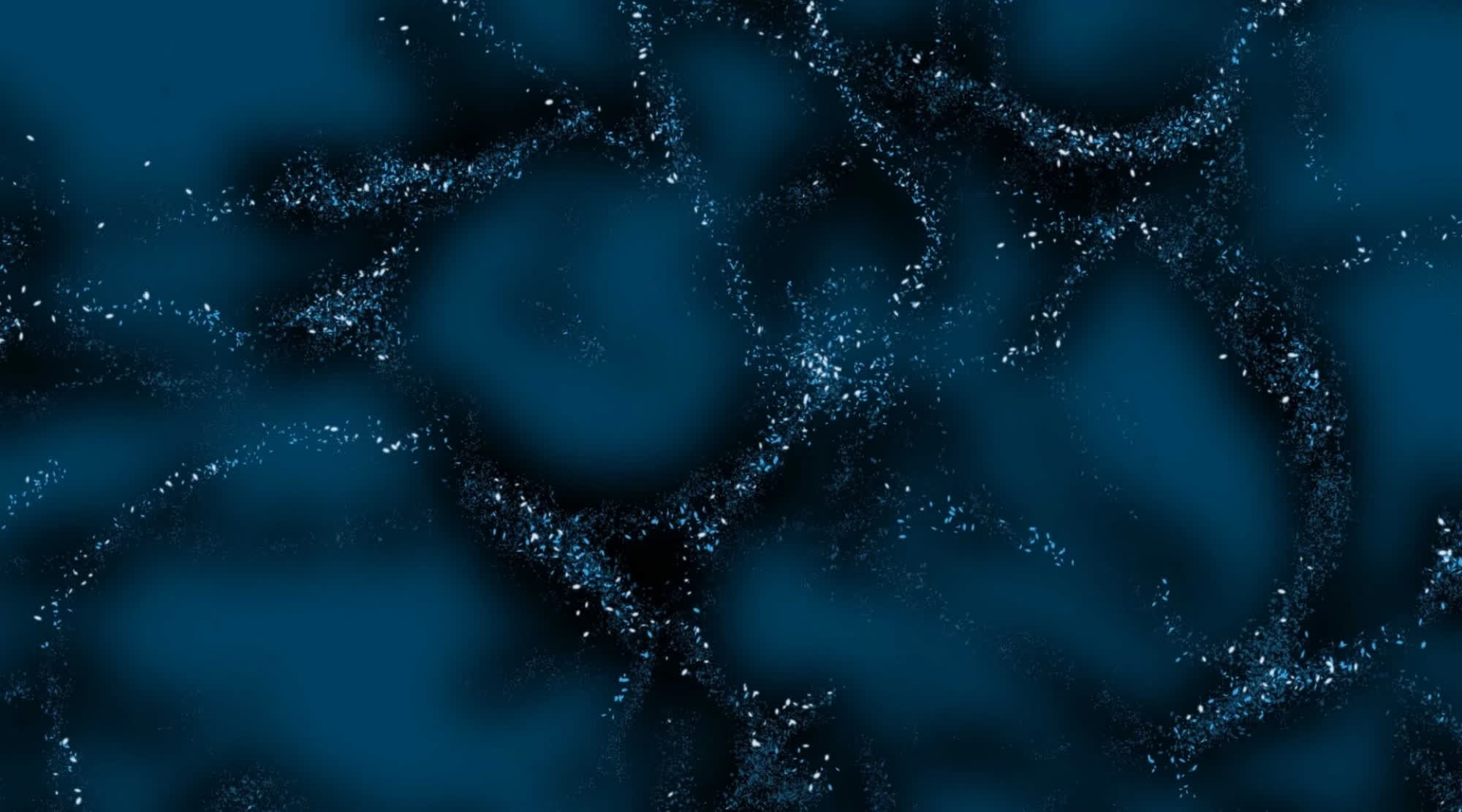
CDG-2 has a luminosity equivalent to one million Sun-like stars, with the four globular clusters making up 16% of its visible content. After using advanced statistical analysis, the astronomers speculate that 99% of all CDG-2's mass is just dark matter. Normal matter, including star-forming elements like hydrogen, was likely removed through gravitational interactions with nearby galaxies in the Perseus cluster.

While recent space telescopes like the JWST might provide unprecedented clues about the presence of dark matter in the local universe, studying and detecting the enigmatic substance continues to be an extremely complex research effort.

According to the study, there is "exceptionally strong" evidence of CDG-2's galactic nature. This is the first galaxy detected by just looking at the nearby globular clusters, and is likely one of the most dark matter-dominated galaxies ever detected. Globular clusters feature extremely high stellar densities that protect them from gravitational tidal disruption, and they are also considered a reliable indicator of "ghost" galaxies like CDG-2.

Permalink to story:

 
The belief in dark matter has become a religion, it's really tiring how they talk about something that can't be detected as it doesn't interact with anything.

And with the 'theory' that Sag A* is some kind of dark matter glob I've had enough of this religion.
 
The principle of causality is fundamental in physics. This means that everything, including fields, must have underlying causes or ingredients. If one starts by saying, "I measure them and I can mathematically model them, but I don't know what dark matter is, I don't know what dark energy is, I don't know what gravity is, I don't know what quantum entanglement is, I don't know what quantum fields are, I don't know what the Big Bang is, etc.," this is not a systematic way to think. The principle of causality demands that everything must emerge from more basic and fundamental things until you reach a fundamental limit, which is likely quantum fluctuations.

Personally, I am not a fan of the widespread of unknown great mysteries in physics. In this framework, dark matter must be something we already know; perhaps it is a form of metastable fragments of neutron matter (which normally decay in a few minutes) produced inside extreme conditions such as black holes or other super-dense systems (e.g., quark stars) and then expanded in some way. It is better to say, "I don't know how it got there" than to say, "I don't know what it is."

In short, dark matter is probably a "rare" (to us) form of matter (a metastable form of neutrons) rather than a different form of matter.
 
If this holds up, it really reframes what a galaxy even is. Turns out stars might be more like decorative lighting, and the real structure is just a huge pile of unseen gravity holding everything together.
 
The principle of causality is fundamental in physics. This means that everything, including fields, must have underlying causes or ingredients. If one starts by saying, "I measure them and I can mathematically model them, but I don't know what dark matter is, I don't know what dark energy is, I don't know what gravity is, I don't know what quantum entanglement is, I don't know what quantum fields are, I don't know what the Big Bang is, etc.," this is not a systematic way to think. The principle of causality demands that everything must emerge from more basic and fundamental things until you reach a fundamental limit, which is likely quantum fluctuations.

Personally, I am not a fan of the widespread of unknown great mysteries in physics. In this framework, dark matter must be something we already know; perhaps it is a form of metastable fragments of neutron matter (which normally decay in a few minutes) produced inside extreme conditions such as black holes or other super-dense systems (e.g., quark stars) and then expanded in some way. It is better to say, "I don't know how it got there" than to say, "I don't know what it is."

In short, dark matter is probably a "rare" (to us) form of matter (a metastable form of neutrons) rather than a different form of matter.

I think causality is more elusive than we realise. At the lowest level humans have modelled, the laws of physics tend not to have directionality, and it is another mystery how, macroscopically, an arrow of time comes about.

Our present understanding of "what things are" is far from the ontological rock bottom. So it is fair to take an approach of "I know its dynamics and can model it, but don't know what it is." With time, more mystery is lifted. Newton thought gravity an invisible force; Einstein showed it was the curvature of spacetime; no doubt, the next theory will model its building blocks, as CDT or LQG do.

Dark matter seems to fit at the intersection of an incomplete Standard Model and general relativity. I think that a future theory, explaining how the fundamental particles relate to the building blocks of spacetime, would shed light on phenomena such as dark matter.
 
Back