Astronomers watch a star being torn to pieces by a supermassive black hole

Alfonso Maruccia

Posts: 2,602   +978
Staff
The big picture: Tidal disruption events are some of the most powerful phenomena ever discovered in the observable universe. When a star wanders too close to a supermassive black hole, the singularity's gravitational pull and tidal forces shred it to pieces through spaghettification. It sounds funny enough but it is one of the worst ways to go, even for a lone star.
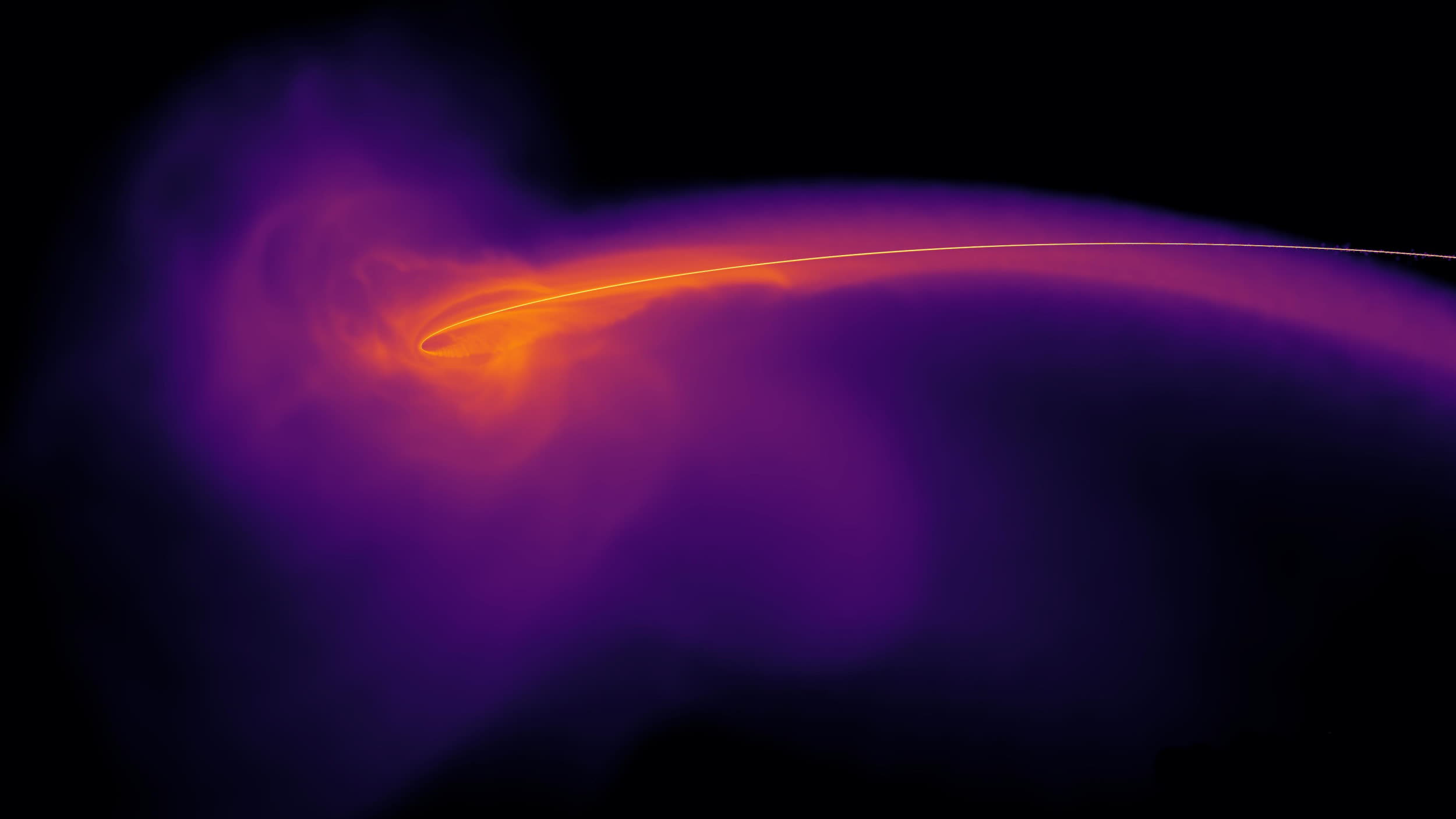
A team of researchers recently reported the discovery of AT2024wpp, an extremely energetic event involving a black hole and a massive star locked in a deadly cosmic dance. The stellar object was "spaghettified" by the black hole, a tidal disruption event that released an amount of energy equivalent to 400 billion times the energy of the Sun.

Daniel Perley, associate professor of astrophysics at Liverpool John Moores University, described the phenomenon as rare and awe-inspiring, surpassing even the most powerful supernovae known to date. While other TDEs have been observed previously, AT2024wpp appears to exist on a scale all its own.

Nicknamed the "Whippet," this TDE was first detected by the Zwicky Transient Facility at Palomar Observatory in California. Follow-up observations were conducted with the Liverpool Telescope in the Canary Islands and NASA's Swift space observatory. These additional studies confirmed that AT2024wpp belongs to a specific subclass of TDEs known as Luminous Fast Blue Optical Transients.

LFBOTs are transient events similar to supernovae and gamma-ray bursts, distinguished by their extremely blue radiation and strong X-ray emissions. According to Perley, AT2024wpp was many times more energetic than comparable star-collapsing events. Only a handful of LFBOTs have been observed so far, and researchers note significant variations in their properties over time.

"Not only do these events help us identify black holes, they provide a new way to identify where black holes occur and how they form and grow, and the physics of how this happens," Perley said.

A unique feature of AT2024wpp is a massive shock wave produced as the star was shredded to atomic pieces. The wave propagated outward at one-fifth the speed of light, reverberating through the black hole's accretion disk before abruptly halting about six months later.

Researchers are now investigating one final mystery surrounding the event. Initially, AT2024wpp emitted no recognizable chemical signatures, but a few months after the explosion, weak traces of hydrogen and helium were detected. These gases may have originated from material stripped from the star's core during its destruction or could even hint at a third, as-yet-undiscovered object within the star – black hole system, the team speculates.

Permalink to story:

 
It is ironic that, with supermassive black holes, an intrepid explorer will be able to pass through the event horizon without much fuss from tidal forces, the latter being stronger for less-massive black holes. Of course, inside would be a different story as tidal forces mount, as well as the forbidding singularity at the centre where all is crushed into mincemeat.
 
It is ironic that, with supermassive black holes, an intrepid explorer will be able to pass through the event horizon without much fuss from tidal forces, the latter being stronger for less-massive black holes. Of course, inside would be a different story as tidal forces mount, as well as the forbidding singularity at the centre where all is crushed into mincemeat.
I'm not into massive black holes, but is this some kind of double entendre for Rocco-Siffredi-style art?
 
More pretty CGI without even a shred of evidence, physics, or observation at all. They didn't watch a star being torn to pieces - they extrapolated shoddy data and made up a fictional story about it to get clicks.

Black holes have been falsified for decades and were never real to begin with. In 1916 Hilbert divided by zero and returned an answer of "2", then misassigned it to Einstein's r-variable and claimed it was a radius. You cannot divide by zero, and that r-variable in Einy's field equations wasn't a simple radius at all.

It's merely a catch-phrase used to generate marketing revenue, much like "AI this" and "AI that". Same horseshit, and you will note there's nothing but CGI offered as evidence.
 
More pretty CGI without even a shred of evidence, physics, or observation at all. They didn't watch a star being torn to pieces - they extrapolated shoddy data and made up a fictional story about it to get clicks.

Black holes have been falsified for decades and were never real to begin with. In 1916 Hilbert divided by zero and returned an answer of "2", then misassigned it to Einstein's r-variable and claimed it was a radius. You cannot divide by zero, and that r-variable in Einy's field equations wasn't a simple radius at all.

It's merely a catch-phrase used to generate marketing revenue, much like "AI this" and "AI that". Same horseshit, and you will note there's nothing but CGI offered as evidence.

Where and when were black holes falsified? Originally, they were thought to be artefacts of the theory, but it was later shown that any mass exceeding the Tolman-Oppenheimer-Volkoff limit, greater than 2.something solar masses, would collapse into a black hole. Then, Penrose proved in a theorem that, once gravitational collapse began and if GR is correct, a singularity was inevitable. The big bang is predicted to have begun with a singularity too, albeit different from that of a black hole, in that the Weyl tensor was zero, but the Ricci tensor, or the R parts of Einstein's field equations, was infinite.

As for observation, there has been ample, indirect evidence consistent with GR's description. Composite photos, built out of data from radio telescopes, have even been put together, and show a striking similarity to computer renderings using GR's equations. Indeed, they are fundamental to the universe and will dominate its distant future when the stars have all gone out. A few speculate we are inside some sort of black hole.

No doubt, the successor to GR will replace the singularities with actual descriptions of what happens at that point, rather than infinities and zero lengths, but the black holes themselves will not go away.
 
Last edited:
"The cosmic release was equivalent to 400 billion times the energy of the Sun", to bad we don't have a giant capacitor.
 
Back