AI Shovelware: Long ago, users had to press physical buttons and navigate on-screen menus to set their brand-new gaming monitors to their preferred settings. Now, Asus is proposing an AI-based solution that could do much more than simply turn the brightness level up or down.

Asus has announced a new update for its DisplayWidget Center software, adding agentic AI and other AI-based features. The tool, which is designed to manage and customize Asus monitors from within the traditional desktop environment, can now enable natural language interactions between users, IT administrators, and "compatible" AI agents for deeper personalization options.
DisplayWidget Center's new version focuses on AI-driven automation. The software is now "AI agent-ready," featuring a command-line interface based on Asus Display Control and AI Agent Skill. In fact, DisplayWidget Center's AI capabilities are essentially a GUI-based extension that allows users to access Display Control and AI Agent Skill directly from the main monitor management application.
Asus said AI agents can respond to user requests to adjust brightness, color modes, color temperature, and even Anti-Flicker settings on OLED displays. On compatible monitors, the AI can recommend optimal settings based on past usage habits or access a user's calendar to adjust color temperature levels based on the time of day.
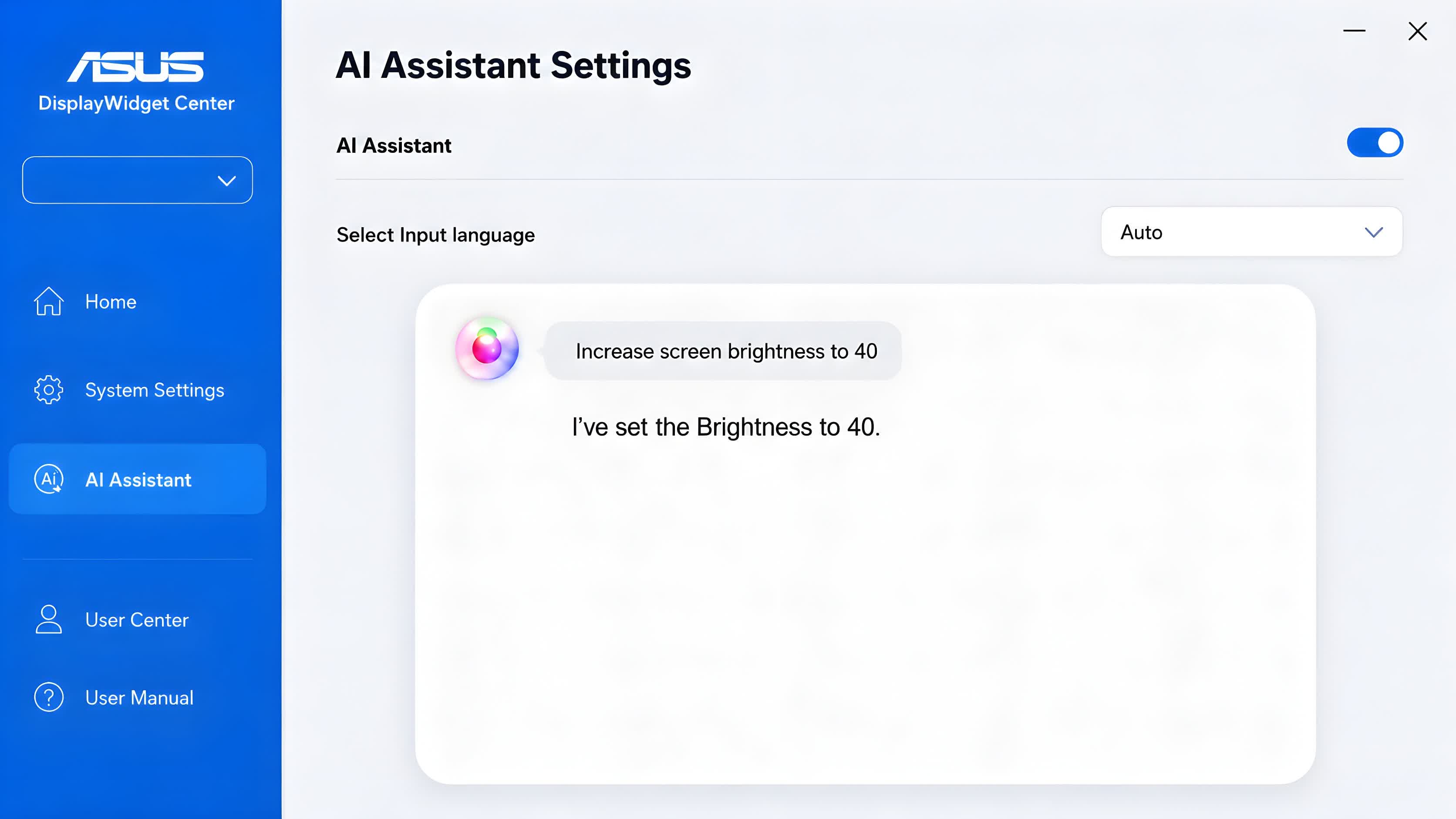
Asus also suggests that the new DisplayWidget Center AI can perform useful tasks for IT administrators, such as deploying a common monitor configuration across an entire enterprise environment. AI agents operate entirely offline, the company said, although some resulting actions may require external services or connectivity. The updated software also includes a couple of AI-based features that do not require any agentic functionality.
With AI Visual, compatible ROG and TUF Gaming monitors can select the most suitable visual mode by analyzing on-screen content in real time. Meanwhile, the AI Assistant feature provides a new text and voice interface for adjusting settings, retrieving support documents, and accessing other help-related functionality.
Other non-AI features in the latest DisplayWidget Center release include the App Tweaker tool, which can be used to create customized display "experiences" for individual applications and games. Finally, additional OLED Care features are designed to further reduce image burn-in risks on OLED models.
Asus said the AI features included in its monitor management software can provide meaningful improvements for gamers, content creators, business users, and traditional desktop users. However, some users may feel differently or simply reject a type of software tool that is becoming increasingly invasive or raises concerns about personal privacy.
Asus' new monitor software lets you control brightness with your voice, or just let AI do it


