720Hz OLED is finally here. Asus' ROG Swift PG27AQWP pushes 540Hz at 1440p or a wild 720Hz at 720p, making it the fastest desktop OLED we've tested.
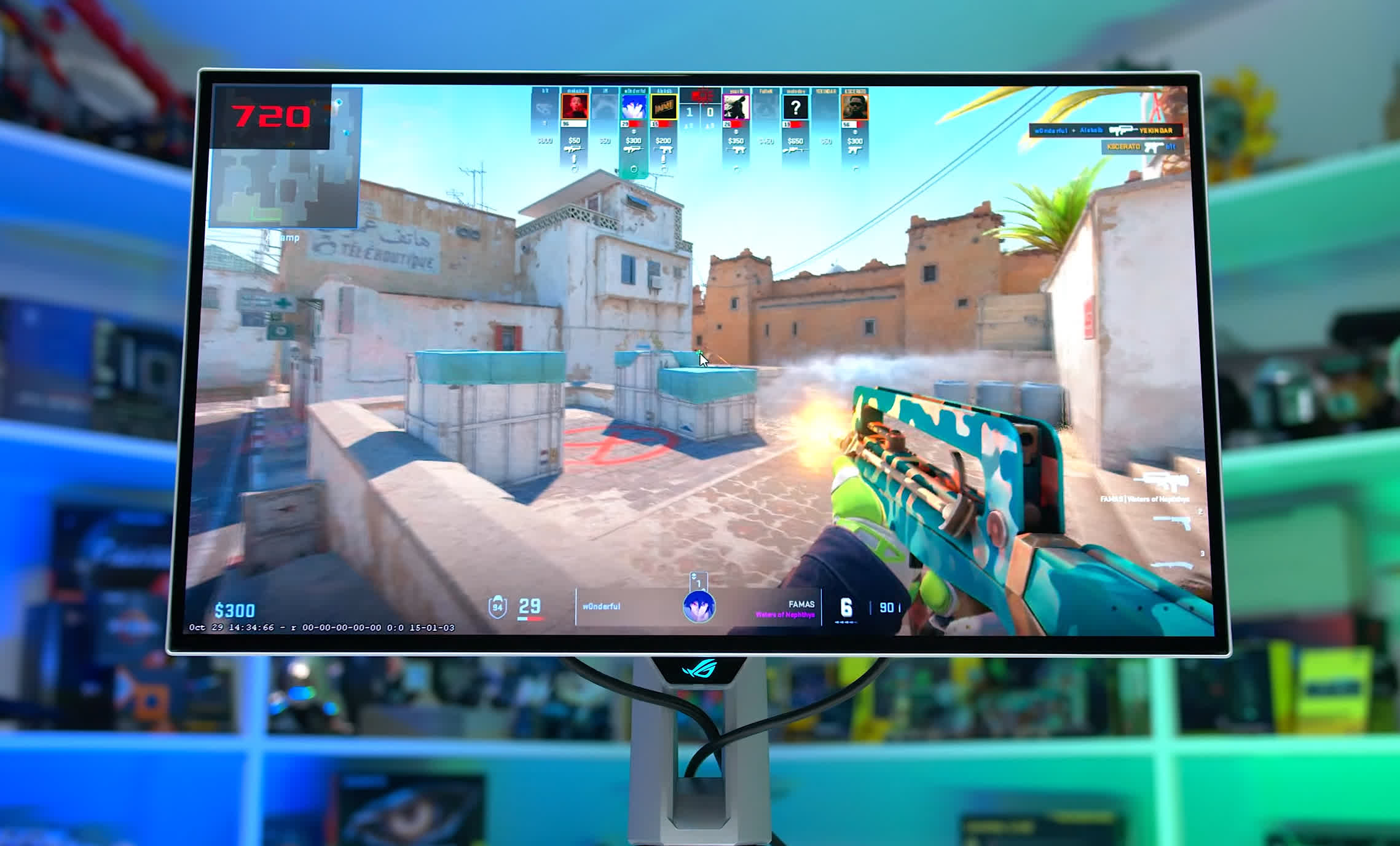
720Hz OLED is finally here. Asus' ROG Swift PG27AQWP pushes 540Hz at 1440p or a wild 720Hz at 720p, making it the fastest desktop OLED we've tested.

I can tell the difference between 120Hz and 165/180Hz in games (my current monitor is 180Hz). Mostly because I've been playing FPS games all my life. It's not the smoothness of the image in general, it's the smoothness of the mouse movement and horizontal fast movement on enemies on screen (like watching enemies from mid to long on CS2 Dust2).700hz is just silly. Personally I can’t see the difference between 60/120hz but apparently some people can. Beyond 120 it’s absolutely pointless and no content will support such refresh rates either.

I’d argue that going beyond 144Hz puts you in the realm of extreme diminishing returns. Monitor vendors have somehow convinced people that higher refresh rates mean more frags, but that’s not entirely true. For example, a player with a 120Hz panel and another with a 700Hz panel would likely perform identically, assuming all other factors are equal.I can tell the difference between 120Hz and 165/180Hz in games (my current monitor is 180Hz). Mostly because I've been playing FPS games all my life. It's not the smoothness of the image in general, it's the smoothness of the mouse movement and horizontal fast movement on enemies on screen (like watching enemies from mid to long on CS2 Dust2).
There are many situation that benefit from higher Hz. It even helps with variable refresh rate (Gsync/Freesync), extending the range.
"Beyond 120 it’s absolutely pointless and no content will support such refresh rates either." - the games I play say otherwise.
When you make statements like that, with nothing to back them up... what am I supposed to say in return?I’d argue that going beyond 144Hz puts you in the realm of extreme diminishing returns. Monitor vendors have somehow convinced people that higher refresh rates mean more frags, but that’s not entirely true. For example, a player with a 120Hz panel and another with a 700Hz panel would likely perform identically, assuming all other factors are equal.
I'm not saying high refresh rates aren't important—they absolutely are. It's just that the optimal range is around 120 to 144Hz, and beyond that, you're essentially hitting a soft cap where higher values become increasingly less impactful or useful.
It would be very interesting to see a double blind study on this.

When you make statements like that, with nothing to back them up... what am I supposed to say in return?
Yes.I suppose the opposite is true as well... has anyone proven that higher than 120Hz provides more frags, all other things being equal?
That isn't what I asked. Has there been any kind of study showing actual, consistent increases in frags among the same players under the same (otherwise) conditions?Yes.
It's just another tool that helps you like a good mouse. It reduces input lag, it reduces pixel response times, it reduces the blurriness that comes with a slow response time and it also helps with VRR.
It's just not a magic bullet for fixing bad skills. In those cases... just git gud.
"studies"... you have youtube full.That isn't what I asked. Has there been any kind of study showing actual, consistent increases in frags among the same players under the same (otherwise) conditions?
Found another blind test with pro gamers conclusion was 240 hz for the pros was the threshold of perceived smoothness and gaming k/d ratio."studies"... you have youtube full.
here you go, absolute noobs, the type of people you claim that they can't tell the difference:
I know of it, but I didn't want to use 60Hz as the baseline for the comparison because that's way too obvious. I also wanted to avoid tech tubers like Linus, to get a more "regular Joe" opinionFound another blind test with pro gamers conclusion was 240 hz for the pros was the threshold of perceived smoothness and gaming k/d ratio.

The test was done with 60 hz , 144hz ,240 hz 360 hz and 540 hz in blind 3x rotation for each player. If I had to extrapolate the results anything above your personal subjective threshold will seem the same shortfalls of this type of study like you mentioned an obviously low baseline which is probably needed as a control, the low time to play around and make up your mind, the game diversity which there was none, larger pool of participants. A great marksman can compensate for blurry motion in my experience if the motion is over a certain threshold. My personal minimum threshold is 120hz oled which has the near instant response times.I know of it, but I didn't want to use 60Hz as the baseline for the comparison because that's way too obvious. I also wanted to avoid tech tubers like Linus, to get a more "regular Joe" opinion

This one doesn't address what I was talking about. Being able to detect the difference is a separate topic from being better at a game (more frags) due to a particular framerate increase. Sure, I might be able to see the difference and consistently identify the higher framerate... but does that always get me better scores in games? If so, where is the threshold where it no longer matters? I would not be at all surprised if the threshold where you stop detecting the difference is much higher than the theshold where it stops making you better."studies"... you have youtube full.
here you go, absolute noobs, the type of people you claim that they can't tell the difference:
being able to tell the difference is being able to take advantage of its capabilities, full stop. what you want is a fantasy study that nobody will be able do.This one doesn't address what I was talking about. Being able to detect the difference is a separate topic from being better at a game (more frags) due to a particular framerate increase. Sure, I might be able to see the difference and consistently identify the higher framerate... but does that always get me better scores in games? If so, where is the threshold where it no longer matters? I would not be at all surprised if the threshold where you stop detecting the difference is much higher than the theshold where it stops making you better.
No. Not "full stop". I seriously doubt that the detection threshold is exactly the same as the "frags" threshold.being able to tell the difference is being able to take advantage of its capabilities, full stop. what you want is a fantasy study that nobody will be able do.
here's a study I made at home: I play better on good monitors. now give me a study that disproves that and which was peer reviewed. I want at least 1000 pro players playing for 1000 hours that objectively disproves my own personal experience.
"Sure, I play better on good monitors as well - to a point." - thanks for proving me right with your own experience.No. Not "full stop". I seriously doubt that the detection threshold is exactly the same as the "frags" threshold.
Sure, I play better on good monitors as well - to a point. I doubt you or I would play any better on a 480hz monitor vs a 240hz one. The fastest human eye-hand reaction time is 0.1s. The frame time for a 240hz display is .004s. In other words... by the time you react to what you see on screen, 24 frames would have gone by at 240hz.
And this doesn't consider the fact that most fps servers have a tick rate in the 60hz range.
You sure you even have 120Hz enabled in your settings?700hz is just silly. Personally I can’t see the difference between 60/120hz but apparently some people can. Beyond 120 it’s absolutely pointless and no content will support such refresh rates either.
"I doubt you or I would play any better on a 480hz monitor vs a 240hz one." - you don't know that.
Movies / tv obviously do not support higher refresh rates and modern high end games cannot achieve such frame rates. Even a 5090 isn’t running cyberpunk at 700fps. It’s total nonsense.You sure you even have 120Hz enabled in your settings?
Several years ago many people were surprised when several YouTube'rs made videos asking people to check their settings. Many people who claimed they did not see any difference beyond 60Hz were surprised to find that they had ran their high refreshrate screens at 60Hz and that is why they never even new what higher refresh rate looked like.
Also you're completely wrong that "no content will support such refresh rates either."
This isn't about resolution. High refreshrate does not necessitate remastering movies, TV shows and games to somehow support high refreshrate.
High refreshrate benefits even games that do not reach that refreshrate number. Say 720hz.
Even running a game at 300fps at 720Hz is still smoother than running a game at 300fps at 300Hz. Of course the user has to disable G-Sync/Freesync to enjoy that benefit at the cost of tearing, but it's possible.
Also I see a lot of arguing about the supposed lack of benefit for K/D ratios and perceived smoothness of higher refreshrate, but what no one is mentioning is that modern panels are all sample-and-hold. Even OLED. They ALL benefit from higher refreshrate to get closer to CRT smoothness and overcome the downside of sample-and-hold.
Also the best way to perceive higher refreshrate is not just to move to higher number. It is to use that higher number for a number of weeks and then temporarily move back to the lower number. The difference becomes immediately apparent.
When I said "you don't know that" I really meant that it is you who might not know and that I know. Personal experience is more than enough for me and even you admitted to playing better on a good monitor.Exactly. Neither of us does. That's why I said "I doubt" as opposed to your "full stop".
You left out the part where I said "to a point". That point being much lower refresh rates than are being referred to here.When I said "you don't know that" I really meant that it is you who might not know and that I know. Personal experience is more than enough for me and even you admitted to playing better on a good monitor.
I specifically avoid lower Hz and told the other person to not give 60Hz comparisons. we are talking well within the specs we started with. your entire argument fell apart when you started to diminish the scope of your original argument and even admitting to playing better.You left out the part where I said "to a point". That point being much lower refresh rates than are being referred to here.
If you "know" you are getting more frags on a 480hz display than on a 240hz one, more power to you.

LinusTechTips also did testing and came to the same conclusion. Beyond 200hz the player can't tell the difference. 720hz is snake-oil. It might work exactly as advertised but the benefit to the user is not there.Found another blind test with pro gamers conclusion was 240 hz for the pros was the threshold of perceived smoothness and gaming k/d ratio.